




The Horvath File · Part One
A documentary record of Lindsey Horvath, the West Hollywood billboard program, and the advertising agency that was her only reported outside income. Forty-eight exhibits, fifteen sections, every source public.
What this is. A working file, not an argument. It collects the primary records on one question: from 2015 to 2022 the only outside income Lindsey Horvath reported on her Statements of Economic Interests was an out-of-home advertising agency, and across those years she voted on West Hollywood’s Sunset Strip billboard program without recusing once.
What is in it. Statements of Economic Interests she signed under penalty of perjury; West Hollywood Council minutes and the City’s own video record; campaign finance filings from the City’s NetFile portal and the Federal Election Commission; corporate filings from California and Georgia; the federal court docket in the billboard litigation; and her own public posts. Documents are reproduced whole, with the quoted language marked.
How to read it. Each section stands alone. Where the record is incomplete we say so in the section itself rather than in a footnote. Where a fact cuts against the file’s own premise, it has its own section: see Eleven.
Corrections. If a document here is misread, mislabeled or missing context, write to us and it will be corrected.
One · The disclosed interest: Statements of Economic Interests, FY2016 to FY2022
Every elected official in California files an annual Statement of Economic Interests, the Form 700. Horvath filed hers every year she served on the West Hollywood City Council.
On Schedule A-2, the schedule for business entities and their income, she reported the same thing every single year. A business called LPH, described as “Creative Advertising and Marketing Strategy,” with herself as Owner. And below it, in the box for each reportable source of income of $10,000 or more to that business, one name:
Leroy & Rose
Not a list. One name, one line, on seven consecutive filings: six annual statements and the 2022 candidate statement.
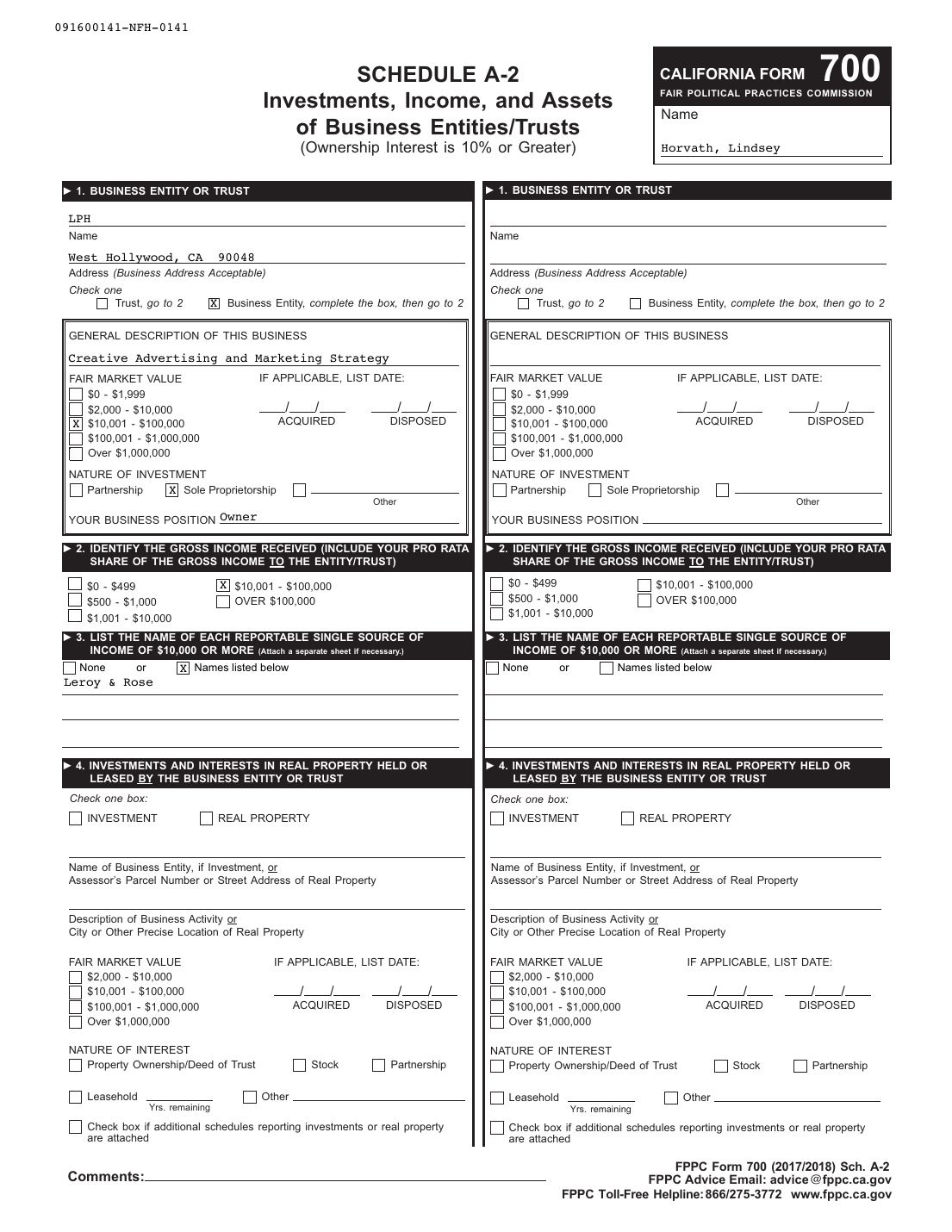 123
123
- 1The business she reported owning.
- 2Its stated line of business.
- 3Its single reportable source of income.
The form does not change. The wording does not change. The income tier does not change. Here is FY2018, FY2019, FY2020, FY2021, and the statement she filed as a candidate for Los Angeles County Supervisor covering FY2022.
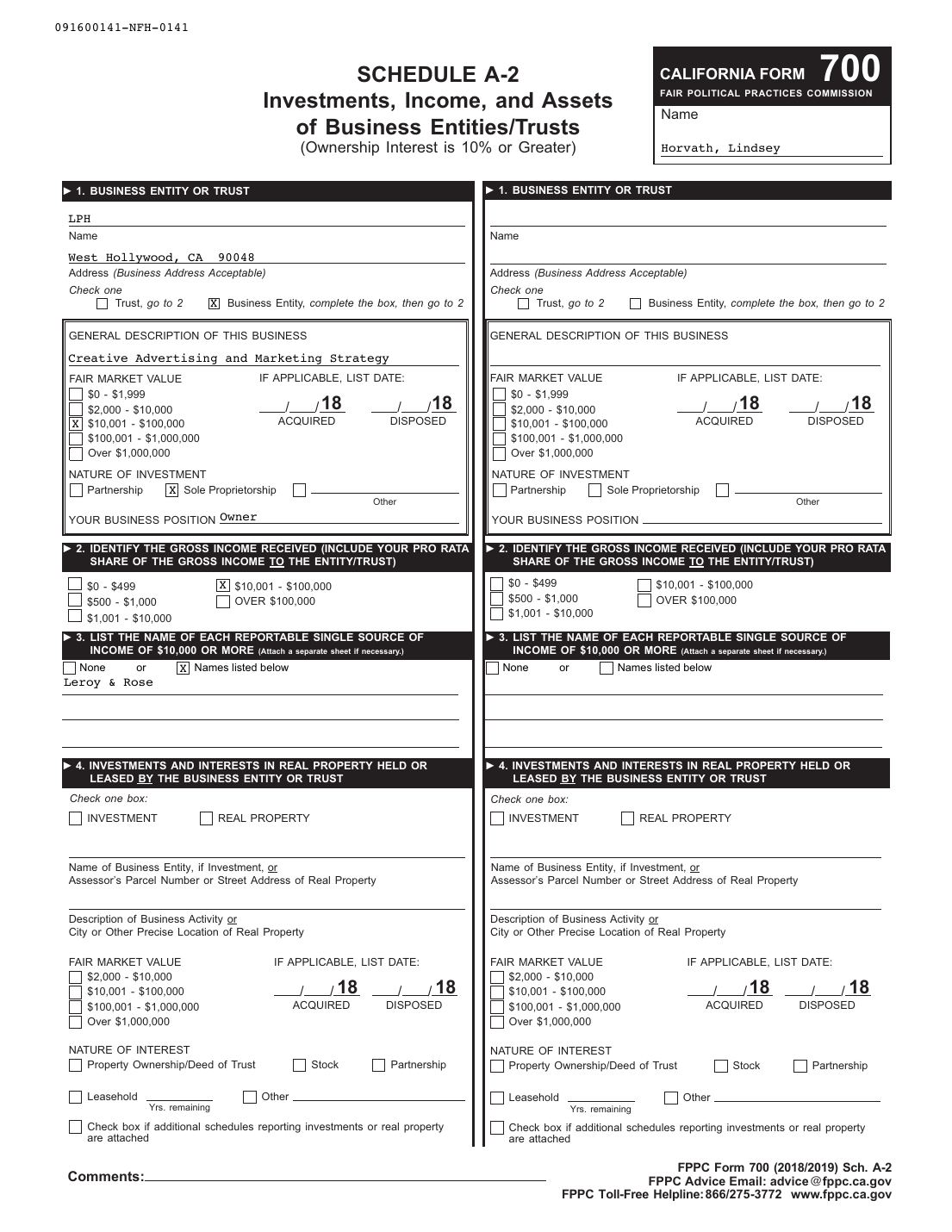 123
123
- 1The business she reported owning.
- 2Its stated line of business.
- 3Its single reportable source of income.
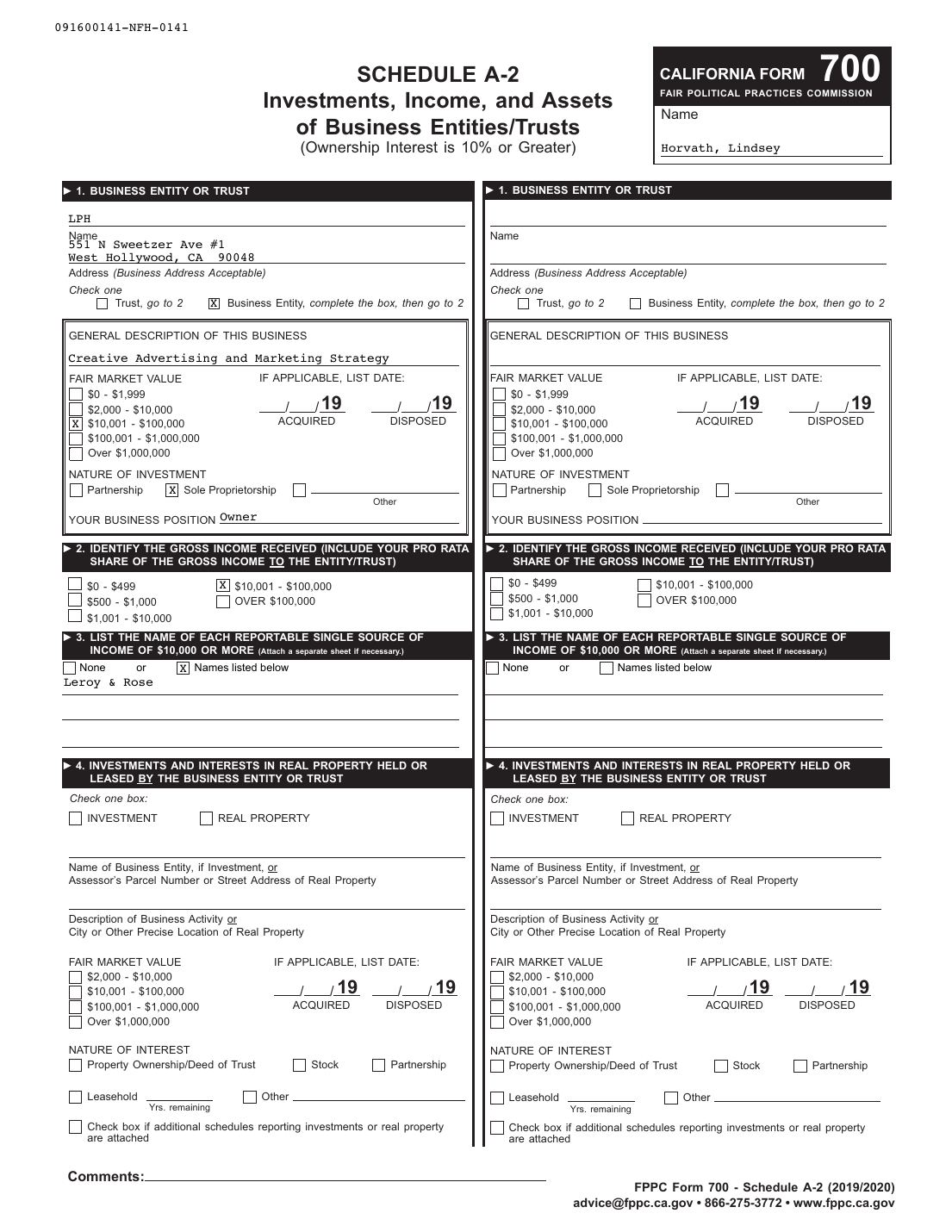 123
123
- 1The business she reported owning.
- 2Its stated line of business.
- 3Its single reportable source of income.
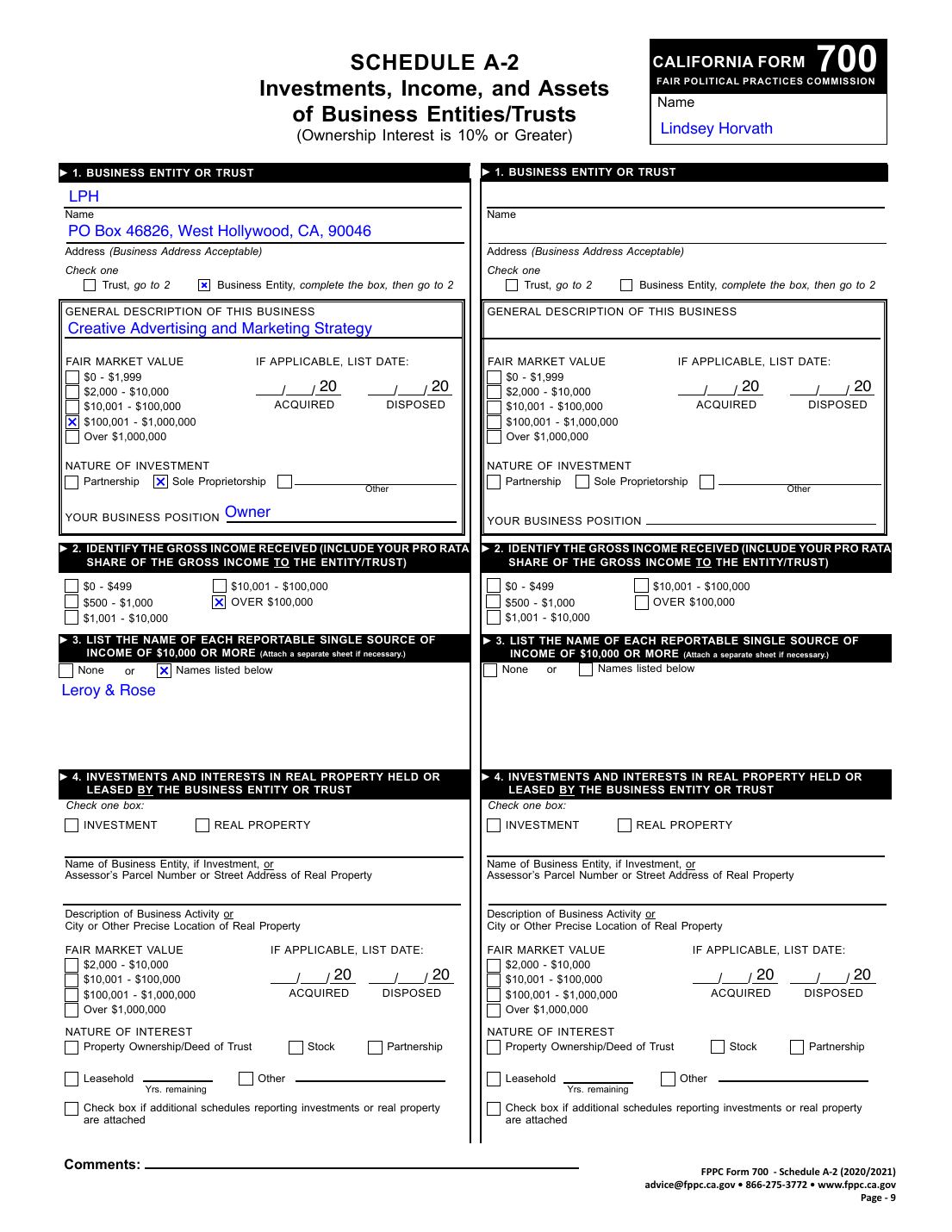 123
123
- 1The business she reported owning.
- 2Its stated line of business.
- 3Its single reportable source of income.
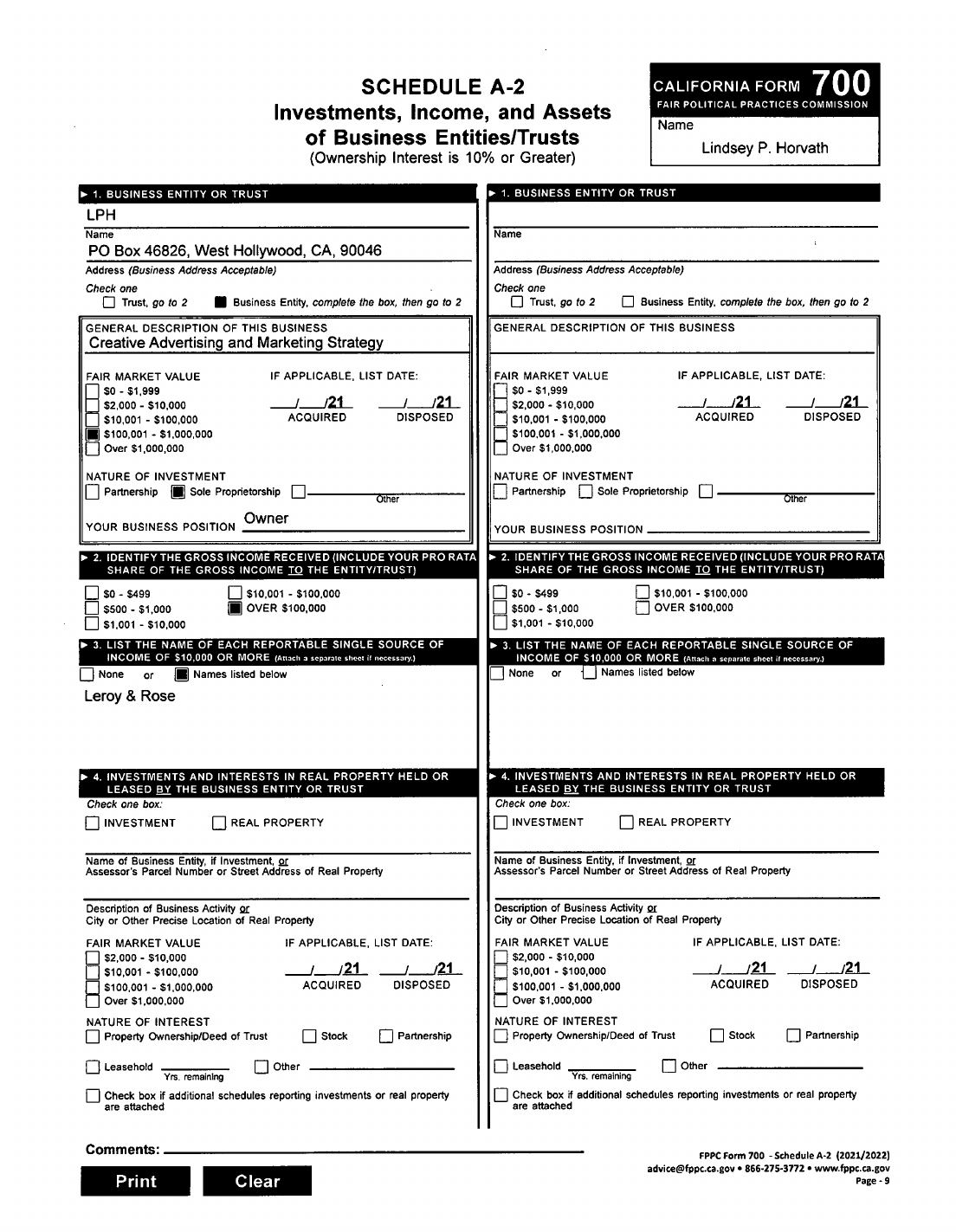 123
123
- 1The business she reported owning.
- 2Its stated line of business.
- 3Its single reportable source of income.
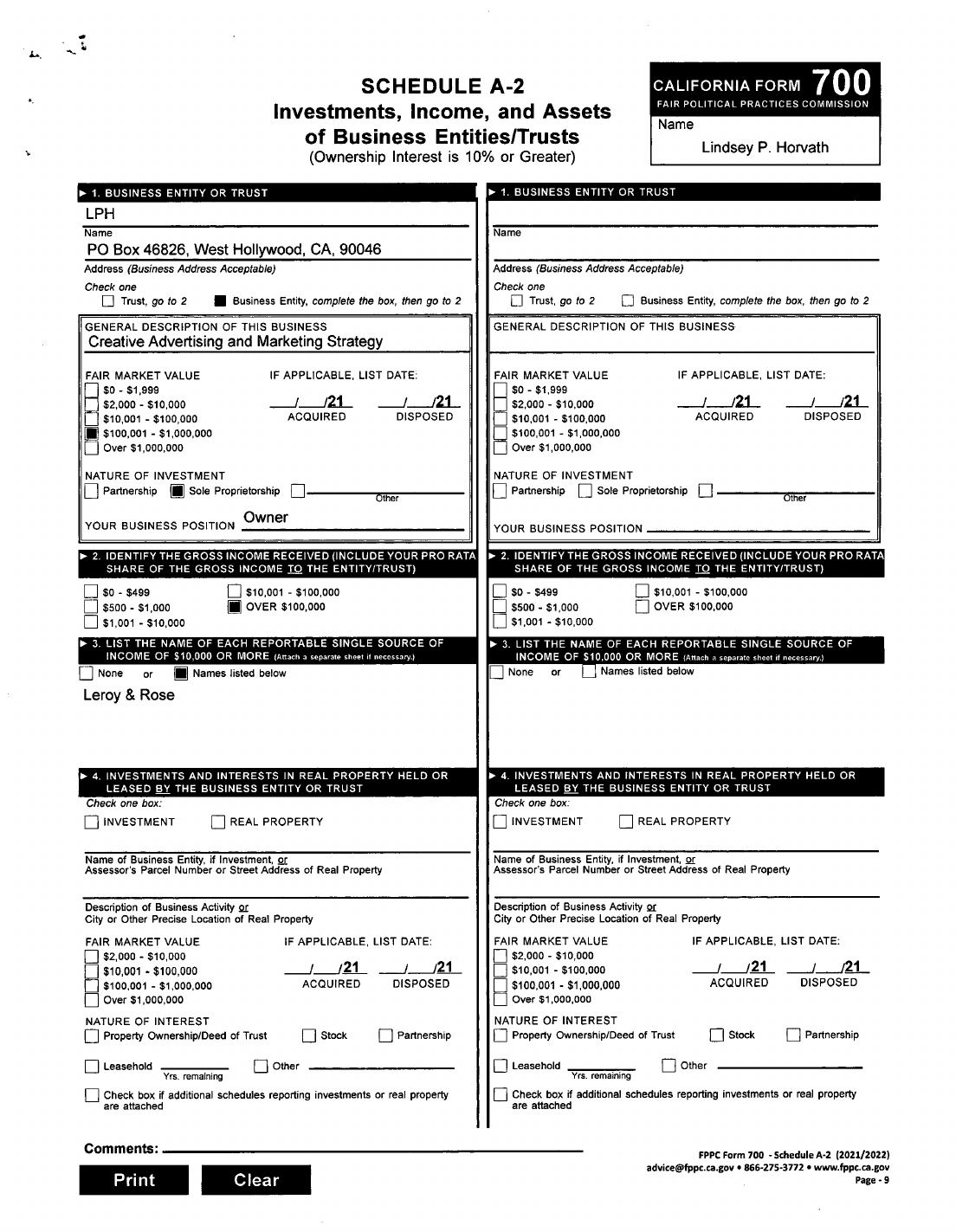 123
123
- 1The business she reported owning.
- 2Its stated line of business.
- 3Its single reportable source of income.
| Statement | Filed | Business reported | Sole reportable income source | Income tier |
|---|---|---|---|---|
| FY2016 Annual | 2017-04-13 | LPH | Leroy & Rose | $10,001 to $100,000 |
| FY2017 Annual | 2018-04-02 | LPH | Leroy & Rose | $10,001 to $100,000 |
| FY2018 Annual | 2019-04-01 | LPH | Leroy & Rose | $10,001 to $100,000 |
| FY2019 Annual | 2020-06-01 | LPH | Leroy & Rose | $10,001 to $100,000 |
| FY2020 Annual | 2021-04-01 | LPH | Leroy & Rose | $10,001 to $100,000 |
| FY2021 Annual | 2022-03-11 | LPH | Leroy & Rose | $10,001 to $100,000 |
| FY2022 Candidate | 2022 | LPH | Leroy & Rose | $10,001 to $100,000 |
Seven filings. One source of outside income, continuously, from FY2016 through FY2022.
What Leroy & Rose does
Leroy & Rose is an entertainment advertising agency in Santa Monica. Its business is selling movies and television shows, and a large part of that business is out-of-home advertising, which is the industry’s term for billboards, bus shelters, subway wraps, and building wraps. Its own portfolio, preserved in the Internet Archive, is full of standard 14-by-48 foot bulletin billboards for national clients including CBS, HBO, TBS, and FX.

This matters for a specific reason. In the Los Angeles entertainment advertising market, the Sunset Strip is the single most valuable out-of-home inventory that exists. It is the wall studios buy to announce a film. And the Sunset Strip is in West Hollywood, which means every billboard on it is there because the West Hollywood City Council allowed it.
West Hollywood does not permit billboards by right. Off-site advertising signs on Sunset require discretionary approval: a development agreement, a zoning action, a sign permit, a design review. Each one comes to the City Council, and the Council can say no. Between 2015 and 2022 the Council said yes many times, and Horvath was in the room for all but two of those items.
And when it stopped
Horvath left the West Hollywood City Council in December 2022 and was sworn in as Los Angeles County Supervisor. Four weeks later, on January 3, 2023, she filed her assuming-office statement for the County. It still reported LPH. It still reported Leroy & Rose.
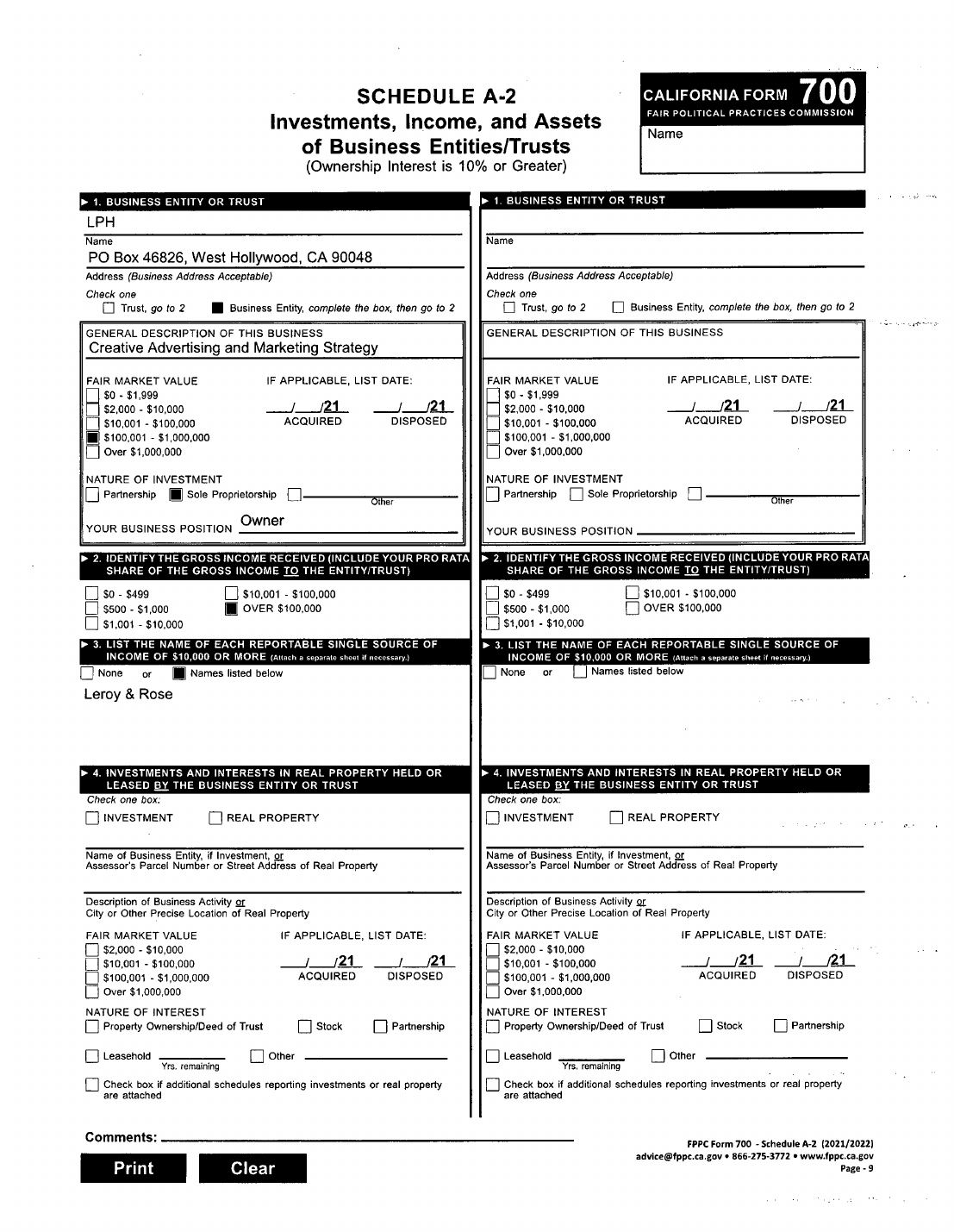 12
12
- 1Still there as she takes County office.
- 2Still the single reportable source.
Then she filed her first annual statement as a Supervisor, covering calendar year 2023.
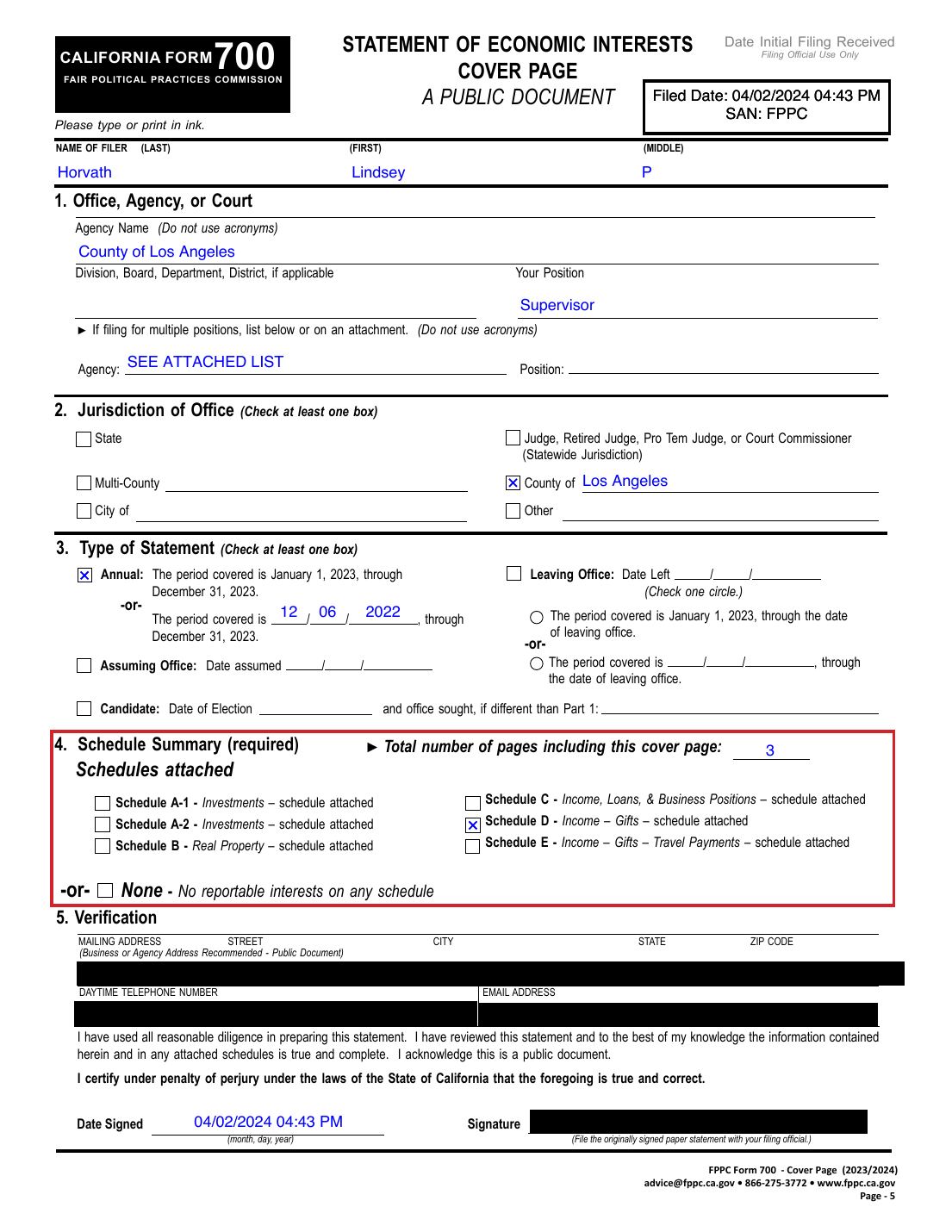 123
123
- 1Business entities. Not checked.
- 2Income and business positions. Not checked.
- 3Three pages, and the only box checked is Gifts.
LPH is gone. Leroy & Rose is gone. There is no Schedule A-2 business entity on the form at all. The filing runs to three pages, and the only schedule carrying anything is Gifts: a labor federation breakfast, two concert tickets, UCLA, the Tournament of Roses.
The same is true of FY2024 and of FY2025.
| Statement | Her office | Reports Leroy & Rose |
|---|---|---|
| FY2016 to FY2021 Annual | West Hollywood Councilmember | Yes, every year |
| FY2022 Candidate | Candidate, LA County Supervisor | Yes |
| FY2022 Assuming Office | LA County Supervisor | Yes |
| FY2023 Annual | LA County Supervisor | No |
| FY2024 Annual | LA County Supervisor | No |
| FY2025 Annual | LA County Supervisor | No |
A seven-year relationship with a single client, running through every year she sat on the council that regulates Sunset Strip billboards, and ending in the first year she did not.
What this does and does not show
It is a fact about her filings, not about her contracts. A Form 700 reports what the filer is required to report. The arrangement may have ended for reasons that have nothing to do with the Council, and we have no document showing why it ended or exactly when.
The arrangement may also simply have become non-reportable. A County Supervisor’s disclosure categories differ from a city councilmember’s, though a source of income of $10,000 or more from a business the filer owns is reportable in both.
What is not in doubt is the correlation. The income is on every statement she filed while sitting on the West Hollywood City Council, including the assuming-office statement she filed a month after leaving it, and on none of the statements she has filed since.
Two · Employment record: Canyon Design Group, Cold Open, Leroy & Rose
Horvath’s own profile records an unbroken career, from 2004, in one corner of one industry.
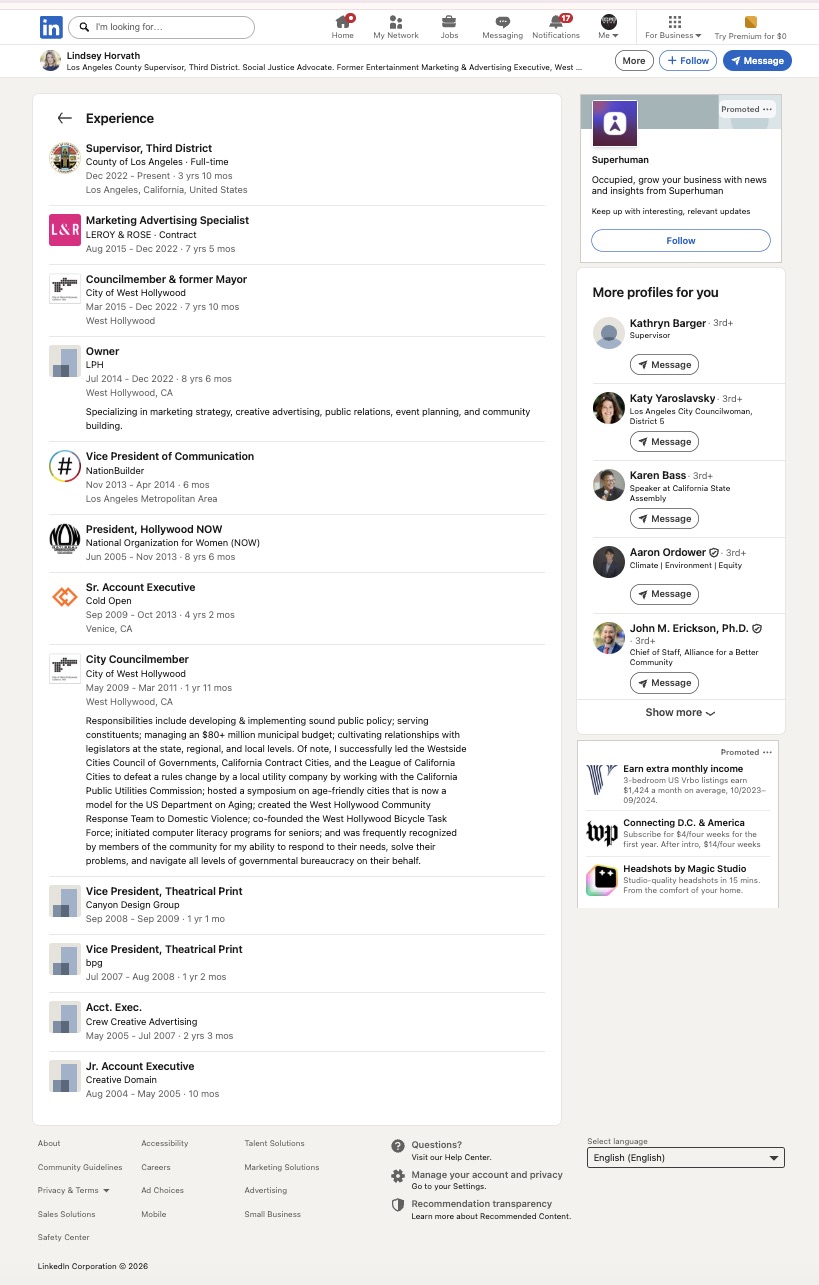
Every employer she lists is an entertainment advertising agency. Creative Domain, then Crew Creative Advertising, then bpg, then Canyon Design Group, then Cold Open, then Leroy & Rose. Her federal campaign filings, which require a contributor to name an employer, corroborate the list independently: CrewCreative in 2007, bpg and then Canyon Design Group in 2008, Canyon Design Group in 2009, Cold Open from 2010 through 2013, and LPH or “self-employed” from 2015 on.
Two of those jobs carry the same title, held consecutively: Vice President, Theatrical Print, at bpg from July 2007 and at Canyon Design Group from September 2008. In entertainment advertising, theatrical print is the out-of-home discipline. It is the one-sheet, the bus shelter, the wallscape and the billboard. It is the department whose product ends up on the Sunset Strip.
She was running that department at Canyon Design Group in May 2009, when the Council appointed her to the seat left vacant by the death of Councilmember Sal Guarriello. Thirty-nine people applied and thirty-six made presentations on May 6, 2009. In the narrowing that followed, each member named five, then three, then two — twelve ballots in all, and her name is on eleven of them. She drew four of four when each member named five, three of four when each named three (Councilmember Duran’s three did not include her), and four of four in the final round of two. The last candidate standing against her was Planning Commissioner Joe Guardarrama, whom Guarriello himself had appointed to the Planning Commission. Councilmember Prang moved the appointment. The vote was four to nothing.
The tape shows how the last round worked. Duran, at 2:38:52: “lindsey horvath has each of our votes. And then we’re divided on joe guardarrma and agassi 2-2.” The two-two was between Guardarrama and Topchian, for the second slot. Horvath was on every ballot. Land, a minute later: “the fact that honestly, that lindsey kept getting the four votes, all through … it seems to me that we actually have our candidate.” Prang then said, at 2:44:18, “I’m going to resubmit my vote and reorder it to lindsey horvath, joe guardarrma and agassi topchian” — moving her to the top of his own ballot.
The consensus was not unanimous on the merits. Duran had argued for Guardarrama minutes earlier: he felt “pretty strongly about joe,” who “has been in the heat of the battle” on the Planning Commission and was “sort of tested, dealing with the complex issues we deal with.” Then, as Prang re-ordered his ballot, one member asked another — “john, can you live with that?” — and the answer was this: “Even though I actually think that joe is the stronger of the three candidates, I can go along with lindsey horvath as a means of compromising and getting consensus between the 4 of us.” A member who thought the Planning Commissioner was the stronger candidate voted for Horvath anyway, to produce a consensus. The vote was recorded four to nothing.
One detail cuts against that caution, and we record it here rather than bury it. The same caption block ends “Pang I would move the election of lindsey horvath as our next councilmember” — and the minutes, which are authoritative for movers, record that motion as Prang’s. “Pang” is this captioner’s rendering of a speaker’s name that failed to open a new block. By the same mechanism, the word sitting immediately before the compromise sentence is “During”, which is what that captioner does with “Duran.” The reading is consistent with the rest of the night: Duran had ranked Guardarrama first and had just said he felt “pretty strongly about joe.” We think it is more likely Duran than Heilman. We do not assert it, and nothing in this file or in the article rests on it.
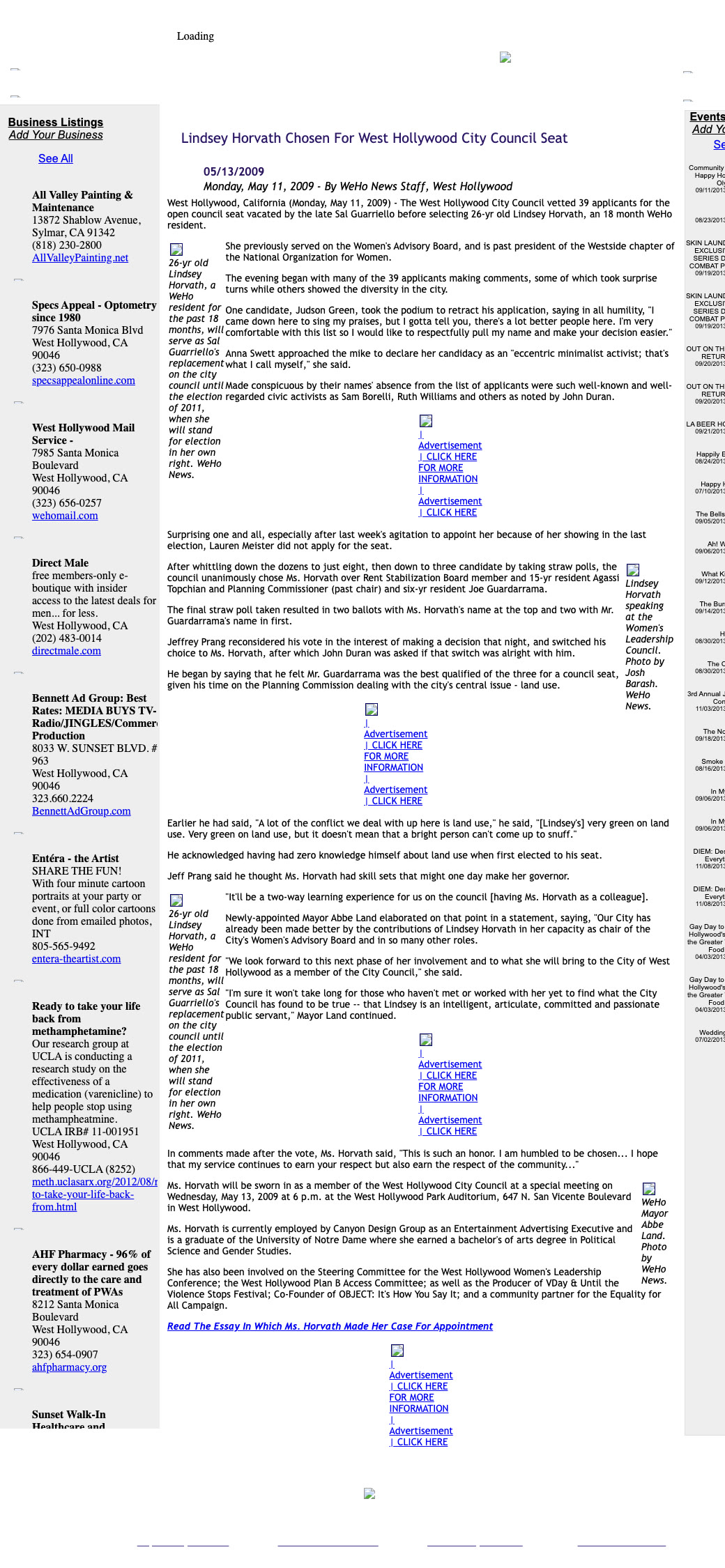
The City’s announcement that week described her, in the words a local outlet reproduced on May 11, as “currently employed by Canyon Design Group as an Entertainment Advertising Executive.” On the dais it was never said. Her two-minute presentation, her written qualifications statement, the members’ deliberation on May 6 and their remarks on the night of her oath do not mention her employer or her trade once. The words the Council used for her were “young, fresh perspective,” “a second woman on the council,” “the youngest applicant,” and, from Councilmember Duran, “very green on land use.” On the night she was sworn in he added that she was “a clean slate” and that “none of us know anything about her.” The Council had required two documents, and we hold only one of them. The distinction, and what the missing one could and could not have carried, is set out later in this section.
What the trade record shows Canyon was. Five days after her oath, on May 18, 2009, The Hollywood Reporter published the finalists for the 38th Key Art Awards, the industry’s prizes for film and home entertainment marketing. Canyon Design Group appears three times: once for a film festival poster in the Theatrical Print categories, the division a 2015 profile says she started, and twice for Warner Home Video’s release of The Dark Knight, once for an outdoor campaign in New York’s garment district and once, in the Electronic Print category, for an “Outdoor Digital Billboard, Countdown.” Her own title there was Vice President, Theatrical Print. The City called the job “entertainment advertising”; the trade paper called it billboards, in the same week.
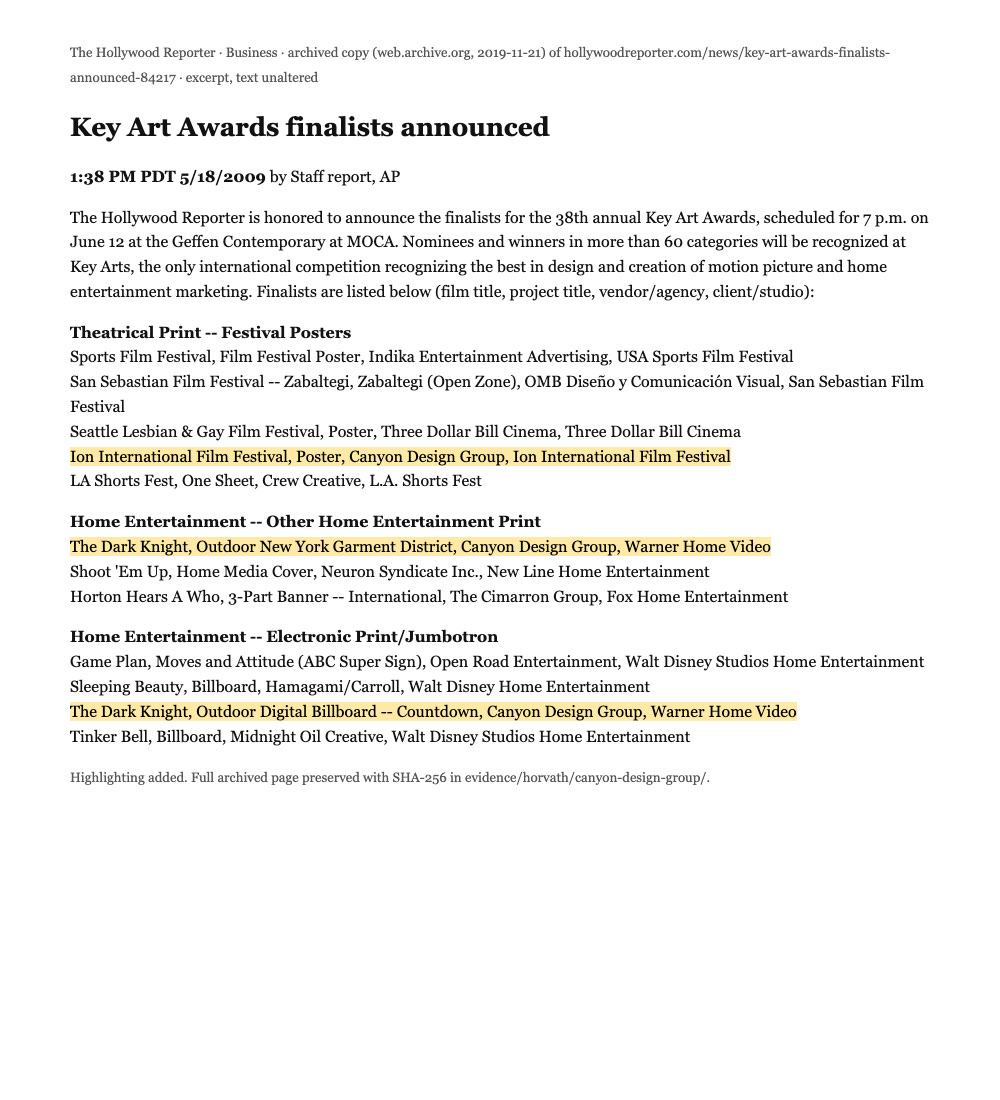
Not established: whether any Canyon creative stood on Sunset during her months there. The Dark Knight boards photographed around Los Angeles in 2008 were the theatrical campaign, not the home video release Canyon worked, and Canyon is absent from the next year’s list of 188 finalist entries.
What she said about digital signs in 2010, from the Cold Open years
The appointed term produced no City digital billboard, no pilot and no study; the signage study that led to all of that was contracted in August 2013, two and a half years after Horvath left. But digital did come before her three times, and twice she spoke to it. Both times she was working at Cold Open, the Venice key-art agency she joined in September 2009.
On July 19, 2010 the Council gave guidance on a proposed LED “Large Screen Video Sign” wrapping three walls of the Sunset Time hotel at 8418 Sunset, the House of Blues site. Staff told the Council the City had “very few video-type or moving image electronic signs” and no experience to draw on. Land called it “one of the most troubling parts of the project” and recalled the Tower Records video sign. She was the only member who objected. Duran said sight and sound were “what makes the Strip the Strip” and wanted the City to take a revenue share. Heilman called the signage “dynamic … exciting.” Prang said he would treat it “somewhat as a pilot project,” five years before the City ran one. Horvath’s answer, from the tape: digital advertising “has always been a signature to the Sunset Strip and I don’t have a problem with advertising as it’s been presented on the building.” Her two reservations were what the building would look like if the signs ever had to be shut off, and the energy an LED board draws against a vinyl one. The minutes summarize her as having “spoke in support of the Large Screen Video Sign.”
On September 7, 2010, when the project returned with the display written into a revenue-sharing development agreement, the chair asked her to weigh in on the sign. “I agree. I like the signage. I think it is what makes it creative. It compliments the design of the building.” She voted no on the project that night, for reasons she stated on the record: the loss of twenty-five rent-stabilized apartments and the House of Blues. Land, who disliked the sign, voted yes because she “could not separate” it from the project. Five months earlier, on February 1, 2010, a staff item on when the City should negotiate for billboards and tall walls had drawn public comment for and against digital boards; no councilmember spoke, it was tabled after midnight to March 1, and it never came back.
Evidentiary class. The quotations are from the City’s own caption files for the two meetings (Granicus clips 1105 and 1144), which in 2010 carry no speaker labels; the passages are identified as hers because the chair calls on “Lindsey” immediately before each, and the minutes summarize the same remarks under her name. The caption files and the transcribed windows are filed in evidence/horvath/appointed-term-digital/. What this establishes is her stated view of digital signage on the Strip in 2010, three years before the City’s study and five before Leroy & Rose. It does not establish that the view was connected to her employment, and we do not claim that.
What the Council asked for in writing, and what it got
The Council’s action of April 27, 2009 required two separate things. It directed the City Clerk to adapt the City Commission application form for the vacancy, and to require every applicant to file with it a statement of up to four hundred words on their qualifications, by 5 p.m. on May 1. Mayor Land described both from the dais on the night of the presentations: “people filled out an application, and they also did a paragraph, up to 400 words … all the councilmembers have had an opportunity to read that.”
We hold the statement. We do not hold the form. WeHo News published her statement on May 11, 2009, five days after the appointment, under the headline “Lindsey Horvath’s Council Application Essay.” Counted to its closing line, “and I ask for your appointment to City Council,” it runs 375 words — inside the Council’s cap. Beneath it the paper printed a further 69 words on community involvement and residency. Where that trailing block came from is unresolved: it sits after the essay’s own closing sentence and reads like an answer to a separate question, which would make it a fragment of the application form, but it could equally be a note the paper appended. We state only that the paper printed it.
The statement runs on community service, the Rent Stabilization Ordinance, green space and the City’s “award-winning arts and design industry.” It never names her employer, never names her trade, and never uses the word advertising. In it she told the Council she had been active in the community for over four years, living “one block outside the City limits” until she “moved into to the Mid-City area of West Hollywood over a year and a half ago.”
The candidate who would not apply
The Council was not short of an alternative. At the April 27, 2009 meeting, the night it chose appointment over a special election, eight residents asked it to appoint Lauren Meister, who had run in the previous election and lost: Credle, Cronin, Dobrin, Eisenberg, Hoopingarner, Isaacs, Omelczenko and Wilson. The minutes record that Meister herself “requested the Council to consider appointing her to the vacant City Council seat.”
A week later she withdrew. On May 4, 2009 she took the public microphone and said she would not file. The minutes record her “decision not to submit an application.” The City’s own captions carry what she actually said, at 31:45 of clip 663:
“After much thought, I have chosen not to turn in application for the job of interim councilmember, because I believe in the democratic process. Within an election, win or lose, at least an election would be the people’s choice. Some of my supporters might be upset by my decision, but for me, it’s the right decision. I choose not to place my political fate in the hands of this council. I say this without malice or ill will. I just do not believe that I nor any politician can rise above the politics. An election by the people is the only fair and democratic way of filling a vacancy. I sincerely wish all of the applicants the best of luck.”
Lauren Meister, public comment, West Hollywood City Council, May 4, 2009
Transcribed from the City’s own caption file for clip 663. The live captioner runs words together in places and the text above is regularised for readability; nothing is added or removed. Two days later the Council appointed Lindsey Horvath, four to nothing. Meister was elected to the Council in her own right in 2015 and sits on it still.
Video of the statement, forty-seven seconds from the City’s feed, runs in the companion article.
The field she was chosen out of
Every applicant on the May 6, 2009 tape states their own record aloud, and introduces themselves by name. Thirty-six of the thirty-nine applicants presented. Among them:
| Applicant | Residency | Public service, in their own words |
|---|---|---|
| Sybil Zaden | in West Hollywood since 1971 | transportation, planning, public facilities and business license commissions, from 1986 onward |
| Donald DeLuccio | resident since 1989 | Planning Commission since 1997; vice-chair, and chair over numerous terms; president, West Hollywood West Residents Association 1994–97 |
| Steven Davis | 24 years, same apartment | Human Services Commission, 15½ years |
| Roberta Sue Buckner | 10 years | Women’s Advisory Board, then years on Rent Stabilization, then the Planning Commission |
| Chad Blouin | eastside tenant | Guarriello’s own public safety commissioner, about ten years; on the PACK since 1996 |
| Pamela Komac | 15 years | four years on a board, twice its chair; Rent Stabilization Commission by Mayor Land’s appointment; Russian Advisory Board since 2000 |
| Norman Chramoff | — | Public Facilities Commission, six years |
| Steven Golightly | — | Public Facilities Commission, fourth year, and its chair |
| Bruce Kaye | — | chair, Historic Preservation Commission |
| Kate Bartolo | — | Planning Commissioner, 2007; Triangle co-captain for a decade |
| Joseph Guardarrama | — | Planning Commission, appointed by Guarriello; 98% attendance |
| Joseph Clapsaddle | 14 years | West Hollywood Chamber of Commerce, seven years |
| Conrad Corral | 21 years | 21-year City employee; told the Council he could not accept the seat while employed by the City |
| Lindsey Horvath | “a proud resident of West Hollywood”, no length given | chair, Women’s Advisory Board |
Horvath spoke for about two minutes. She gave no length of residency, offered that single credential, and, as in the written statement, did not say what she did for a living. Guardarrama, the Planning Commissioner Guarriello had appointed, ran again in the 2015 election and lost; he appears on the certified canvass for that race.
The agency was founded by a man she had worked with
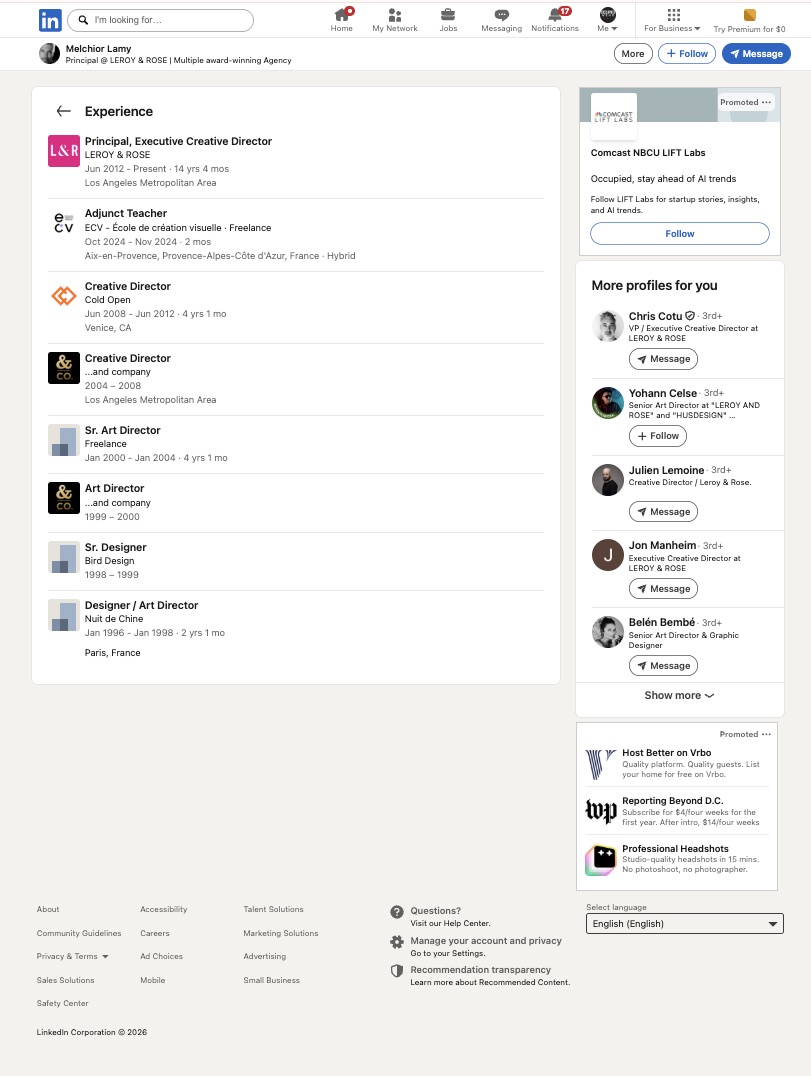
Leroy & Rose was founded by Melchior Lamy, its sole corporate officer: secretary, chief executive and chief financial officer of a Georgia corporation whose principal office is in Santa Monica. His profile records that before founding it he was Creative Director at Cold Open, in Venice, from June 2008 to June 2012.
Horvath was a Senior Account Executive at Cold Open from September 2009 to October 2013. They overlap there by two years and ten months, he as creative director, she on the account side.
And he was not the only one. Reading the current staff list of Leroy & Rose against their own public professional profiles, as they stood in September 2026, the firm’s early core is a Cold Open alumni group. Chris Cotu, its executive creative director since December 2014, was an associate creative director at Cold Open from March 2011 to December 2014, overlapping her there by two years and eight months. Toni Schwartz, now its VP of account services, was a senior account executive at Cold Open in 2011 and 2012. Rachel Hodges, who spent nearly nine years at Cold Open, is the account coordinator a 2015 profile of Horvath describes her mentoring there. Four of the people at this agency, including its founder and its creative head, came out of one Venice key-art shop where she also worked.
The corporate record dates the founding more precisely than the agency’s own publicity does. Leroy and Rose Inc. was incorporated in Georgia on May 16, 2012, about a month before Lamy left Cold Open. On the paperwork the company then went quiet: no annual registration exists for 2013 at all. The 2014 registration was filed on November 21, 2014, seven months past the deadline and two and a half years after formation, and the website was still a placeholder carrying the words “Leroy and Rose” and nothing else as late as December 2014. The site went live as a working Los Angeles agency on March 10, 2015. The precision matters, because the Internet Archive lets us bound it: the page was still the bare placeholder, byte for byte the same file it had been since January 2014, on March 1, 2015. Horvath won her seat on March 3. Seven days later the placeholder was a full agency site.
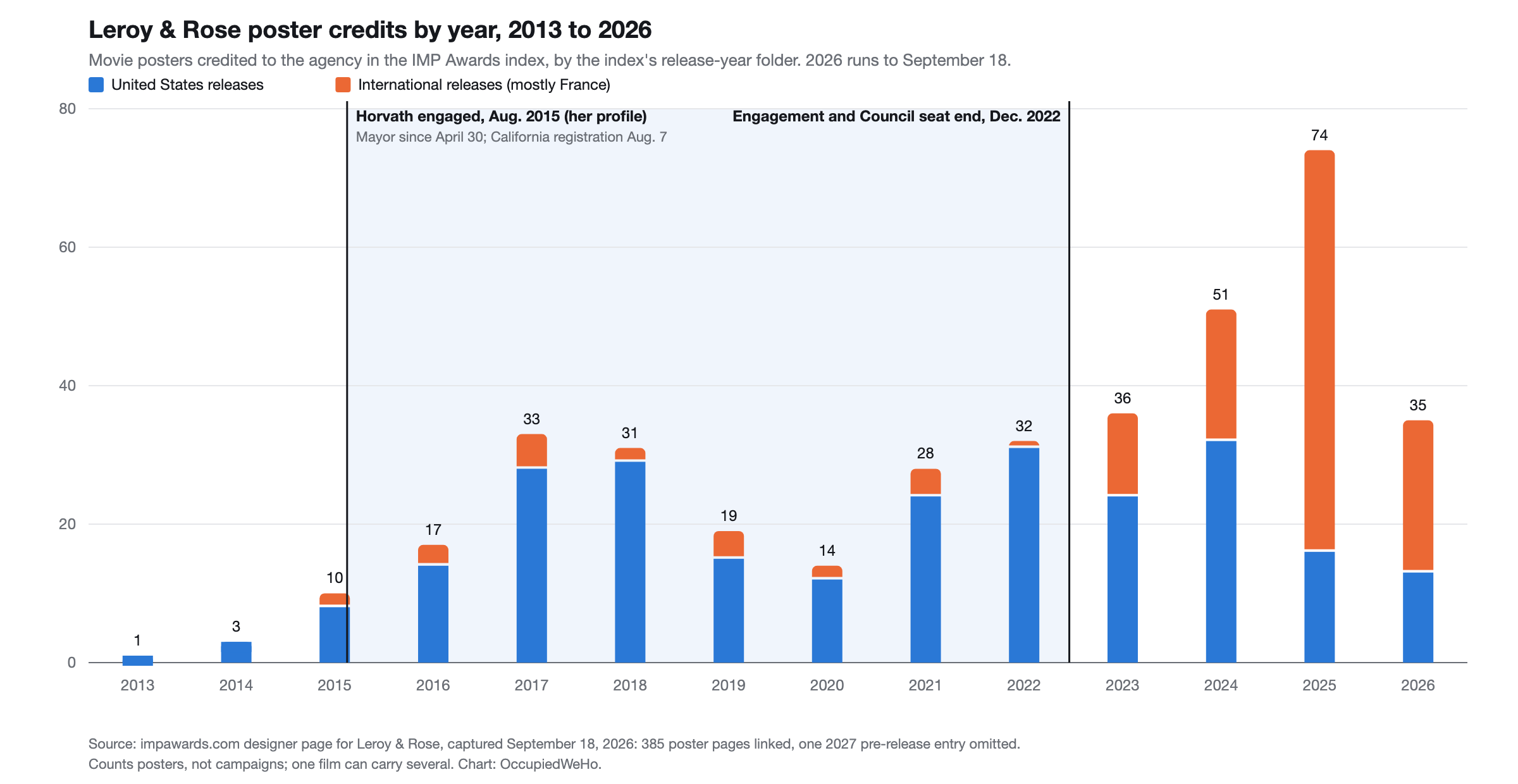
The trade record shows what the firm was doing before and after her. IMP Awards, the movie-poster index, credits Leroy & Rose with one poster in 2013 and three in 2014. The year she joined it made ten; by 2017, thirty-three. It held near that level for as long as she sat on the Council. After she left, its American work fell away: thirty-one United States posters in 2022, her last year, then sixteen in 2025 and thirteen in the first nine months of 2026. What replaced it is French. The firm registered to do business in California on August 7, 2015, and her own profile dates the engagement to that same month.
And the two of them were not strangers by then. On February 24, 2015, a week before the election, Melchior Lamy gave $250 to her campaign. On the disclosure form, filed with the City under penalty of perjury, he gave his occupation as Creative Director and his employer as Leroy and Rose. That is five months before the firm engaged her company, and it is the earliest documented transaction between them. It runs from him to her.
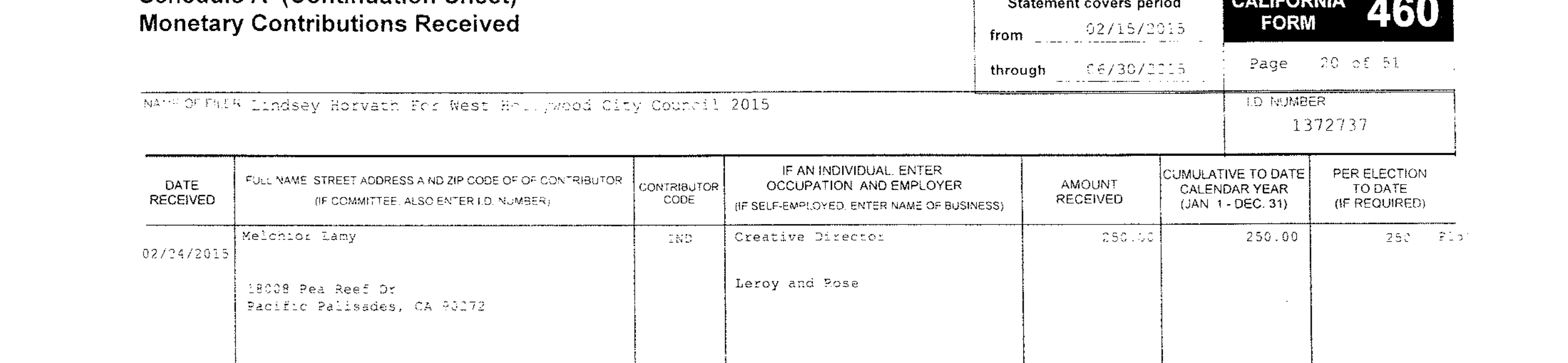
What the contribution establishes: a relationship existed before the employment did, and Leroy & Rose was a name Lamy used publicly in February 2015, while the firm’s website was still a placeholder and its corporation had filed nothing for years. It does not establish coordination, and none is claimed.
What this establishes, and what it does not. It establishes that the man whose firm paid her sole proprietorship between ten thousand and a hundred thousand dollars a year, for seven years, while she sat on a council voting on Sunset Strip billboards, was a former colleague rather than an arm’s length client who found her through a bidding process. It does not establish why he engaged her, and we do not assert a reason. The clients were his before she arrived: the March 2015 site already carried work for Showtime, HBO and Netflix. Nothing in this record shows she brought business with her, and anyone arguing that she did has to account for it.
One name that never appears
Federal law requires anyone giving more than two hundred dollars to a federal committee to state their employer. Horvath is a frequent small donor. Across her complete federal record, 2007 through 2026, she names CrewCreative, Canyon Design Group, bpg, Cold Open, LPH, “self-employed,” and later Los Angeles County.
Leroy & Rose appears zero times. One hundred and thirty-four of those contributions, dated 2016 through 2022, fall inside the years her sworn Form 700 named Leroy & Rose as the single source of ten thousand dollars or more to her business.
Three · Recusals and abstentions on the record
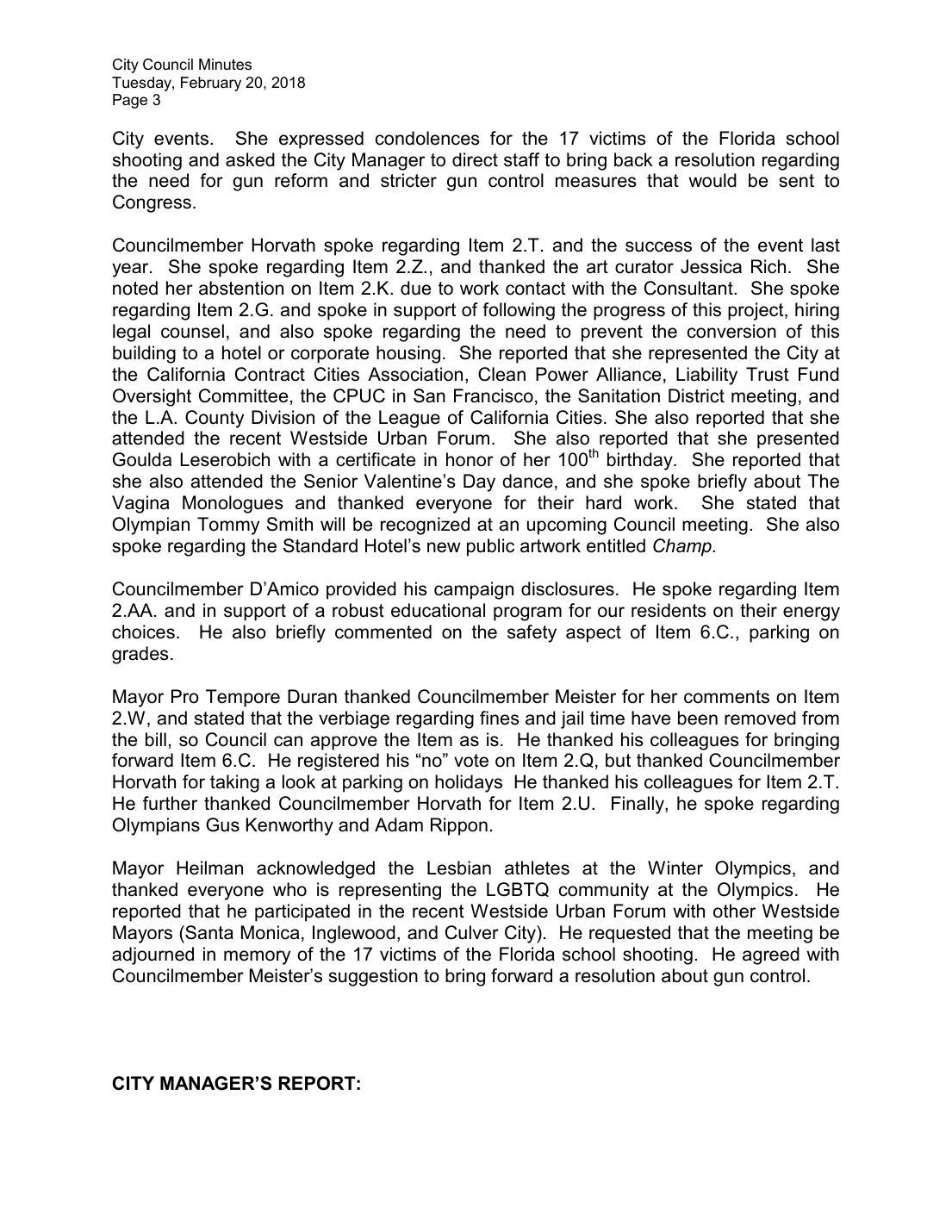
On February 20, 2018, during Council comments, Horvath told the public she had abstained from an item on that night’s Consent Calendar. The minutes record her explanation:
 1
1
- 1Her own stated reason for stepping aside: a work relationship.
“She noted her abstention on Item 2.K. due to work contact with the Consultant.”
Item 2.K was an amendment increasing the City’s contract with a consultant working on West Hollywood’s homelessness plan by $50,000, to a not-to-exceed total of $65,000. She had some professional contact with that consultant. She concluded that the contact disqualified her, she stepped aside, and the City Clerk wrote it into the permanent record.
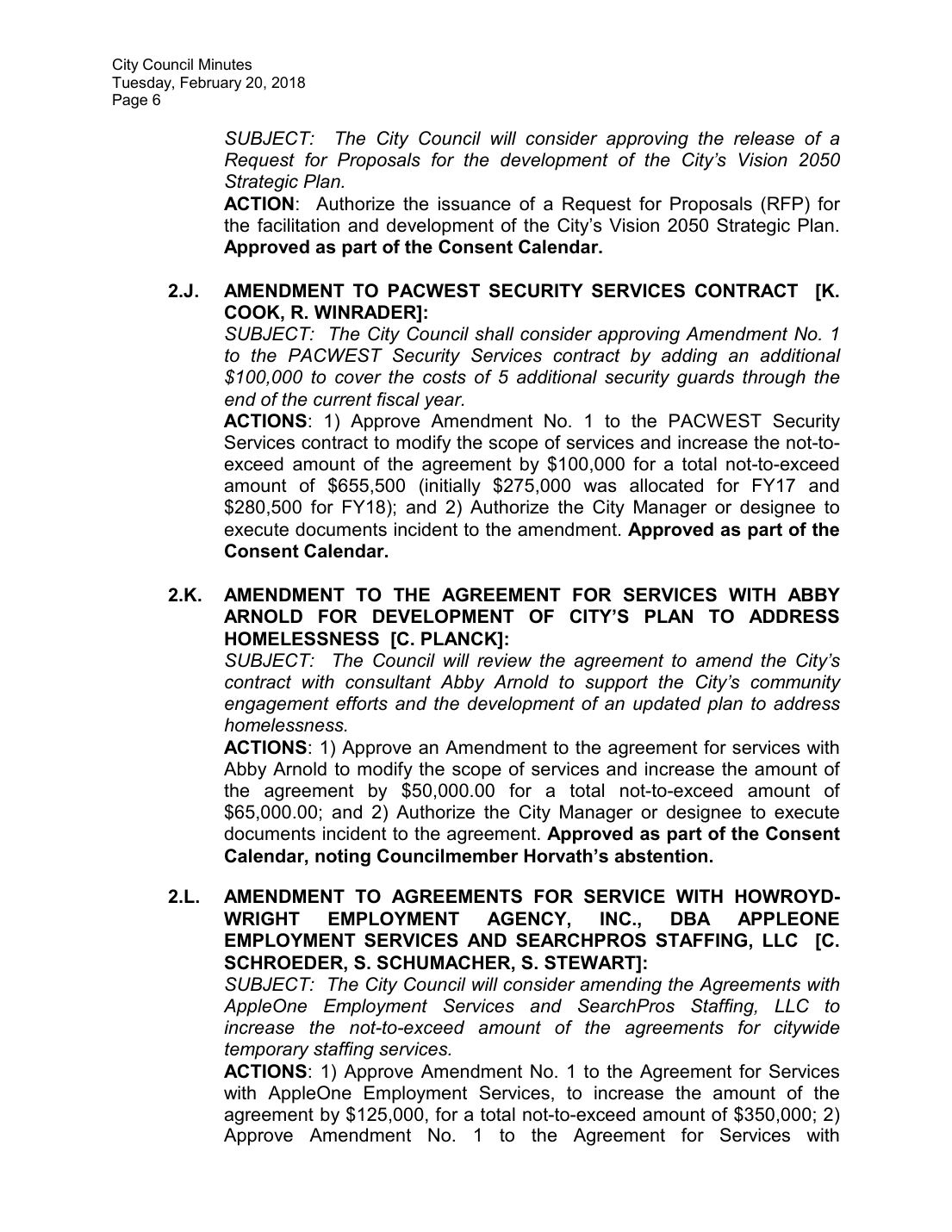 12
12
- 1A $65,000 consultant contract.
- 2The clerk records the abstention when she makes one.
Why this page matters
It closes off every innocent explanation for what comes next.
She knew the rule existed. She applied it twice, without being asked, in two different years.
She knew the mechanism. She did not need a city attorney to tell her how to abstain.
She understood that a work relationship is the kind of thing that triggers it. That is the precise reason she gave.
And the clerk records it when she does. So the absence of any similar entry elsewhere is not an artifact of how West Hollywood writes its minutes. When Horvath stepped aside, it got written down.
Hold that against the rest of the record. She stepped aside from a $2,500 street closure and from a $65,000 homelessness consultant, both times because of her work. The record shows no instance of her stepping aside from any decision about the Sunset Strip billboard program, in eight years, while her only reported outside income came from a billboard advertising agency.
Four · Signage items and votes, 2009 to 2022
The clearest single example is November 5, 2018, Item 4.B.
The City owns land at 8775 Sunset Boulevard. The item before the Council was final design approval and a site license agreement for a pilot digital billboard on that City-owned parcel, to be built and operated by Orange Barrel Media, an outdoor advertising company.
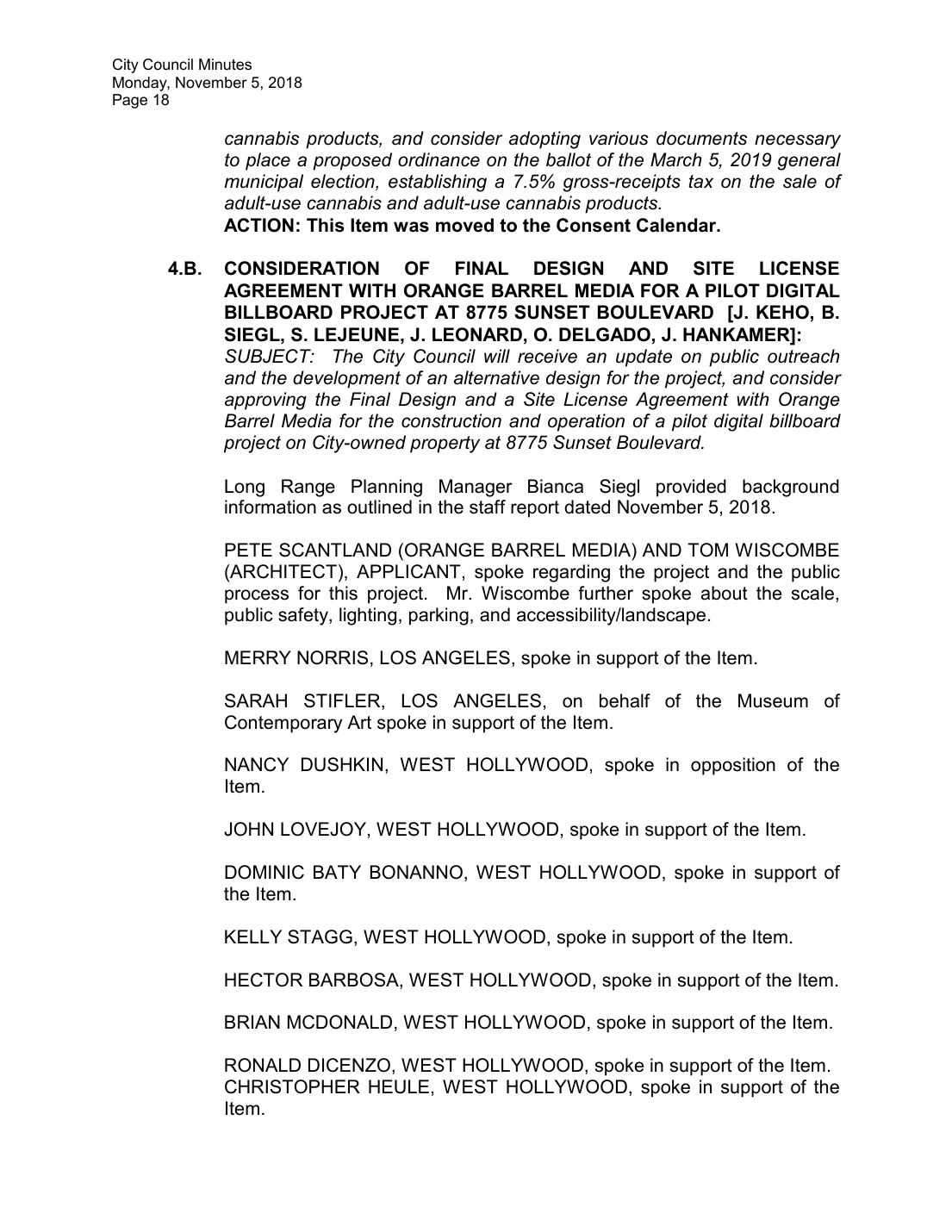 1
1
- 1The item: a digital billboard on City-owned land.
It was a contested item. Residents spoke on both sides. Councilmember Heilman raised the height. And when it came to a vote, Horvath did not simply support it.
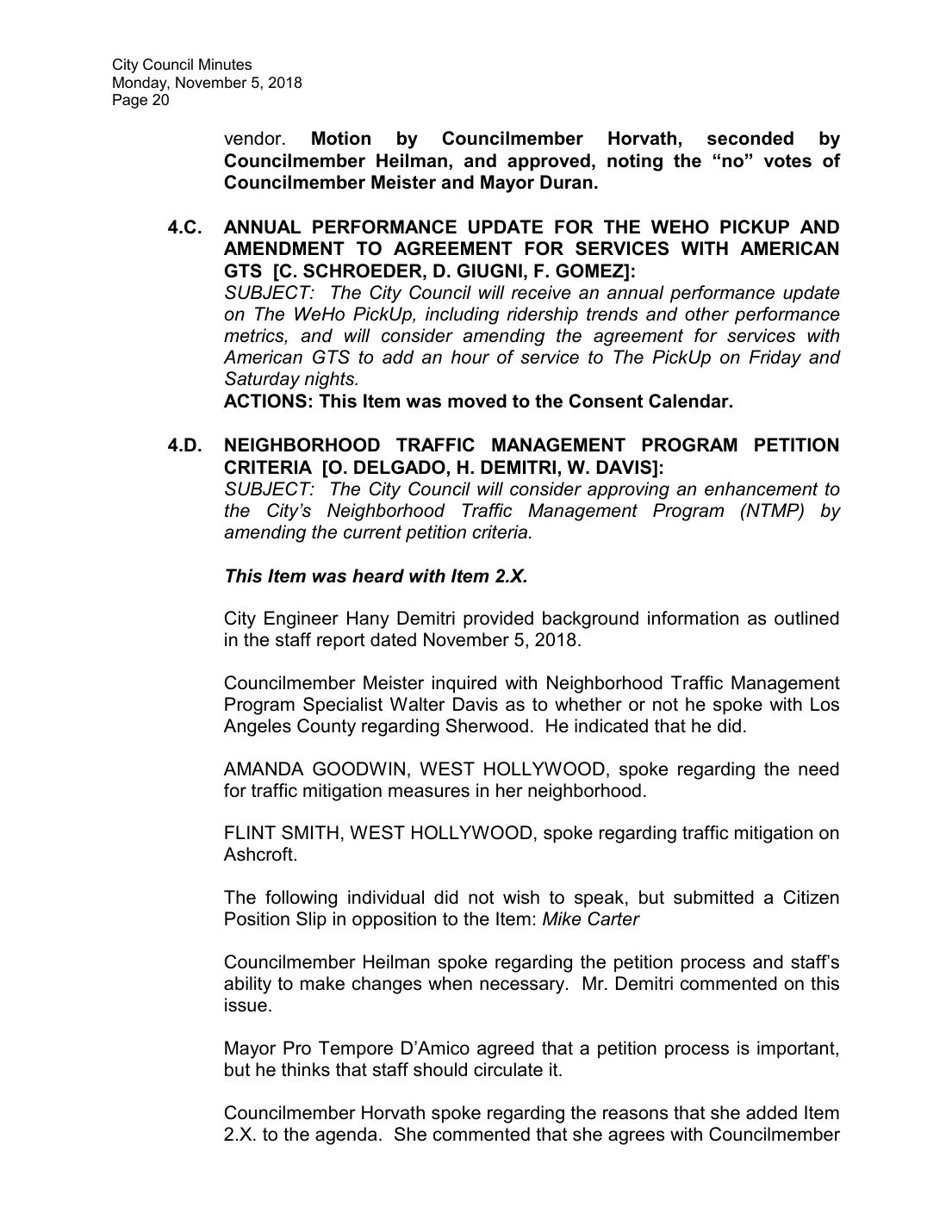 12
12
- 1She did not merely vote for it. She moved it.
- 2Approved over two no votes.
“Motion by Councilmember Horvath, seconded by Councilmember Heilman, and approved, noting the ‘no’ votes of Councilmember Meister and Mayor Duran.”
She moved it. The City’s own video confirms both the motion and the margin. At 3:34:48 she says “I move the project.” At 3:36:31 a colleague addresses her directly: “councilmember horvath, I support your original motion.” At 3:37:56 the chair announces the result: “The motion passes with a 3-2.”
Across the four and a half hours of that recording, in a fifty-four minute item, the words recuse, abstain, conflict of interest, and step down do not appear once in the City’s machine transcript.
The rest of the billboard record
Horvath participated in Sunset Strip off-site advertising decisions throughout her tenure. These are the ones we have confirmed item by item:
| Date | Item | Matter | Her role in the record | Recusal |
|---|---|---|---|---|
| 2016-08-15 | 4.A | 8775 Sunset, pilot digital billboard update | Seated | None recorded |
| 2018-11-05 | 4.B | 8775 Sunset, final design and site license, Orange Barrel Media | Made the motion | None recorded |
| 2019-09-23 | 3.A | Sunset Specific Plan amendment on modifying off-site signs | Seconded | None recorded |
| 2020-12-07 | 3.C | 8743 Sunset, static to digital conversion, Netflix as advertiser | Mayor; presided | None recorded |
| 2021-07-19 | 3.A | 9157 Sunset, new digital billboard and development agreement | Mayor; opened the hearing | None recorded |
| 2021-12-06 | 3.B | 9165 to 9169 Sunset, new billboard and development agreement | Seated | None recorded |
| 2022-06-27 | 3.G | 8730 Sunset, new billboard | Seconded | None recorded |
| 2022-11-21 | 3.A | 8901 Sunset, Whisky a Go Go billboard, Orange Barrel Media | Seconded | None recorded |
She did make a disclosure on a billboard item. Just not that one.
On December 6, 2021, the Council heard Item 3.B, a request to permit a billboard at 9165 to 9169 Sunset Boulevard, carrying a development agreement, a zoning map amendment, a sign permit and a certificate of appropriateness. The Mayor opened the public hearing, and the members made their disclosures.
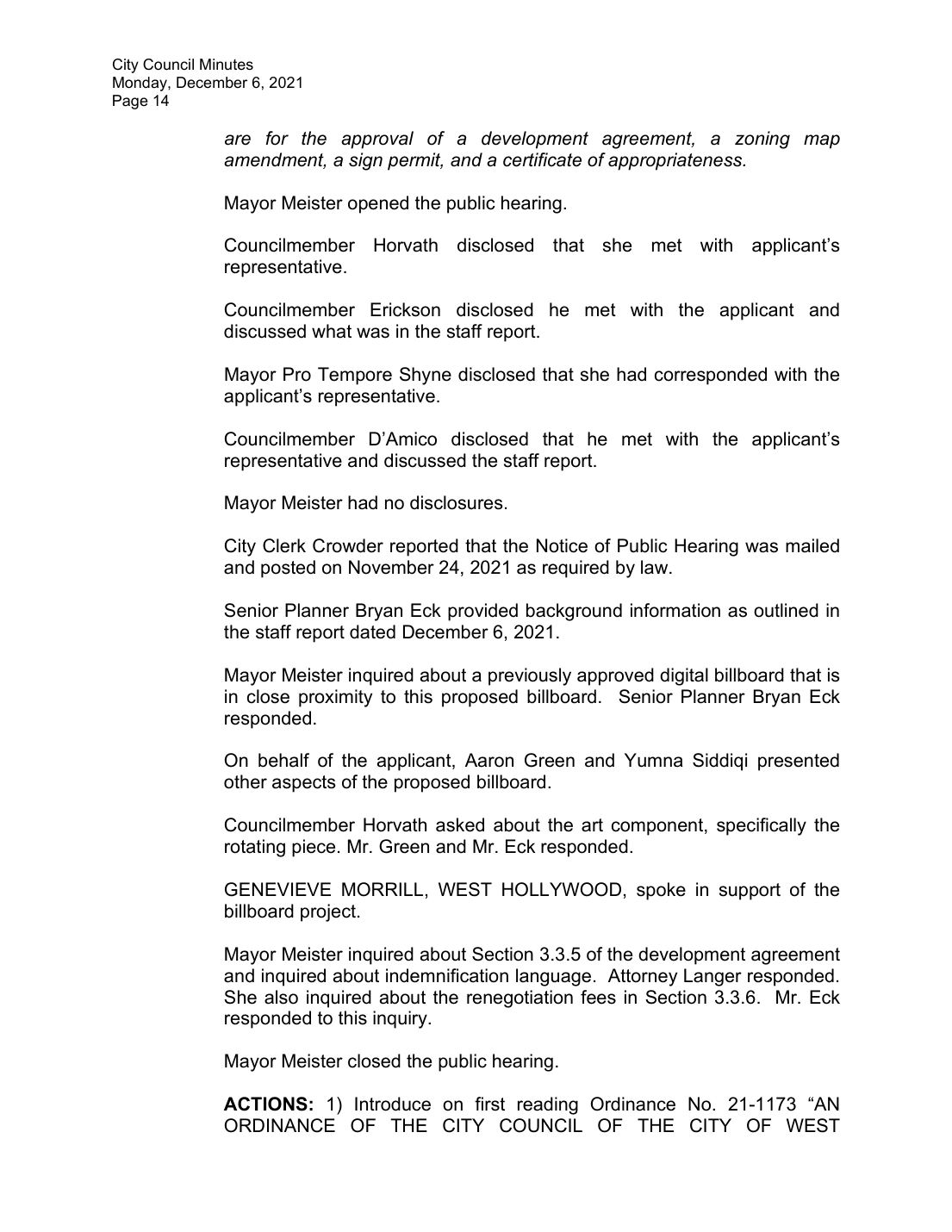 1
1
- 1She made a disclosure. It was about meeting the applicant, not about her income.
“Councilmember Horvath disclosed that she met with applicant’s representative.“
She made the same kind of disclosure on the preceding item that night. So this is not a Council that skipped disclosures, and not a member who was unaware they were expected. On a Sunset Strip billboard item, in a formal hearing, she told the room she had met the applicant’s representative.
She did not tell the room that her only outside income came from an agency in the billboard business.
Nor was disclosing billboard money an unfamiliar idea on that Council. On February 16, 2016, the minutes record this:
“Councilmember D’Amico disclosed that he received campaign donations from representatives from 8335 Sunset Blvd; which as an Item on the Closed Session Agenda.”
A colleague, in the same period, told the room he had taken money from a Sunset Boulevard property’s representatives, and the clerk wrote it down. Horvath took money from two billboard operators and had a campaign supported by roughly $40,000 to $50,000 of billboard-industry money, and made no comparable disclosure on any signage matter in eight years.
How many billboards there are, and how often they came to her
West Hollywood counted them. The City’s own 2019 Off-Site Sign Inventory, an appendix to the Sunset Boulevard Off-Site Signage Policy, maps and numbers every off-site sign on the Strip:
| The City’s count, March 2019 | |
|---|---|
| Billboards | 63 |
| Tall wall signs | 29 |
| Total signs | 92 |
| Distinct addresses | 50 |
Against that inventory we built a database of every signage matter that came before Horvath, across both of her terms. Sweeping 1,169 items of minutes from her appointed term and 5,393 from her elected one returns 78 signage items over thirteen years. She moved one and seconded seven. Twenty-four touch an address in the City’s own inventory.
And the wider search: across 5,393 items of West Hollywood City Council minutes covering 2015 through 2022, language recording a recusal or abstention by Horvath appears five times. Two are procedural, on certifying and approving minutes from meetings that predated her term. One is a 2020 exchange about someone else’s possible conflict. The other two are her own abstentions, one of them the homelessness consultant on February 20, 2018.
None of the five is a billboard matter. None of the five is a signage matter of any kind.
How she voted, on all of it
West Hollywood does not write its votes down. Across the harvested minutes of both terms, 207 meetings and 6,562 items, we have found one numeric tally: “the motion failed (2-3-0)”, on a procedural motion to table, in August 2019. That is the whole of it.
What the minutes do record, every time, is dissent. They name each no vote, abstention and recusal, by member and by item, 133 times in 39 of the 45 meetings of her first term alone, and they do it even inside a consent calendar: “Approved as part of the Consent Calendar, with Councilmember Prang ABSTAINING.” Her own two abstentions are in the record that way.
So her vote is recoverable by subtraction. Present at the roll call, item recorded approved, no no vote or abstention or recusal recorded against her name: she voted for it. We read every one of the eleven dissents she registered across thirteen years and matched each to its item.
| Her vote on 78 billboard items | Appointed | Elected | Total |
|---|---|---|---|
| For | 12 | 43 | 55 |
| Against | 2 | 0 | 2 |
| Absent | 1 | 2 | 3 |
| Undetermined | 4 | 14 | 18 |
She is documented dissenting on a signage-related item twice, both in her appointed term, and not once in the seven years of her elected term. Neither dissent was against a sign. In September 2010 she voted no on the Sunset Time hotel at 8418 Sunset, a project that carried a digital media display over three of its walls; the tape records her saying of that display “I like the signage. I think it is what makes it creative,” and giving her reasons for the no as the loss of twenty-five rent-stabilized units and the House of Blues. In November 2010 she voted against refusing to put an off-site advertising tax on the ballot. She wanted the voters to decide that one.
Eighteen items are undetermined and stay that way. Sixteen are items where she is recorded present but the minutes carry no approval language, most of them continuations. We are not counting those as votes in either direction.
Five · Her employer’s artwork on West Hollywood boards
Among the agency’s own public Instagram posts, four place a campaign in West Hollywood or on Sunset Boulevard. Horvath personally liked all four. What follows is bounded by that corpus. We searched the agency’s public posts and Horvath’s own; we did not obtain client lists, creative credits, operator booking records or invoices, any of which could place further work on boards she voted on.
February 4, 2022. The Whisky a Go Go.
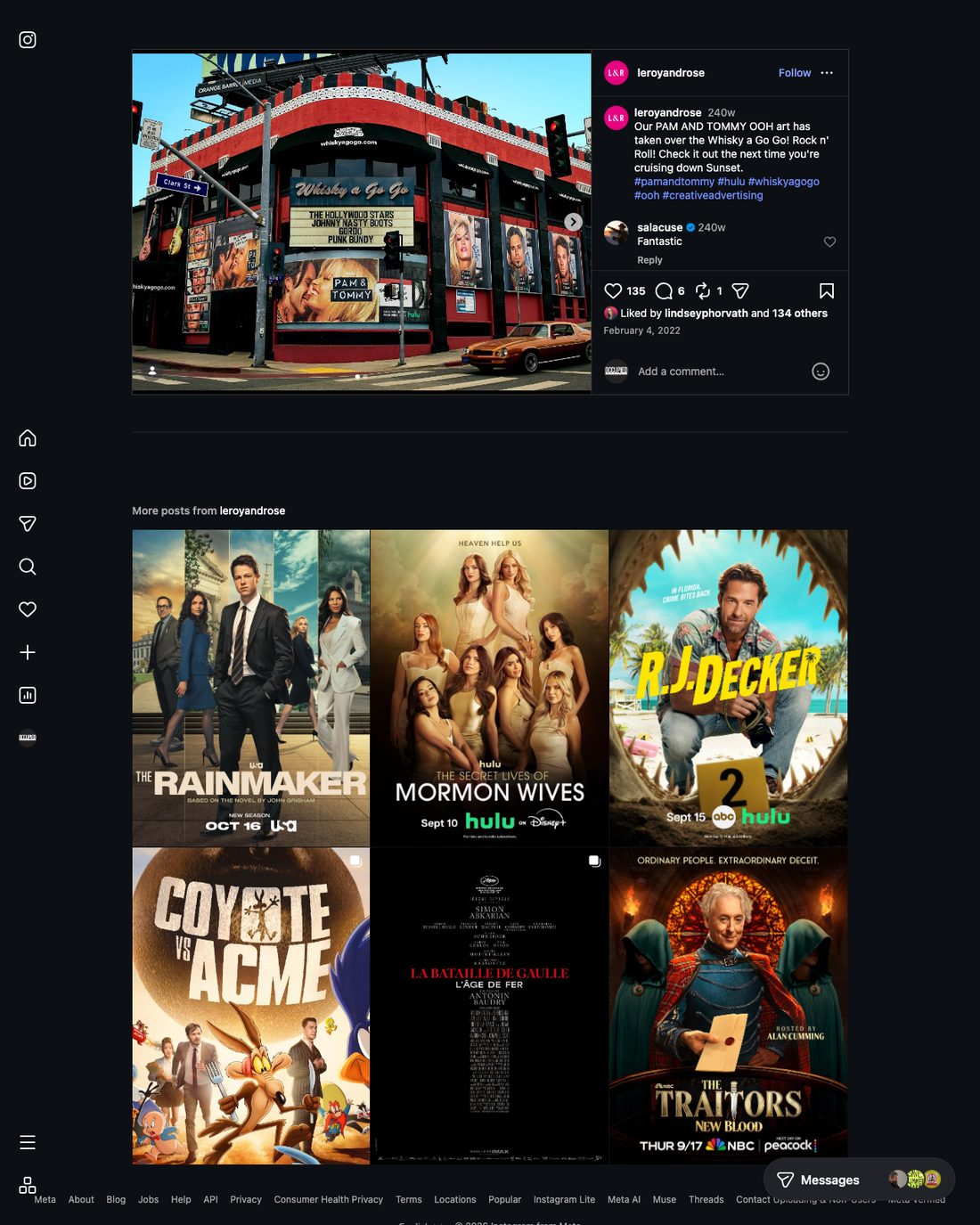
“Our PAM AND TOMMY OOH art has taken over the Whisky a Go Go! Rock n’ Roll! Check it out the next time you’re cruising down Sunset.”
The agency tags @thewhiskyagogo. The Whisky a Go Go is 8901 Sunset Boulevard. Hulu was the client. And in the likes: lindseyphorvath.
Nine months later, on November 21, 2022, in one of her last acts on the Council, Horvath seconded the motion approving a new billboard for that building.
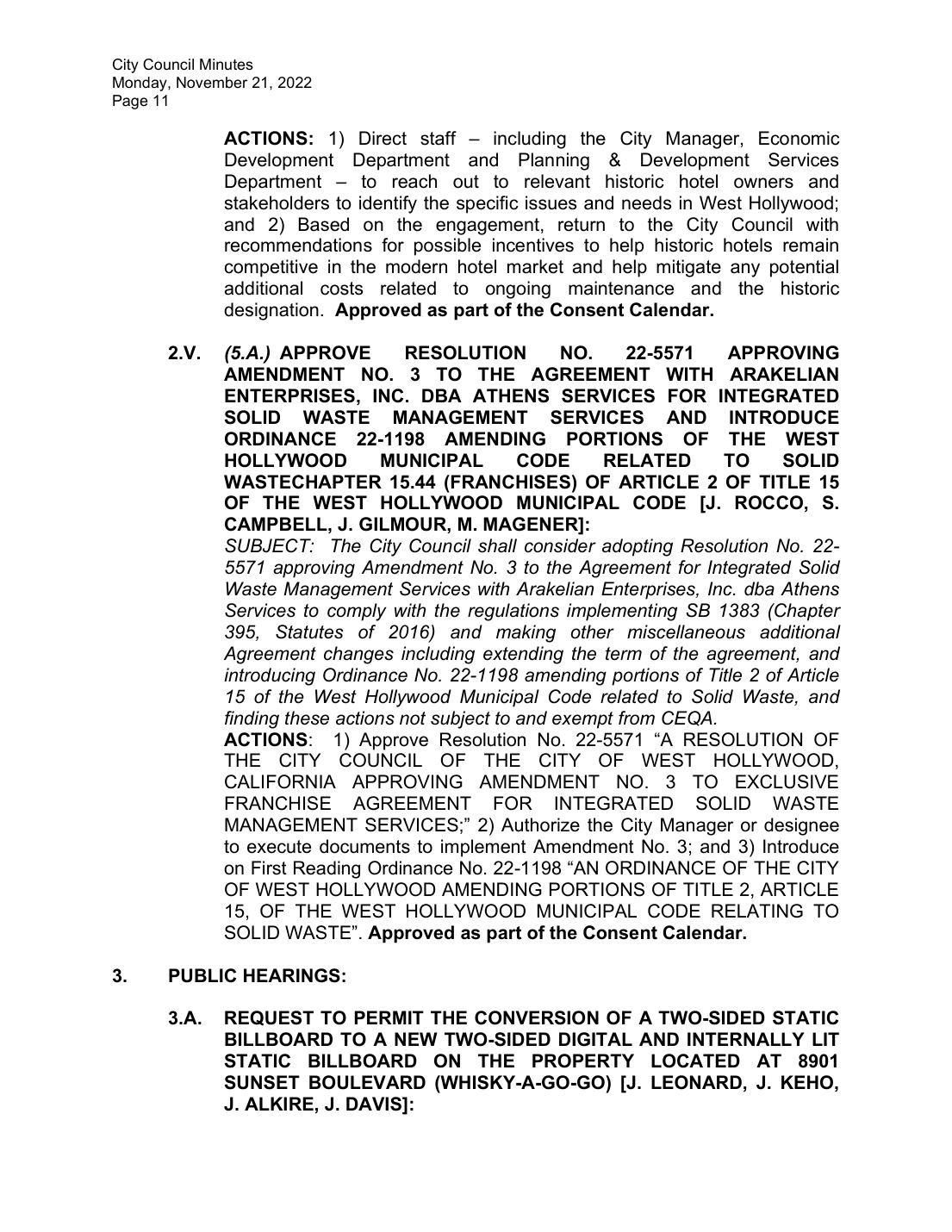 1
1
- 1The board her employer had used twice.
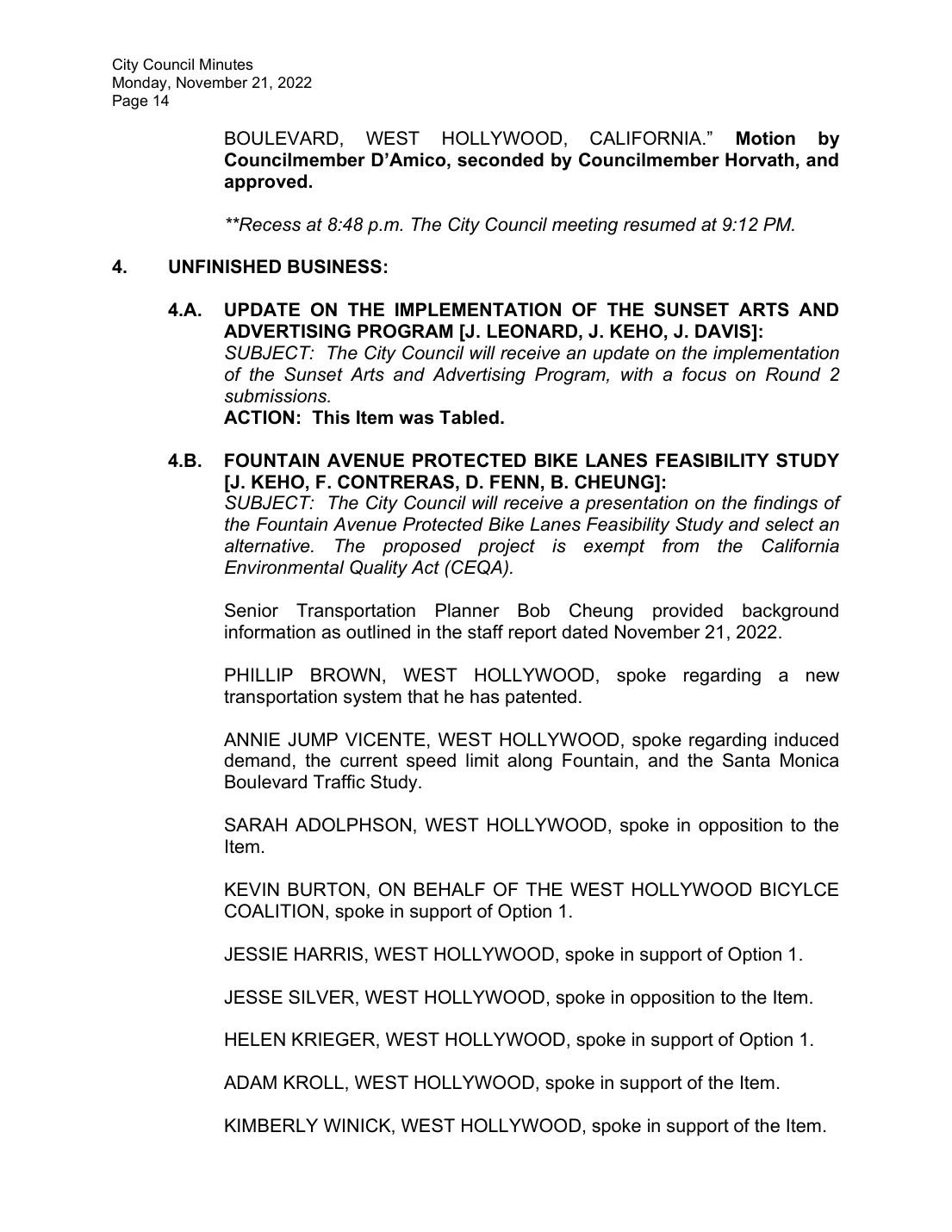 1
1
- 1She seconded the conversion to a digital face.
“Motion by Councilmember D’Amico, seconded by Councilmember Horvath, and approved.”
The City’s staff report puts a number on it. The billboard’s owner and operator pays West Hollywood $1,298,311 in the first year, rising three percent annually, $61,767,685 across the thirty-year term, plus $330,000 in extraordinary public benefit. That is the scale of the agreement she seconded. The minutes for the item record that “The City Councilmembers provided their disclosures.” No financial-interest disclosure by Horvath appears.
Limits
The Pam and Tommy art was not on the billboard she voted on. Look at the photograph: the campaign occupies the building’s façade wall panels, at and above street level. The November 2022 item concerned the elevated two-sided billboard, and the City’s Master Project MP20-0015 is defined as converting that billboard and nothing else. Same property, same owner, different sign.
What the record supports is this: her employer’s client had paid advertising on that building nine months before she seconded a $61.8 million agreement about that building. Not that she voted on the sign her employer used.
Worth noting alongside it, from the same staff report: the enabling Sunset Boulevard Off-Site Signage Policy is the City’s first comprehensive policy for “billboards, tall wall signs, and other types of creative advertising.” Wall signs are inside the policy she voted for. They were not inside this particular project.
Whose billboard it is
Magnify the top left of that photograph. There is a plate bolted to the steel billboard structure above the roofline, and it reads:
ORANGE BARREL MEDIA
That is not incidental. It is written into the permit. West Hollywood’s own conditions of approval for the project state: “The Orange Barrel media logo signs shall have the maximum lettering height of eight (8) inches.”
And the City’s enacted resolution says who brought the project:
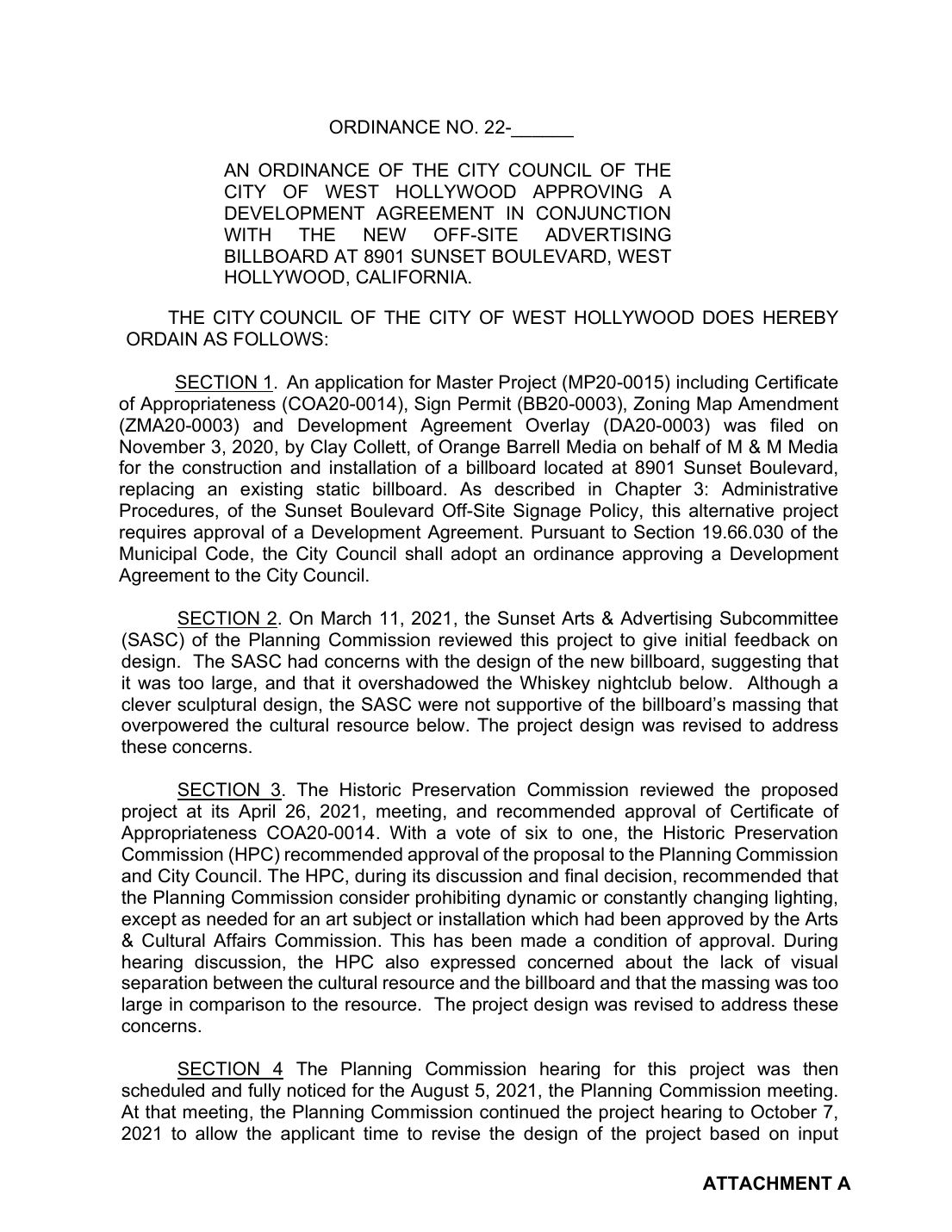 12
12
- 1Orange Barrel Media filed the application.
- 2The Whisky a Go Go billboard.
“An application for Master Project (MP20-0015)… was filed on November 3, 2020, by Clay Collett, of Orange Barrell Media on behalf of M & M Media, for the construction and installation of a billboard located at 8901 Sunset Boulevard, replacing an existing static billboard.”
So the November 2022 vote Horvath seconded was an Orange Barrel Media application.
Four years earlier she had made the motion to give Orange Barrel Media the pilot digital billboard at 8775 Sunset, on land the City owns. Eight weeks after that motion, Orange Barrel Media and its executive vice president each put $500 into her re-election committee, and the following month Orange Barrel put $5,000 into the independent committee supporting her.
| Date | Orange Barrel Media and Lindsey Horvath |
|---|---|
| 2018-09-29 | Orange Barrel Media appears as a Silver Sponsor of the Equality California gala she attends. It had never sponsored that event before. |
| 2018-11-05 | She makes the motion awarding Orange Barrel Media the 8775 Sunset billboard on City-owned land. |
| 2018-12-31 | Orange Barrel Media LLC gives $500; its executive vice president gives $500, to her committee. |
| 2019-01 | Orange Barrel Media gives $5,000 to the independent committee supporting her. |
| 2020-11-03 | Orange Barrel Media files the 8901 Sunset application. |
| 2022-02-04 | Her employer’s Hulu campaign covers that building. She likes the post. |
| 2022-10-10 | Melchior Lamy, her employer’s sole officer, gives $250 to her campaign for County Supervisor. |
| 2022-11-21 | She seconds the motion approving Orange Barrel Media’s 8901 Sunset billboard and its $61.8 million agreement. |
What connects to what
Her employer’s advertising was not on the Orange Barrel billboard. The Hulu art is on the building’s façade wall panels; the Orange Barrel plate is on the elevated billboard structure above them; the Master Project covers that billboard and not the panels. Three different things on one building, and we are not merging them.
We have no evidence of any money between Leroy & Rose and Orange Barrel Media.
What is documented is the pattern. She moved the award to Orange Barrel in 2018, took its money weeks later, and seconded its next application four years on, while her own employer’s client advertised on the same building and she engaged with it publicly.
July 9, 2018. A wall on Sunset.
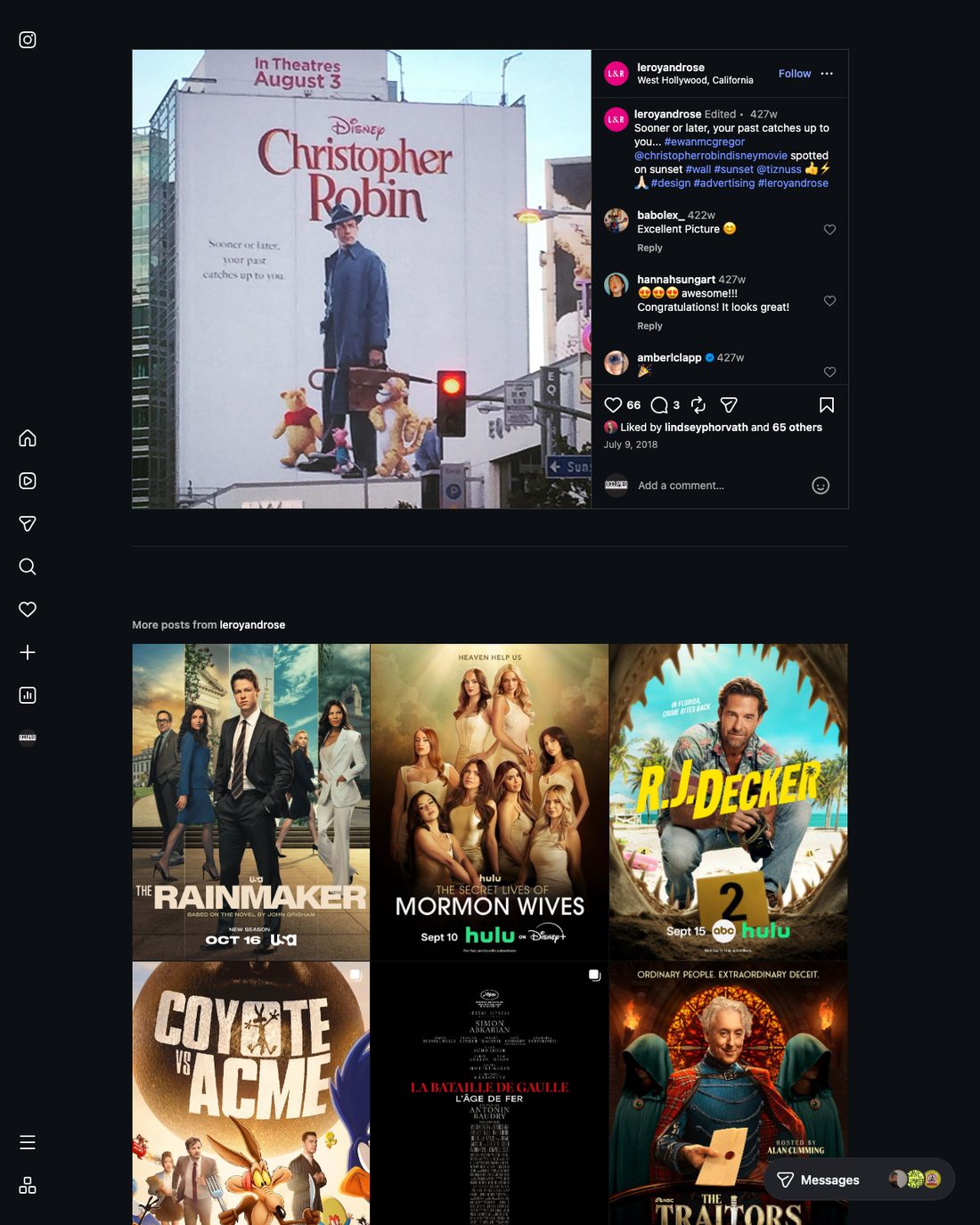
“Sooner or later, your past catches up to you… #ewanmcgregor @christopherrobindisneymovie spotted on sunset #wall #sunset“
Disney’s Christopher Robin, geotagged West Hollywood, California. “Liked by lindseyphorvath and 65 others.” This post is dated four months before she made the motion to approve the Orange Barrel Media billboard at 8775 Sunset.
January 2, 2021. Not the Whisky.
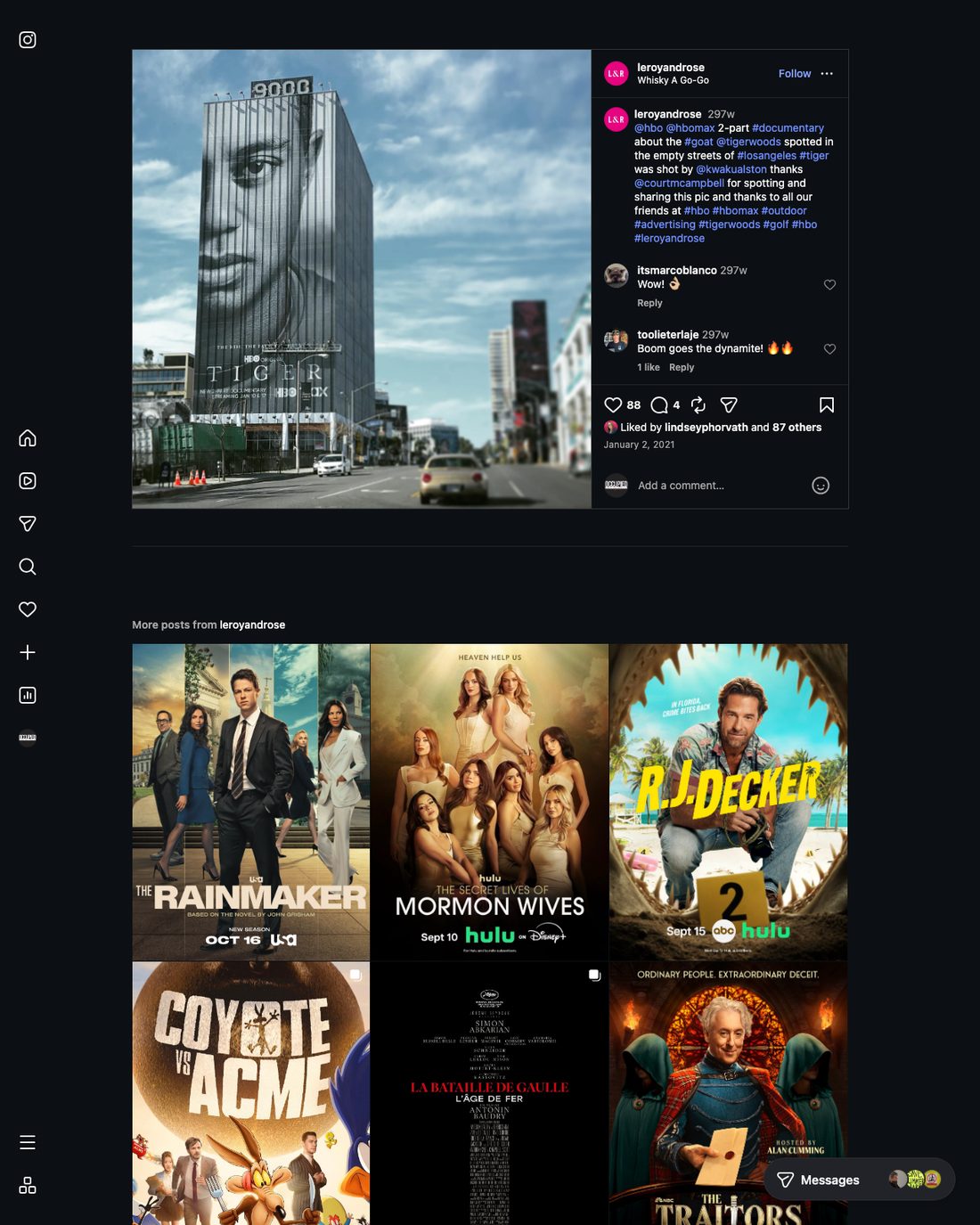
The post is geotagged “Whisky A Go-Go,” which would place a second campaign on that building. It does not. Read the building: the tower carries 9000 across the top. It is 9000 Sunset, a different address, and no signage item there came before Horvath in her elected term. It is, though, the building whose east-face tall wall she seconded in July 2009, in her appointed term, as Section Eleven sets out; which face carried the HBO wrap in 2021 is not established. Horvath is in the likes.
The one we chased hardest, and what it came to
The July 2018 post is the one that looked most promising, because it is captioned “spotted on sunset #wall,” geotagged West Hollywood, and Horvath liked it. If that wall turned out to be a board she later voted on, this section would read very differently.
It is not. The Equinox signage in the frame fixes the location: the Disney Christopher Robin tall wall was on 8560 Sunset Boulevard. And “8560” appears zero times across 5,393 items of her elected term and zero times across 1,169 items of her appointed term. No signage item at any 8500-block Sunset address exists in either. No item at that address appears in the minutes of either term.
We are telling you about the lead that failed because a file that only reports its hits is not a file, it is an argument.
January 13, 2020. The last one, and the same answer.
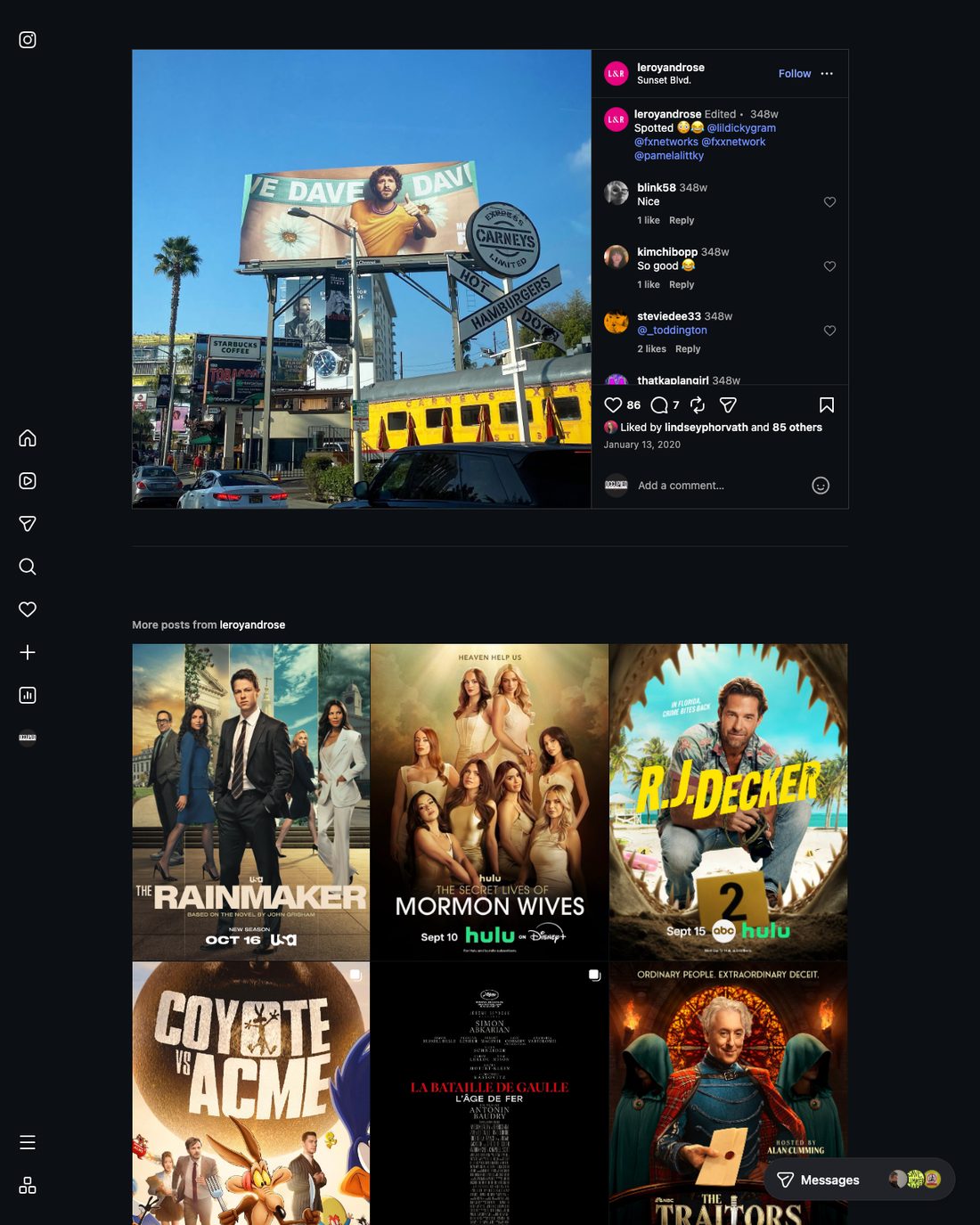
FXX’s Dave, geotagged “Sunset Blvd.” The yellow rail car in the frame is Carney’s, at 8351 Sunset. The plate bolted under the sign reads Clear Channel. “Liked by lindseyphorvath and 85 others.”
Clear Channel gave Horvath nothing, and no signage matter at any 8300-block Sunset address appears anywhere in her record.
All four, in one place
The four agency posts that place a campaign in West Hollywood, and what each one connects to for Horvath: which operator ran the board, whether that operator had funded her, whether the board came before her for a vote, and whether she engaged with the post.
| Date | Campaign | Board | Operator | Funded her | She voted on it | She liked it |
|---|---|---|---|---|---|---|
| 2018-07-09 | Disney Christopher Robin | 8560 Sunset, tall wall | not identified | n/a | No | Yes |
| 2020-01-13 | FXX Dave | ~8351 Sunset, at Carney’s | Clear Channel | No | No | Yes |
| 2021-01-02 | HBO Tiger | 9000 Sunset, tower wrap | not identified | n/a | No | Yes |
| 2022-02-04 | Hulu Pam & Tommy | 8901 Sunset, façade panels | building’s billboard is Orange Barrel Media | Yes | Seconded the billboard, not the panels | Yes |
9157 Sunset. The one she photographed herself.
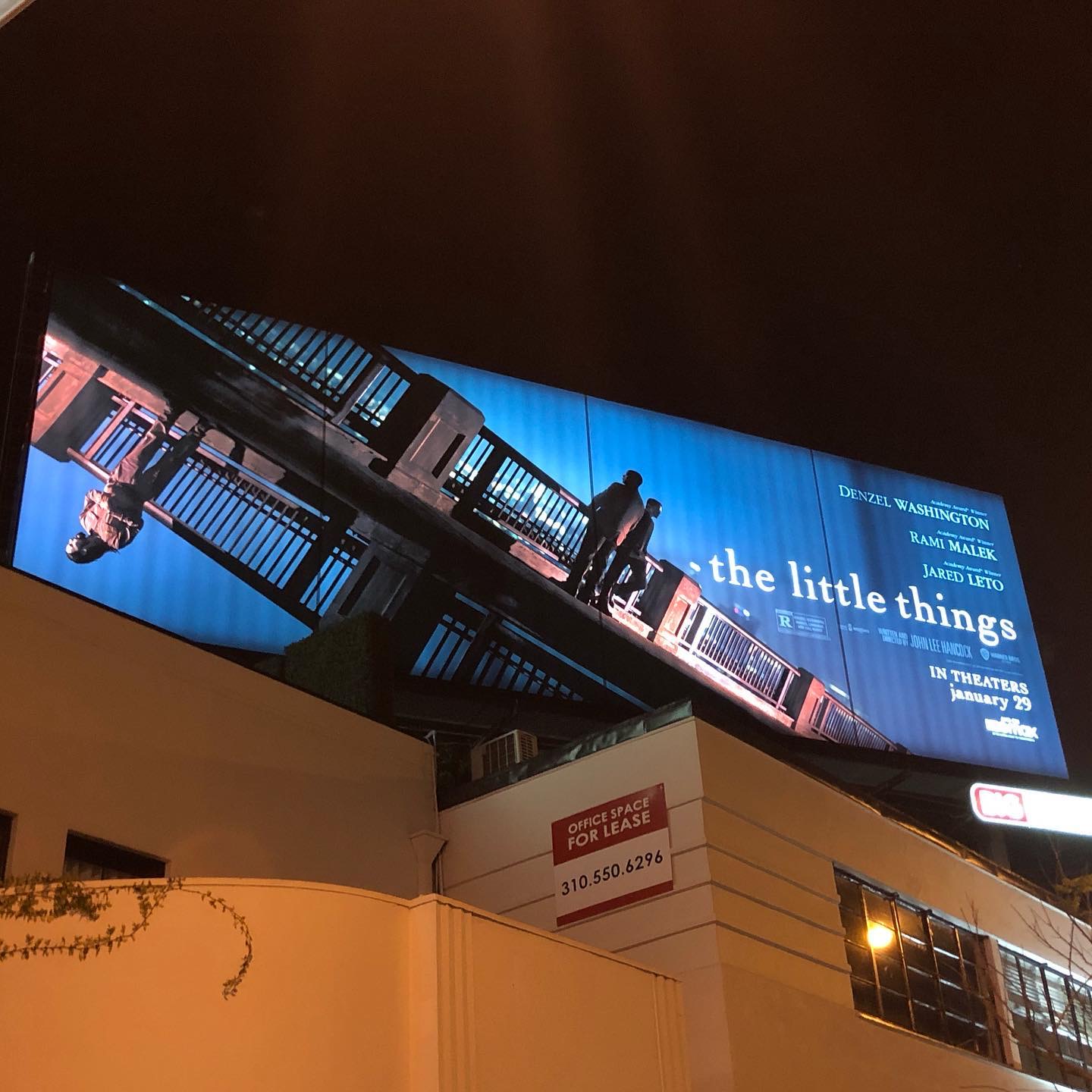
On January 1, 2021, on her own account, Horvath posted a photograph of a roof-mounted billboard carrying Warner Bros’ The Little Things, in theaters January 29. Her caption: “Love starting the new year seeing the amazing creative of @leroyandrose on the #SunsetStrip in #WeHo With gratitude to @wbpictures for the opportunity.” She tagged Warner Bros, Warner Bros Entertainment, Leroy & Rose and HBO Max.
The board is 9157 Sunset Boulevard. A commercial listing for the building shows the same roof structure, and Street View six weeks later shows the same sign carrying Warner Bros’ Tom & Jerry. The illuminated red sign blown out at the lower right of her night photograph is legible in daylight: it reads BIG OUTDOOR, the sign’s operator.
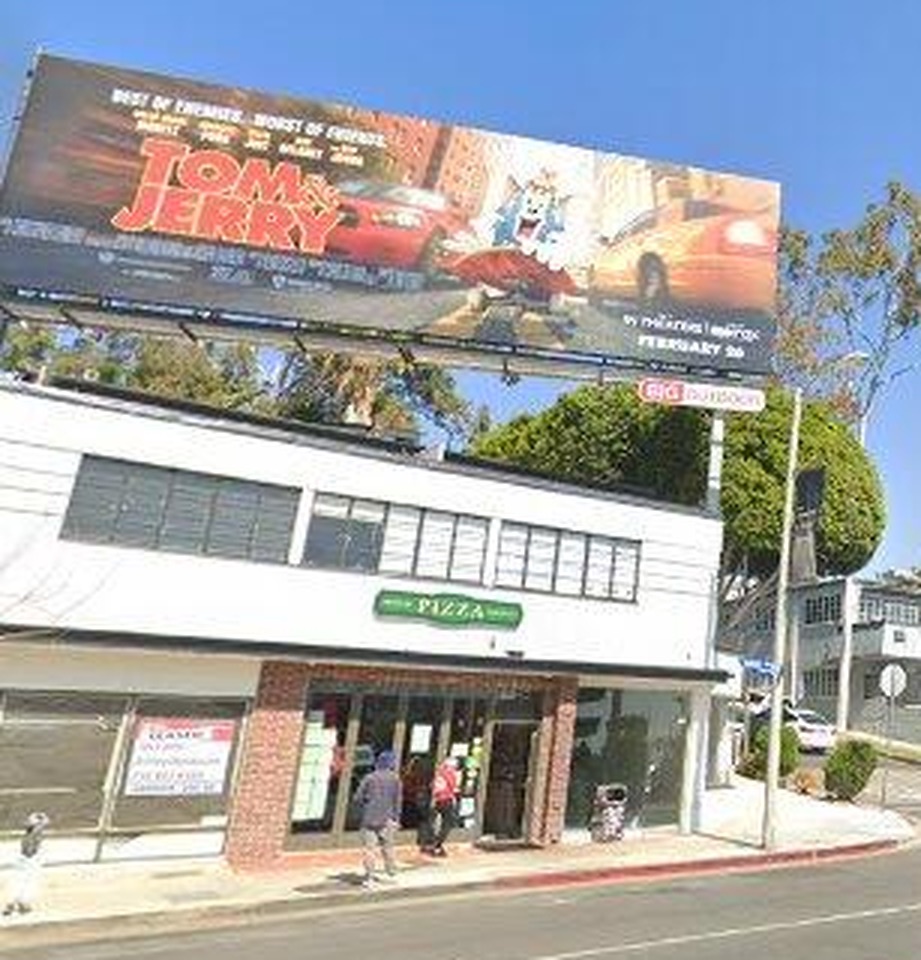
On July 19, 2021, six and a half months later, she sat as Mayor and opened the public hearing on the request to convert that sign to digital.
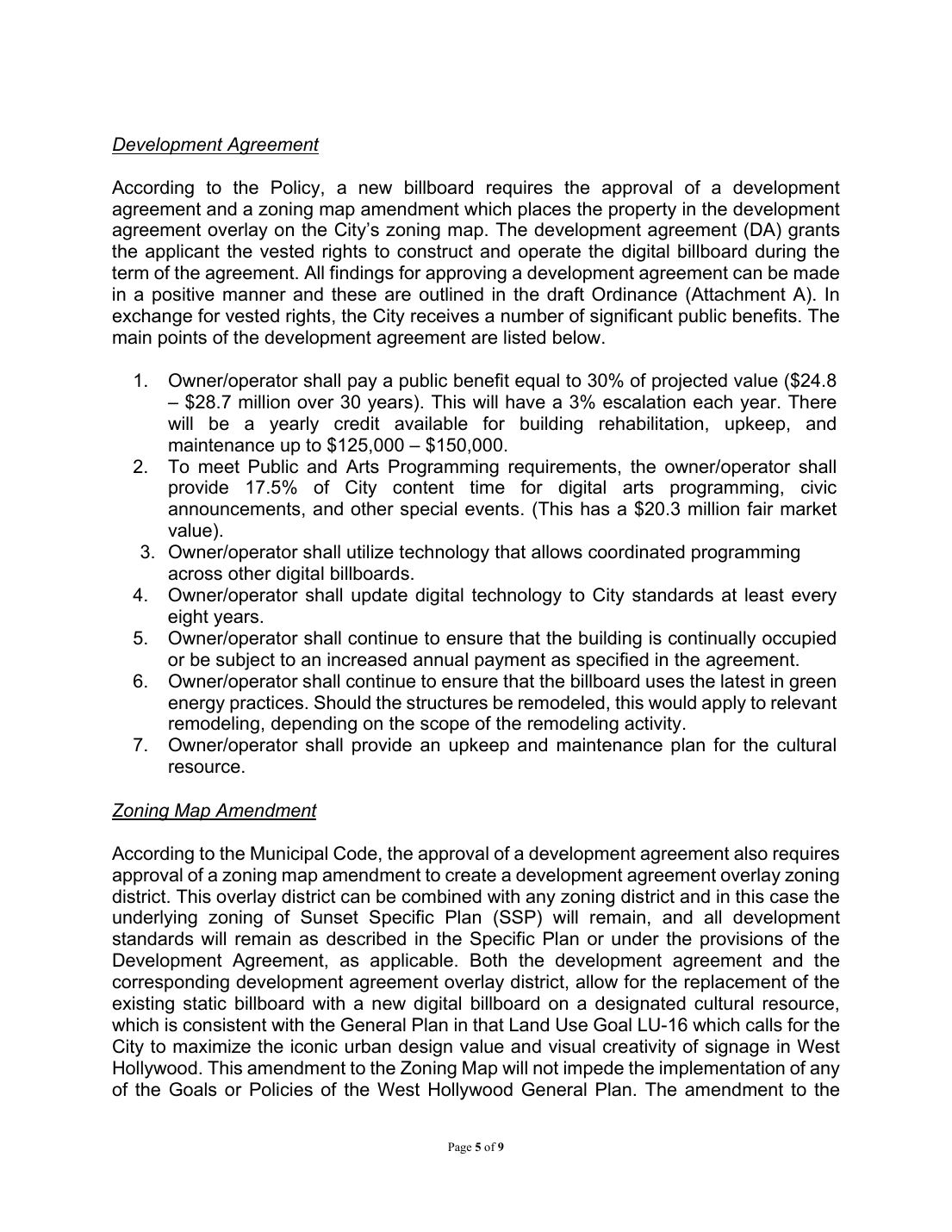
It is worth being exact about what that conversion is, because it is the whole point of the item. A static billboard carries one advertisement at a time. A digital one rotates, selling the same face to advertiser after advertiser through the day. Converting a board from static to digital is the single change that most increases what it earns and how many campaigns can run on it. And the City priced it. The public benefit below is set at 30% of the sign’s projected value, which puts that projected value, on the City’s own arithmetic, at roughly $83 million to $96 million over the life of the agreement.
 12
12
- 1the public benefit
- 2the figure
The development agreement obliged the owner to pay a public benefit equal to 30% of projected value, $24.8 million to $28.7 million over thirty years, escalating 3% a year, alongside an arts-programming obligation the City valued at $20.3 million. It carried, with a zoning map amendment, a sign permit and a certificate of appropriateness.
She voted aye. The vote is not in the minutes, which record only “Motion by Mayor Pro Tempore Meister, seconded by Councilmember D’Amico, and approved.” It is on the tape. At 01:49:12 the clerk reads the roll: D’Amico yes, Erickson yes, Shyne yes, Meister yes, and Mayor Horvath, “aye.” Five to nothing. No recusal. No disclosure of a financial interest.
What this does not establish. No FPPC determination exists, here or anywhere in this file. Nothing connects the January post to the July hearing beyond sequence, proximity, and her role in both, and we assert no exchange. That the creative is her agency’s work is her own account of it, given publicly with the studio tagged, and we report it as she gave it. On the governing test, see Section Six: the question is not whether the agency owns the sign, which it does not, but whether the decision aided a purpose of the agency for which she was paid.
Six · The governing test, and the limits of this record
The standard
The economic interest is not in dispute. Leroy & Rose paid Horvath’s sole proprietorship between $10,001 and $100,000 in each of seven consecutive years, on her own sworn Form 700s. A source of income of $500 or more in twelve months is an economic interest under section 87103(c).
The materiality standard for such a source is Regulation 18702.3(b), the nexus test, set out by the FPPC in its December 8, 2025 advice letter to Santa Monica, A-25-153:
“Any reasonably foreseeable financial effect on a source of income to a public official or the official’s spouse is material if the decision will achieve, defeat, aid, or hinder a purpose or goal of the source and the official or the official’s spouse receives or is promised the income for achieving the purpose or goal.”
There is no dollar threshold and no requirement that the source be a party. The question is whether the decision touches the purpose the official is paid to serve.
Applied here. Leroy & Rose is an out-of-home entertainment advertising agency: its product is the creative that occupies billboards, and it markets itself on where that creative appears. A decision that creates a billboard, enlarges one, or converts a static face to digital on the Sunset Strip expands and improves the inventory that work runs on. She is paid by that agency for creative advertising and marketing strategy; her own Form 700 describes the business that way. Before it she was Vice President, Theatrical Print at two agencies, which is the out-of-home discipline itself.
Asking who owns the sign, or who is a party to the approval, is the wrong test for an official whose economic interest is a source of income rather than a party. The nexus test above is the one that governs.
The Santa Monica comparison
The FPPC found Councilmember Jesse Zwick disqualified from housing decisions because his employer’s goals intersected them, despite safeguards this record does not contain: fixed salary with no bonus or commission, an agreement to do no work in or related to Santa Monica, and an employer that had carved the City out of his portfolio and stopped advocating there before he started. Here there is no documented carve-out, no evidence the agency excluded West Hollywood from its work, and the agency’s creative was physically on a Sunset Strip board that came before her, 9157 Sunset.
How the test was applied to all 78 items
The two prongs were scored separately. Prong two asks who was paying Horvath on the date of the vote. Prong one asks what the item did.
- Prong two, elected term: satisfied from her own filings. Leroy & Rose is a source of income on seven consecutive sworn Form 700s.
- Prong two, appointed term: inferred, not filed. We hold no Form 700s for 2009 to 2011. Her employment at Canyon Design Group and then Cold Open is documented by her federal campaign filings and her own profile, but the reportable-source element is inference. Every first-term item is marked that way and carried at lower weight.
- Prong one: classified by what the Council decided. Items that create, convert, extend or permit a specific sign; items that set city-wide rules for off-site signage; items governing what runs on City-owned faces; items where signage is one component of a larger project; the City’s own contracts and fees; and procedural matters. Ordinance second readings are sorted by whether they attach to a specific sign address or to none, which is readable from the record.
| Nexus test, Regulation 18702.3(b) | Appointed 2009–2011 | Elected 2015–2022 | Total |
|---|---|---|---|
| Signage items she sat on | 19 | 59 | 78 |
| Both prongs met on our reading | 11 | 48 | 59 |
| Arguable, signage incidental to a larger project | 5 | 0 | 5 |
| Weak, administrative or procedural | 2 | 9 | 11 |
| Absent, did not participate | 1 | 2 | 3 |
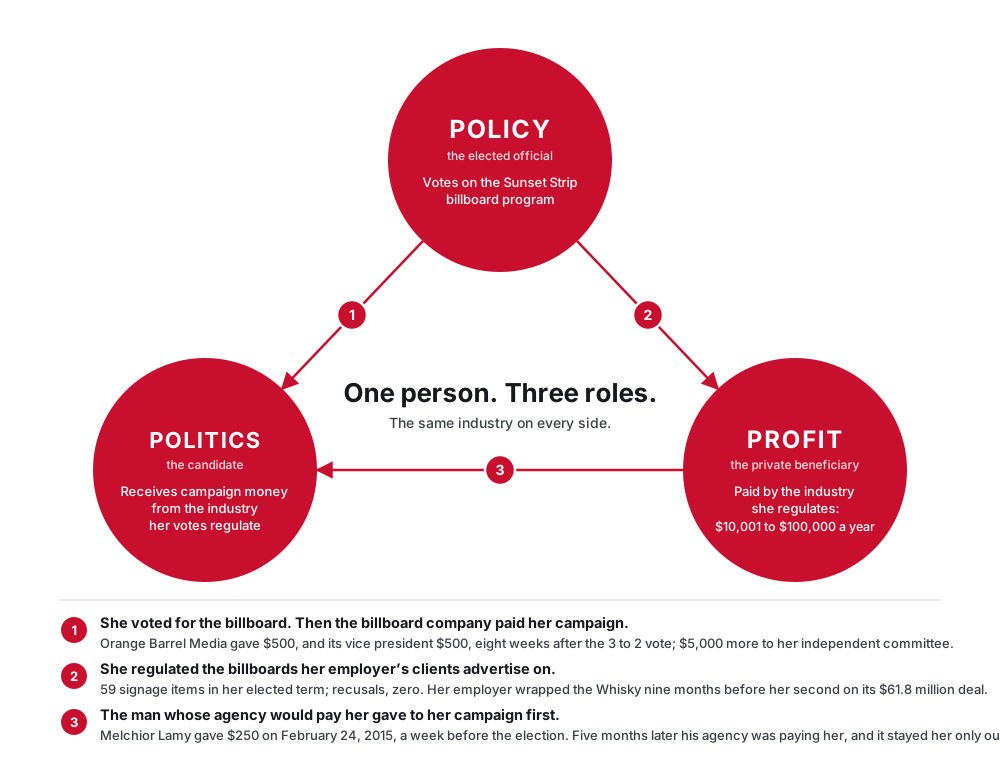
| Recused, or disclosed a conflict | 0 | 0 | 0 |
Results
Forty-eight of the fifty-nine signage items of Horvath’s elected term satisfy both prongs on our reading. They span eleven distinct addresses. She presided over eighteen as Mayor. Twenty-two passed on the consent calendar in a single unread block. Sixteen touched an operator that had given money to her campaigns. She recused from none, and the minutes record no conflict disclosure by her on any of the seventy-eight.
The first term is weaker. Eleven of its nineteen items meet prong one comfortably, including the 9015 Sunset billboard permit appeal she seconded. Prong two there rests on inference about income we cannot show was reported, because the filings that would show it are gone.
Limits of the scoring
- Prong one is scored on what each decision did, from the agenda title and the staff description. It is not scored on proof that Leroy & Rose had artwork on that sign at that time. One placement is documented so far, 9157 Sunset, which Horvath photographed and then voted on six months later. We have not run an exhaustive search and do not present this as a complete count. For the rest we found no placement in the material we examined, which is not the same as there having been none.
- A defender would answer that a city-wide signage rule does not aid one agency in particular. A-25-153 is why we think that answer fails: the FPPC found a disqualifying nexus there even though the employer had agreed to do no work in the city at all.
- This is a reading of the standard, not a determination. The FPPC decides conflicts and has made no finding here. A-25-153 was prospective only: it required future recusal and made no finding about past votes or past disclosure.
What the minutes do and do not record
- They are summary minutes. Across all 5,393 items from 2015 to 2022 there is one numeric vote tally, on a procedural motion to table in August 2019. The City began publishing tallies later.
- So there is no ballot-by-ballot record. Where a table says “seated” it means Horvath was a serving member on the item, not that a clerk wrote down her vote.
- Dissent, however, is recorded without fail. The minutes name every no vote, abstention and recusal, by member and by item, including inside a consent calendar. Where she is recorded present, the item is recorded approved, and no no vote, abstention or recusal is written against her name, she voted for it. That is a derivation from the clerk’s own convention, marked “derived” wherever used. Where any condition fails the item stays undetermined; eighteen do.
- The asymmetry runs one way. An ordinary aye on a consent calendar leaves no individual trace. A recusal does: section 87105 requires an official with a conflict to state it publicly, so the clerk writes it as narrative. That is why the February 2018 abstention is visible at all.
The video check
Granicus publishes machine transcripts of West Hollywood meetings, and we pulled them for the billboard votes. They are uneven: one meeting has no transcript, one publishes a transcript that does not cover the item, and several are too garbled to read a vote from. Of the eight billboard items, two carry a vote verifiable from the recording: the November 2018 motion, where the chair announces the 3-2, and the July 2021 roll call at 9157 Sunset, read line by line.
A first automated pass through those transcripts produced four apparent votes, and three were wrong: a consent calendar, an applicant quoting the Planning Commission, and staff describing a Planning Commission vote in which a commissioner recused. None involved the Council or Horvath. Each was caught by hand. Any of the three would have been a printed error.
Seven · Chronology, 2008 to 2026
Here is the sequence, with no inference attached to it.
| Date | Event |
|---|---|
| 2007-07 | Horvath becomes Vice President, Theatrical Print at bpg. Theatrical print is the out-of-home discipline. |
| 2008-06 | Melchior Lamy becomes Creative Director at Cold Open, Venice. |
| 2008-09 | She takes the same title, Vice President, Theatrical Print, at Canyon Design Group. |
| 2009-05-06 | Horvath is appointed to fill a West Hollywood City Council vacancy. |
| 2009-07-20 | She seconds the motion to erect a 6,500 square foot tall wall billboard at 9000 Sunset Boulevard, and seconds the amended motion. |
| 2009-09 | She joins Cold Open as a Senior Account Executive, four months after being appointed, while sitting on the Council. Lamy is its creative director. |
| 2010-02-01 | The Council approves Billboard Permit 2009-004 at 9015 Sunset Boulevard, unanimously. The roll call records her present. |
| 2011-03-08 | She loses the election, finishing fifth of ten for three seats, 502 votes behind the third seat, and leaves the Council. |
| 2012-05-16 | Leroy & Rose Inc. is incorporated in Georgia. Its sole officer, as secretary, chief executive and chief financial officer, is Melchior Lamy. The company has no Georgia address of its own: its principal office is in Santa Monica and its registered agent is a commercial service. |
| 2012-06 | Lamy leaves Cold Open, one month after incorporating Leroy and Rose Inc. |
| 2012 to 2015 | The company is dormant on the record. Its web domain is a placeholder. It does not register to do business in California. |
| 2013-03-05 | West Hollywood elects two councilmembers. Horvath is not a candidate. Leroy & Rose files no annual registration for 2013 at all. |
| 2013-10 | Horvath leaves Cold Open. |
| 2014-10-23 | Horvath files her candidate intention statement for the 2015 election. |
| 2014-11-21 | The dormancy ends. Leroy & Rose files its first annual registration, twenty-nine days after she filed her candidate intention statement, and two and a half years after the company was formed. |
| 2015-02-24 | Melchior Lamy gives $250 to her campaign, declaring his employer as Leroy and Rose. |
| 2015-03-01 | The website is still the placeholder, byte for byte the file it had been since January 2014. |
| 2015-03-03 | Horvath is elected to the West Hollywood City Council, third of twelve candidates for three seats. The certified canvass: D’Amico 2,312, Meister 2,138, Horvath 2,135, Heilman 2,066. Sixty-nine votes separate her from the man who had held a seat since the City was created in 1984, and who had voted to appoint her in 2009. He returns in June by winning the special election for Jeff Prang’s vacated seat. |
| 2015-03-10 | Leroy & Rose’s Los Angeles agency website goes live, seven days after she wins. |
| 2015-04-30 | Horvath is sworn in as Mayor of West Hollywood. |
| 2015-08-07 | Leroy & Rose registers to do business in California. |
| 2015-08 | Her own profile dates the start of the Leroy & Rose engagement to this month. |
| 2015 | Leroy & Rose becomes the sole reported source of Horvath’s outside income. It remains so through 2022. |
We state the limits of this table as carefully as we state the table. The year the Leroy & Rose engagement began is documented. The month is not established by any public record. Her own LinkedIn profile dates it to August 2015, which would place it after she was sworn in as Mayor on April 30, 2015, but that is her own account of it and not a filing. One document would settle it, and it is the one document we do not have: her 2015 West Hollywood assuming-office statement, which reports the twelve months before she took that seat. It is not online, and we are not pursuing it by records request; the point it would settle is the month, not the fact. (Not to be confused with her 2022 Los Angeles County assuming-office statement, which we do hold and which appears below.)
We also want to be exact about “LPH.” Horvath reported LPH on Schedule A-2 as a sole proprietorship she owned. We have found no registered legal entity of that name in California Secretary of State records or Los Angeles County fictitious business name filings. That is not necessarily a defect. A sole proprietorship does not require registration, and the Political Reform Act’s definition of a business entity expressly includes a proprietorship, so Schedule A-2 was an appropriate place to report it. What the form shows is what we say it shows: she reported a business she owned, and that business had one client.
Eight · Her own public statements about the agency
Horvath did not treat Leroy & Rose as an arm’s-length client. She described herself, publicly and repeatedly, as part of it.
Between 2017 and 2021, from her public Instagram account, while serving as a West Hollywood councilmember and twice as Mayor, she posted the agency’s work at least nine times. The language is consistent, and the pronouns are the point.
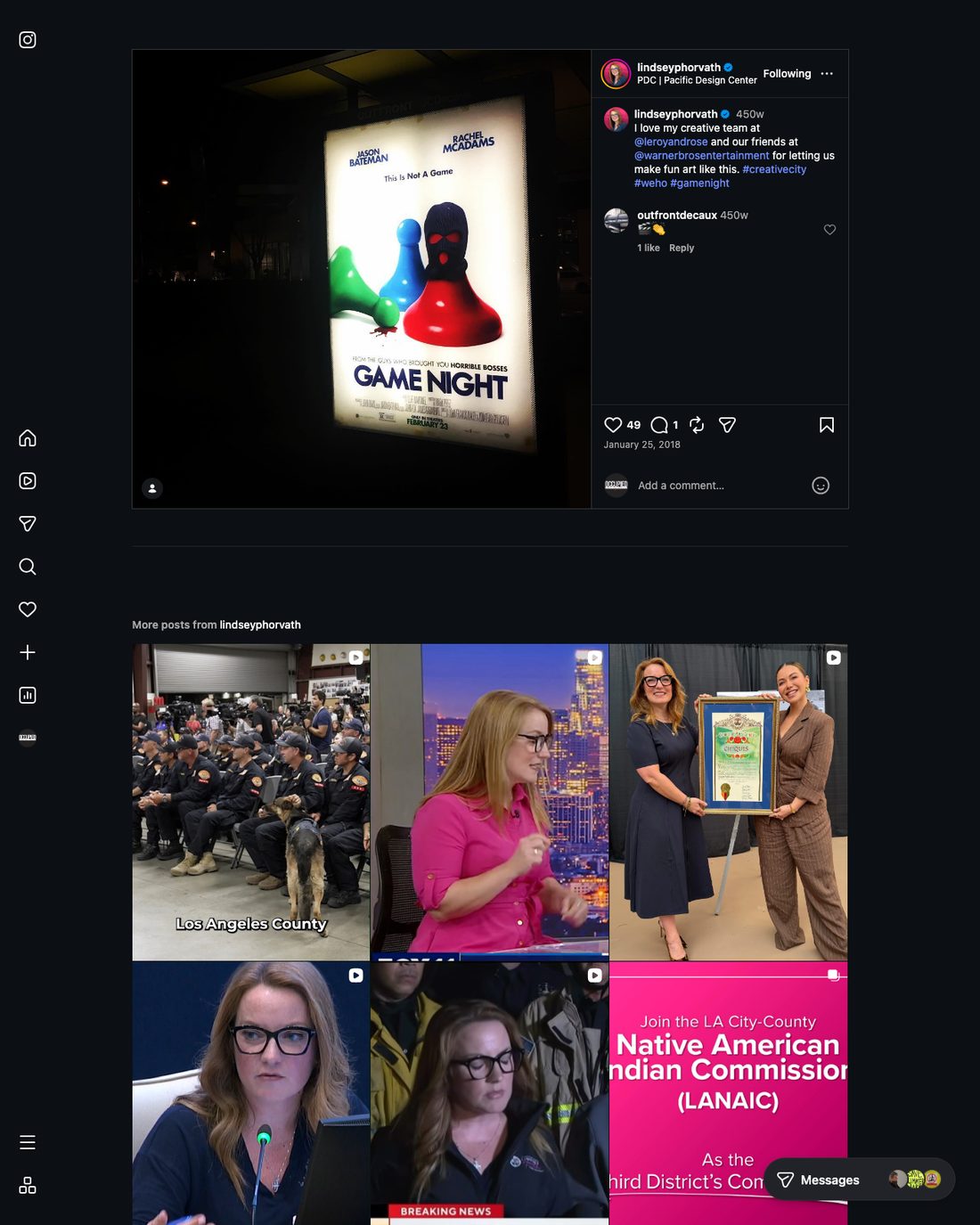
January 2018, geotagged at the Pacific Design Center in West Hollywood: “I love my creative team at @leroyandrose and our friends at @warnerbrosentertainment for letting us make fun art like this.” The billboard operator OUTFRONT/Decaux applauded in the comments.
Not “a client of mine.” My creative team. Our friends. Us.
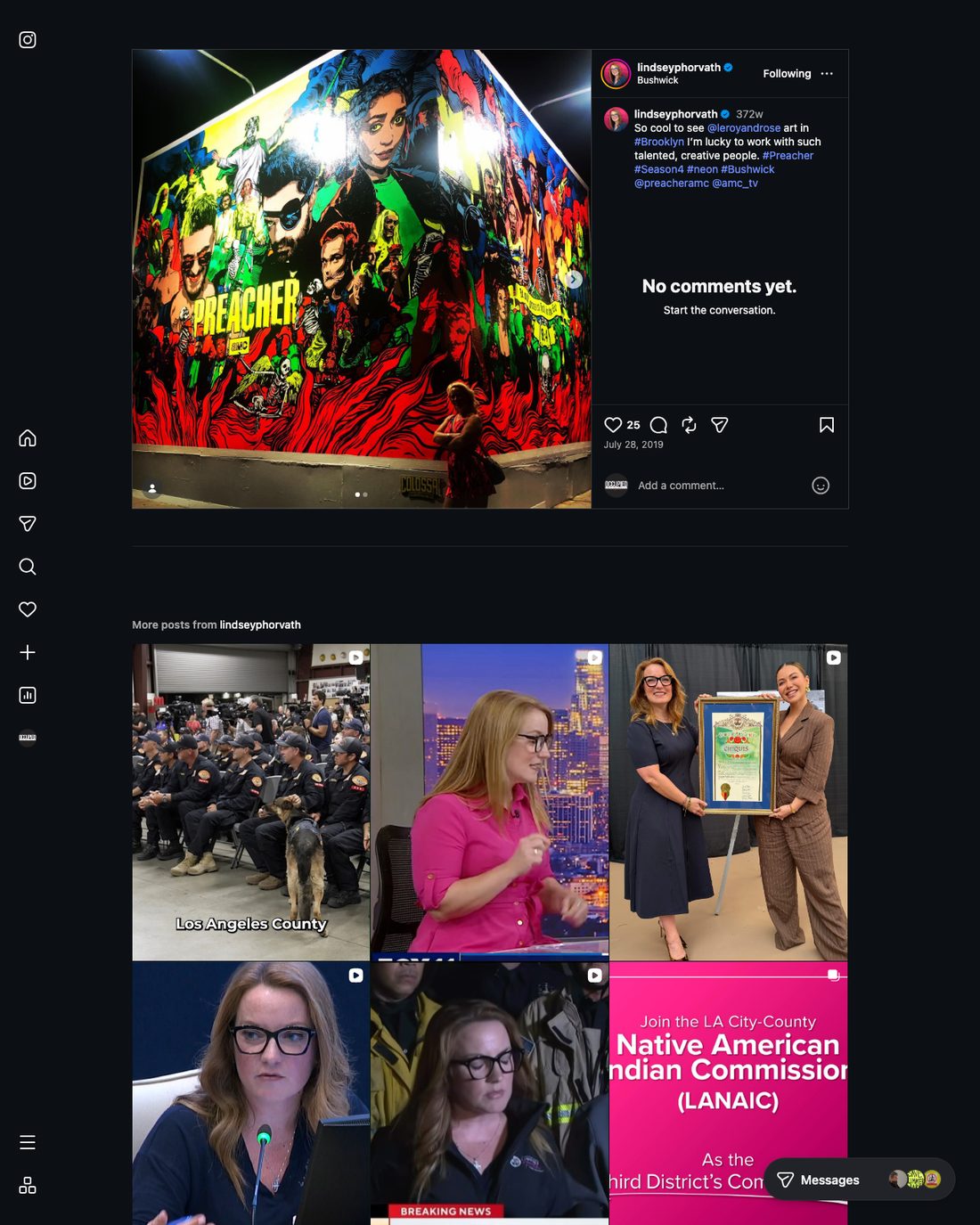
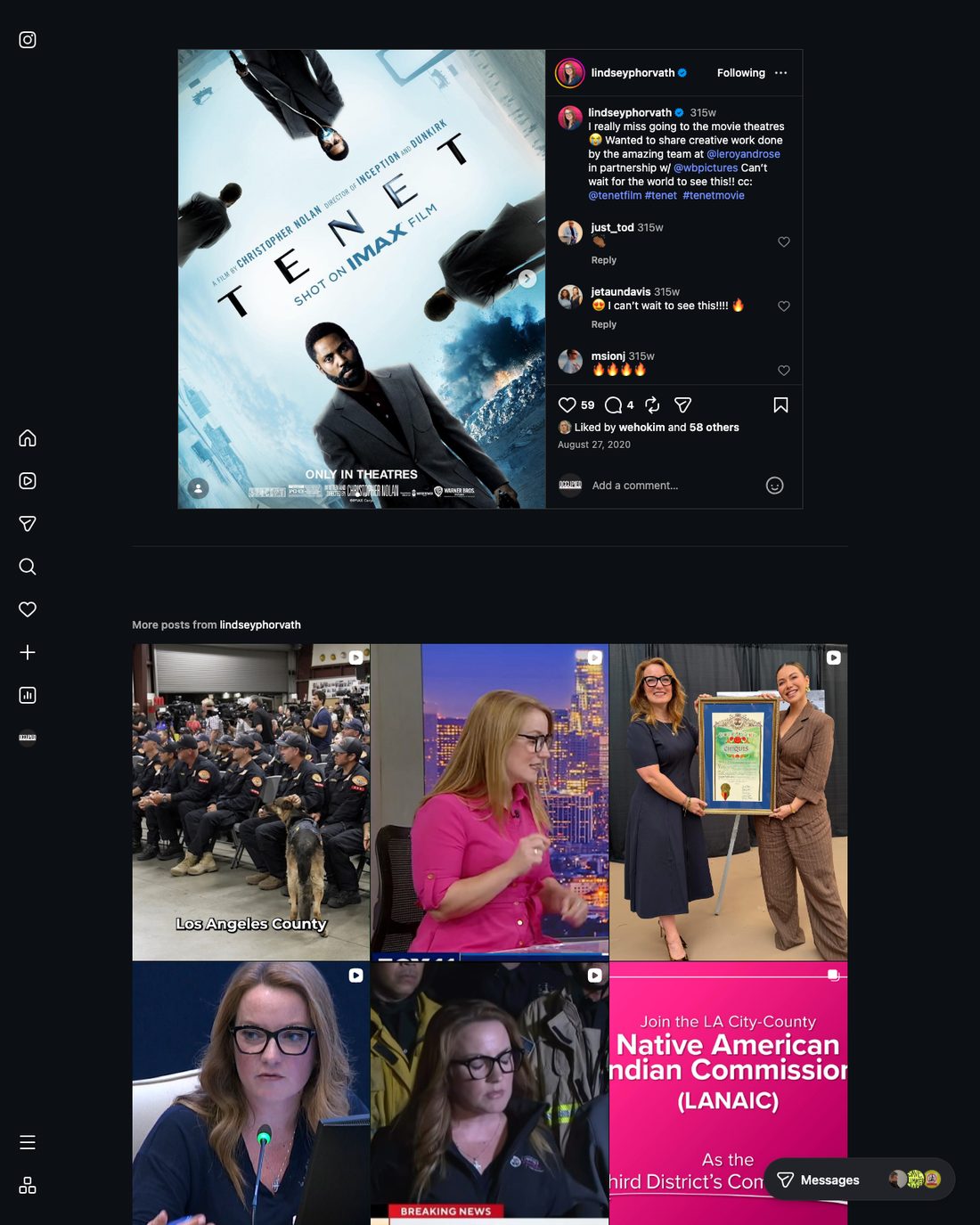
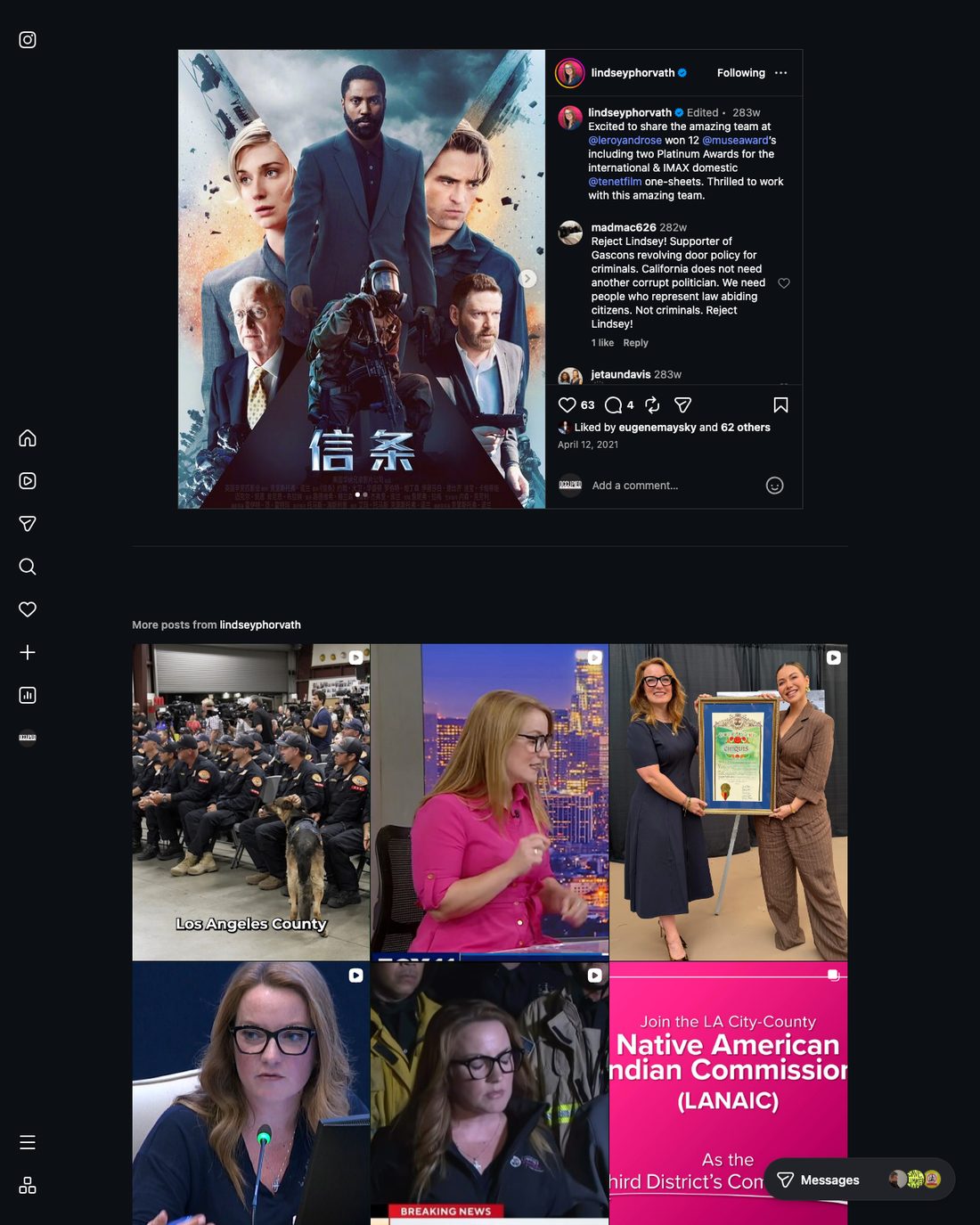
And then the single cleanest artifact in the file.
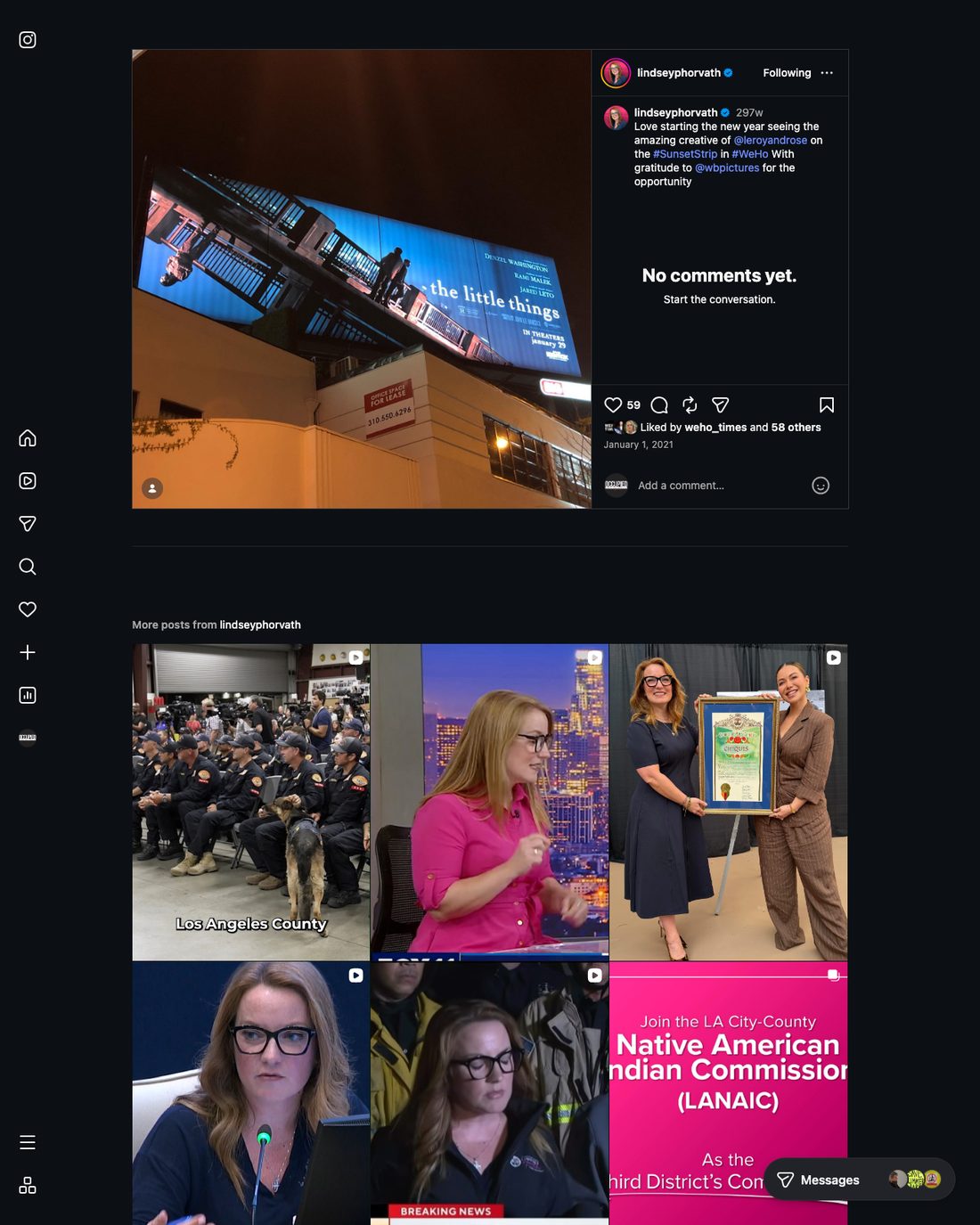
“Love starting the new year seeing the amazing creative of @leroyandrose on the #SunsetStrip in #WeHo. With gratitude to @wbpictures”
A sitting West Hollywood councilmember and former Mayor, celebrating her employer’s advertising, on the Sunset Strip billboard inventory her Council controls, thanking the studio that paid for it, from her own political account. Office, employer, regulated inventory, and studio client, in one post, in her own words.
And in June 2018, midway through her tenure, she posted this from a policy panel:
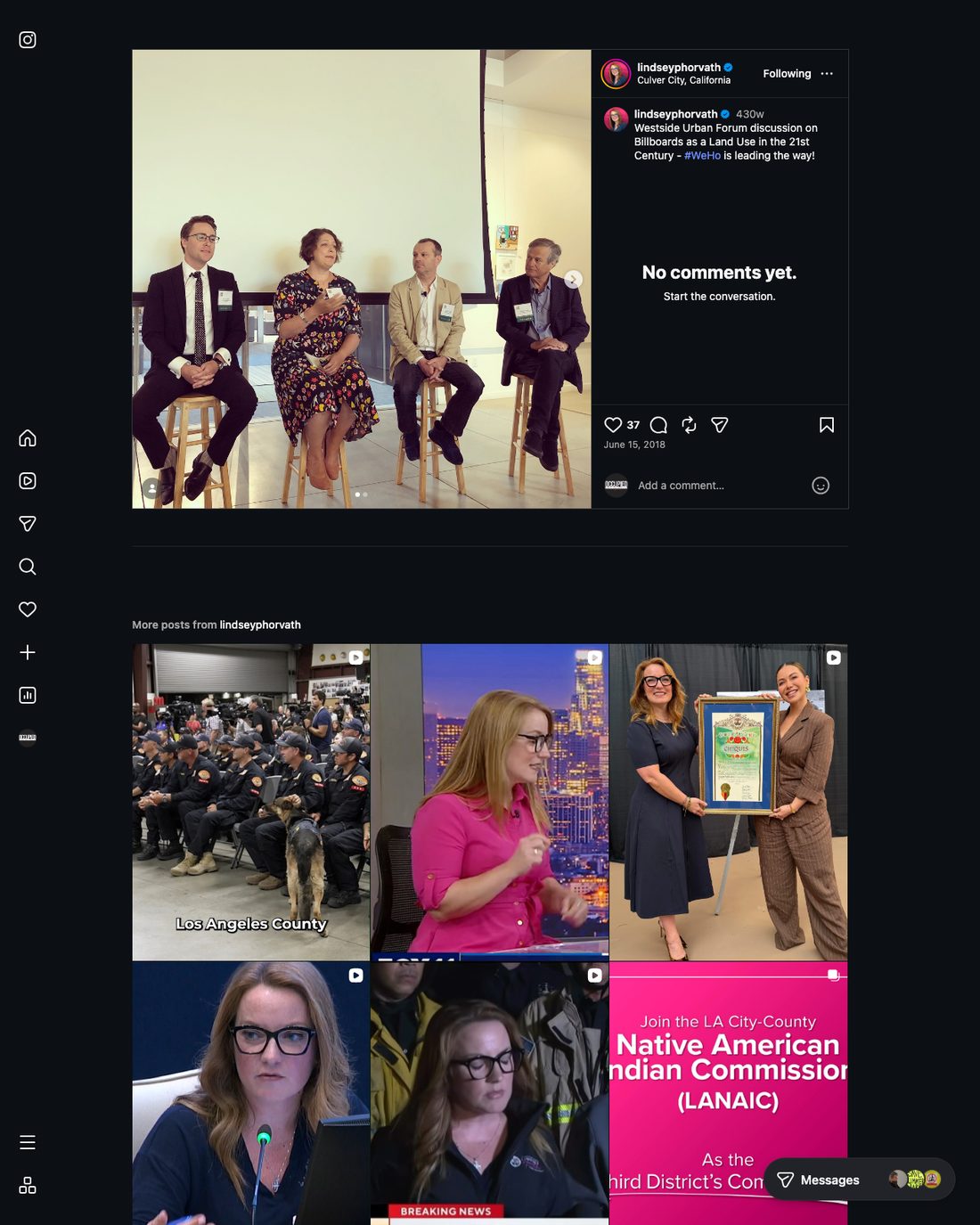
“Westside Urban Forum discussion on Billboards as a Land Use in the 21st Century, #WeHo is leading the way!”
A sitting councilmember on a panel about billboard land-use policy, whose only reported outside income came from a billboard advertising agency.
She also liked Leroy & Rose’s own posts of campaigns physically installed on Sunset Boulevard boards: HBO’s Silicon Valley at Sunset and Havenhurst in October 2019, a corner that may sit just outside the City line, and FXX’s Dave geotagged on Sunset Boulevard in January 2020. Both posts were still live, and still showed her like, when we captured them with content hashes in September 2026.
What the public could actually learn
Horvath did not hide the relationship. She posted it, repeatedly, under her own name. The gap is narrower than concealment and harder to answer.
The disclosure named a firm, not an industry
“LPH · Creative Advertising and Marketing Strategy · Leroy & Rose” satisfies the form and tells a reader nothing. You would have to look up the agency’s portfolio to learn that the advertising was billboards, or that the clients were studios.
The word “billboard” appears once across her more than 3,400 Instagram posts, and it is the 2018 policy panel above, not her job. She never describes her own work anywhere in that archive.
And the biography she controls omits the career entirely. The page the County publishes under her name runs to about 540 words and does not contain the word “advertising,” or “marketing,” or the name of any company that has ever paid her.
So the public knew she worked in advertising. It had no practical way to learn she was paid for seven years by a shop whose business is billboards on the street she regulated.
Nine · Campaign money from outdoor advertising
Three flows are documented in campaign finance filings: from the agency’s owner to Horvath’s campaigns, from the billboard operators whose projects she voted on, and from the parcels those signs stand on.
Her employer’s owner paid into her campaigns for eight years
Leroy & Rose has one officer. Melchior Lamy is its secretary, chief executive and chief financial officer, and, on her own account of the date, the man whose firm engaged her company in August 2015. He also gave money to her campaigns, four times, across three elections and eight years.
| Date | Committee | Amount | Her status that day |
|---|---|---|---|
| 2015-02-24 | Horvath for West Hollywood City Council | $250 | Candidate, out of office, seven days before she won |
| 2019-03-01 | Re-Elect Horvath for West Hollywood City Council | $500 | Sitting councilmember, four days before the election |
| 2022-07-11 | Horvath for Supervisor | $250 | Sitting councilmember |
| 2022-10-10 | Horvath for Supervisor | $250 | Sitting councilmember |
On every one of the four he gave his occupation as Creative Director and his employer as Leroy and Rose. On the last three, Leroy & Rose was simultaneously paying her, between $10,001 and $100,000 a year, on her own sworn Form 700s. The money was running in both directions at the same time.
The first of them matters for a different reason. Her own account dates the engagement to August 2015. But the earliest documented transaction between these two people is his, not hers: $250 on February 24, 2015, a week before she won the seat back, at a moment when the firm’s website was still a blank placeholder carrying nothing but its name. They were not strangers when she was hired. He had already paid into the campaign that put her in office.
There is a further oddity in that filing, and it is about where the company existed. Leroy & Rose is a Georgia corporation with no Georgia office, no Georgia staff and no Georgia work, registered through a commercial agent service. California is where it actually operated. It did not register to do business in California until August 7, 2015. Yet its name appears in a California public filing five and a half months earlier, in February, attached to a person: on the disclosure form for her campaign. The earliest appearance of this company in a California record that we have been able to locate is a contribution to Lindsey Horvath.
Two cautions on that sentence. Earliest located is not earliest existing: we have not searched Los Angeles County fictitious business name filings, which is where an earlier California record would most likely sit. And the Georgia corporate registry names him earlier than any document we have read. Georgia law requires every annual registration to list the chief executive, chief financial officer and secretary, and he is all three, so the registration filed in November 2014 must carry his name. That filing is a paid document we have not ordered. Nobody should say this contribution is the first time Lamy used the name Leroy and Rose. It is the first time we can show him using it in the state where the company did its business.
And the last of them sits very close to a vote. He gave $250 on October 10, 2022. Six weeks later she seconded the motion approving Orange Barrel Media’s billboard at 8901 Sunset, the Whisky a Go Go, the building whose façade had carried her employer’s own Hulu campaign nine months earlier, a post she had liked.
Limits. These are small contributions, and her donor lists carry many people from the entertainment advertising trade. Nothing in them shows an agreement, and none is claimed. No Levine Act violation is alleged: section 84308 reaches contributions from parties and participants in permit proceedings, Leroy & Rose was never an applicant on any of these items, and the law did not extend to local elected officials until January 2023, after all four. What the filings do establish is that the man whose firm paid her had a personal financial stake in her holding the office, sustained across eight years.
And five weeks before the motion, the same company was in the room
Equality California holds an annual awards dinner in Los Angeles, and Horvath went most years: 2015, 2016, 2017, 2018, 2019 and 2021, on the evidence of her own account. Orange Barrel Media sponsored exactly two of those years.
We read the sponsor pages for every one of them. The company does not appear on the 2016, 2017 or 2021 sponsor grids; the 2015 page survives only as a stub without one. It appears in 2018 as a Silver Sponsor, and again in 2019. Then not again until 2024, by which time she had left the Council. Its first appearance as a sponsor of that dinner was on September 29, 2018. Five weeks later she moved the motion awarding it the City’s own billboard. Eight weeks after that, the company and its executive vice president each paid $500 into her committee.
Limits. A Silver sponsorship at this event carries a table, and whose table she sat at on September 29, 2018 is not on the public record. She posted twice from the JW Marriott at L.A. Live that night, once with Estevan Montemayor, then president of LA Pride and later her own chief of staff; nothing is drawn from that either way. On the record is the sequence: a first-ever sponsorship, a motion five weeks later, and a payment eight weeks after that.
The other two flows
The outdoor advertising industry funded the independent committee backing Horvath’s re-election. There was more than one such committee in 2019, which matters because the money divides between them. The larger one, “West Hollywood United to Support Lindsey Horvath and John D’Amico for Council 2019,” took roughly $40,000 to $50,000 from outdoor advertising and billboard interests: Orange Barrel Media, Ace Outdoor, Big Outdoor, E.T. Legg & Associates, the entities holding the 9040 Sunset and 8850 Sunset billboard sites, and Daniel and Simon Mani of Mani Brothers, who hold 9200 Sunset. A second committee, “West Hollywood Alliance for Continued Progress Supporting John D’Amico, Lindsey Horvath, and Lauren Meister for City Council 2019,” is where Porter24’s $9,500 went. The largest billboard contribution in this record sits in that second committee, not the first.
Whose boards she was voting on
West Hollywood’s resolutions name the party that filed each billboard application, in a single recited sentence. We pulled the agenda packets and read them. Five of the projects Horvath participated in were brought by companies that had funded her.
| Board | Filed by | What they gave her | What she did |
|---|---|---|---|
| 8775 Sunset 2018-11-05 | Orange Barrel Media | $500 + VP $500 to her committee; $5,000 to her IE | Made the motion |
| 9157 Sunset 2021-07-19 | Big Outdoor | $10,000 to her IE (two entities) | Mayor; opened the hearing |
| 9165-69 Sunset 2021-12-06 | Orange Barrel Media | as above | Disclosed meeting the applicant’s representative. Not her income. |
| 8901 Sunset 2022-11-21 | Orange Barrel Media | as above | Seconded; $61.8M agreement |
| 8730 Sunset 2022-06-27 | Porter24 | $500 to her committee; $500 from its registered agent’s household; $9,500 and $1,000 to an independent committee supporting her | Seconded, over a colleague’s motion to continue |
| 8440 Sunset Mondrian tall wall | owner Wolverines Owner, LLC | no contribution found | Participated 2016, 2017, 2019 |
Three Orange Barrel Media projects, one Big Outdoor project and one Porter24 project. In eight years she recused from none of them and disclosed a financial interest in none of them.
Orange Barrel Media, after Horvath’s motion
Orange Barrel Media, after Horvath’s motion. Horvath moved approval of Orange Barrel Media’s 8775 Sunset billboard on November 5, 2018. On December 31, 2018, eight weeks later, Orange Barrel Media LLC gave $500 and its executive vice president Danielle Williamson gave $500 to “Re-Elect Lindsey Horvath for WeHo City Council 2019.” In January 2019 Orange Barrel Media gave $5,000 to an independent committee supporting her.
Big Outdoor, at 9157 Sunset
Big Outdoor, at 9157 Sunset. The board Horvath photographed on New Year’s Day 2021 is a Big Outdoor board; its plate is legible in daylight in Section Five. Big Outdoor gave $10,000, through two entities, to the independent committee backing her 2019 re-election. On July 19, 2021 she sat as Mayor and opened the hearing that converted that board to digital. She recused from nothing and disclosed no financial interest.
Porter24, the closest vote
The Porter24 case is the one where the money is largest and the vote is closest to a contested one. Porter24 gave $500 directly to Horvath’s own committee in February 2019, a further $500 came the same day from the household of the man listed as its registered agent, and the company gave $9,500 to an independent committee named for her three weeks later, with $1,000 more the following year. That $9,500 is the largest single contribution from any billboard interest in this file, larger than Orange Barrel Media’s $5,000.
In June 2022 its application came to the Council and the Council did not like it. The Mayor Pro Tempore called the public benefit too low. Another member said the design was not extraordinary and the benefits were not adequate, and moved to continue the item. The Mayor wanted the benefit increased. Horvath said she liked the design. When a colleague moved to approve instead of continuing, she seconded it, and it carried.
And one more operator
On March 5, 2019, “OutFront” gave $500 to “Re-Elect Lindsey Horvath for WeHo City Council 2019.” Her own committee, not the independent one.
Seven months later her employer posted this:
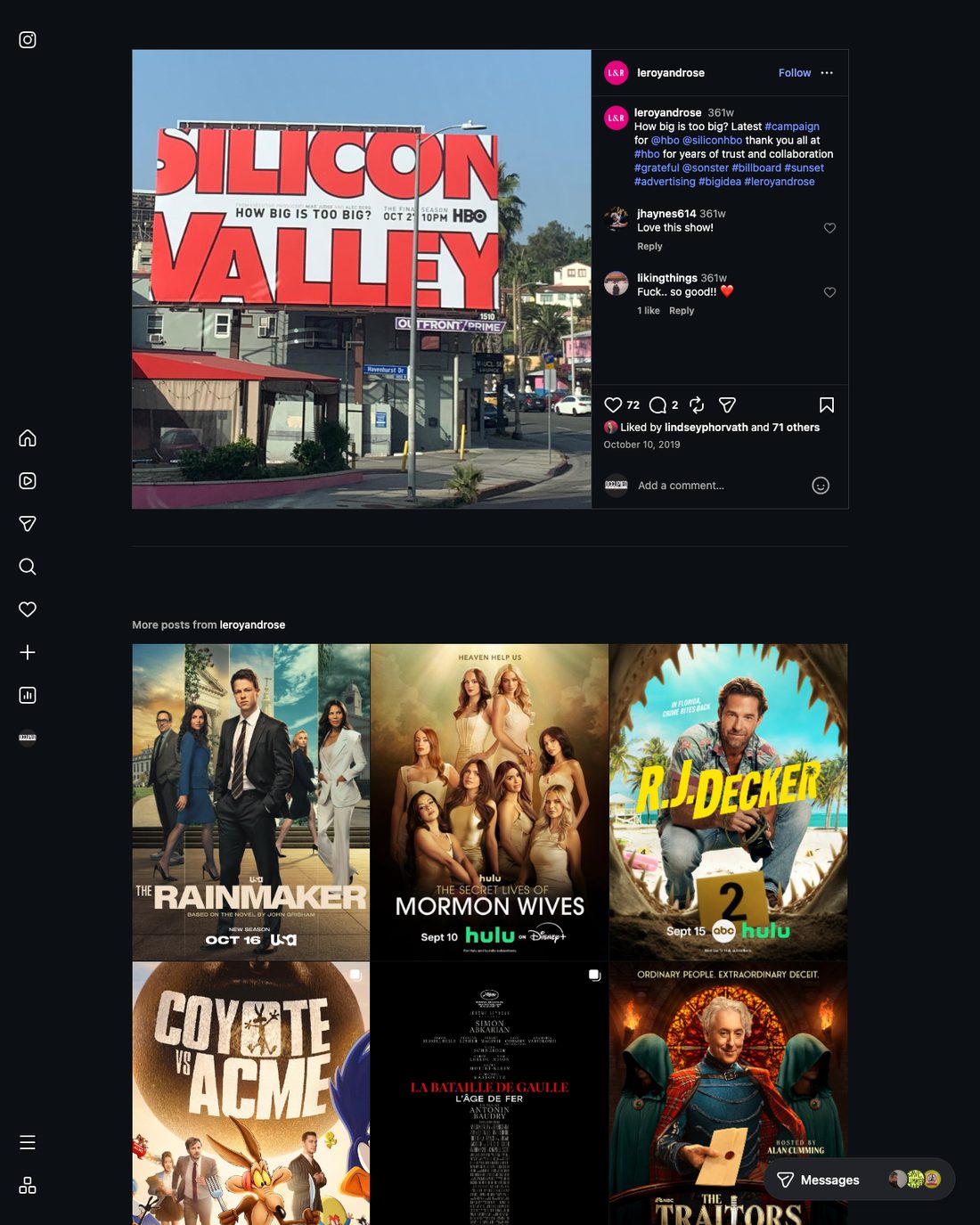
HBO’s Silicon Valley. Read the plate bolted beneath the board: OUTFRONT / PRIME, panel 1510, with the Havenhurst Drive street sign in the frame. “Liked by lindseyphorvath and 71 others.”
A billboard operator paid her committee, and seven months later her employer’s client art was on that operator’s board, and she engaged with it publicly. We found no vote by her on that board. No signage item at Havenhurst appears anywhere in her record, and the City’s own minutes describe Havenhurst Drive as running “at the City boundary,” so that board may sit outside West Hollywood altogether. Until someone establishes which side of the line it is on, no conclusion should be drawn from the absence of a vote.
Limits
These are reported contributions, disclosed as the law requires, and they were lawful when made: the 2018 and 2019 payments predate SB 1439, which extended the Levine Act’s pay-to-play rules to local officials in 2023. No exchange is alleged and nothing in the public record establishes one.
And the owner of 9157
The development agreement at 9157 Sunset was made with Sunset Place Building, LLC. Its registered agent, at the company’s own principal address in Beverly Hills, is Bijan Chadorchi.
On December 18, 2018, Bijan C Chadorchi gave $500 to “Re-Elect Lindsey Horvath for WeHo City Council 2019,” giving his occupation as “Real Estate.” Two and a half years later she sat as Mayor and opened the hearing that granted his company an agreement carrying $24.8 to $28.7 million in public benefit.
Three limits. He is documented as the company’s registered agent at its principal address, which is strong evidence he is a principal but is not the same as establishing ownership; the Statement of Information would settle it and we have not ordered it. The contribution is from December 2018 and predates SB 1439, so it was lawful when made and the Levine Act framing does not reach it, exactly as with the other 2018 and 2019 money in this section. And $500, two and a half years earlier, is not a quid pro quo and we do not suggest one. What is documented is that the owner’s principal was a donor, and that she chaired the hearing without disclosing or recusing.
And the parcels themselves
The operators are one layer. Underneath them are the properties. West Hollywood’s own 2019 off-site sign inventory lists 92 signs across 50 addresses. We ran all 50 against the City’s campaign finance record, counting only contributions where the street number appears in the donor’s own name, and de-duplicating on content rather than on transaction id.
Five of the fifty sign parcels are political donors: 22 contributions totaling $20,016.
| Parcel | Signs on it | Contributions | Total |
|---|---|---|---|
| 8850 Sunset | Billboard 20 | 4 | $11,160 |
| 8228 Sunset | Tall wall 62 | 7 | $3,375 |
| 8240 Sunset | Tall wall 61 | 7 | $2,231 |
| 8335 Sunset | Billboards 55E and 55W | 3 | $2,000 |
| 8420 Sunset | Billboards 46, 47E, 47W | 1 | $1,250 |
The recipients span Heilman, Duran, Horvath, D’Amico by way of the independent committee, Byers, Oliver and the Chamber’s political action committee. Horvath took $250 from 8228 Associates and $250 from 8240 Sunset Associates on the same day, August 8, 2019, both of them tall wall parcels. The independent committee supporting her took $6,160 from 8850 Sunset, LLC.
This is a floor, not a total. Only five parcels give under a name containing their own street number; the other forty five give, if they give at all, under owner or operator names we have not yet traced. And a contribution is not a vote: nothing here shows any of these parcels had business before her. What it shows is the shape of the thing. Fifty sign parcels on one boulevard, five of them funding the council, alongside the operators who also fund it, in a city where every one of those signs needs a discretionary approval.
Ten · The March 2021 conflict-of-interest amendments
On March 15, 2021, with Horvath serving as Mayor, the Council took up Item 5.E, updates to West Hollywood’s Code of Conduct for Elected and Appointed Officials. The item was split into two motions. The first, on gender-neutral pronouns, nonprofit board service, and Brown Act social media rules, passed without objection.
The second motion was the one on conflicts of interest.
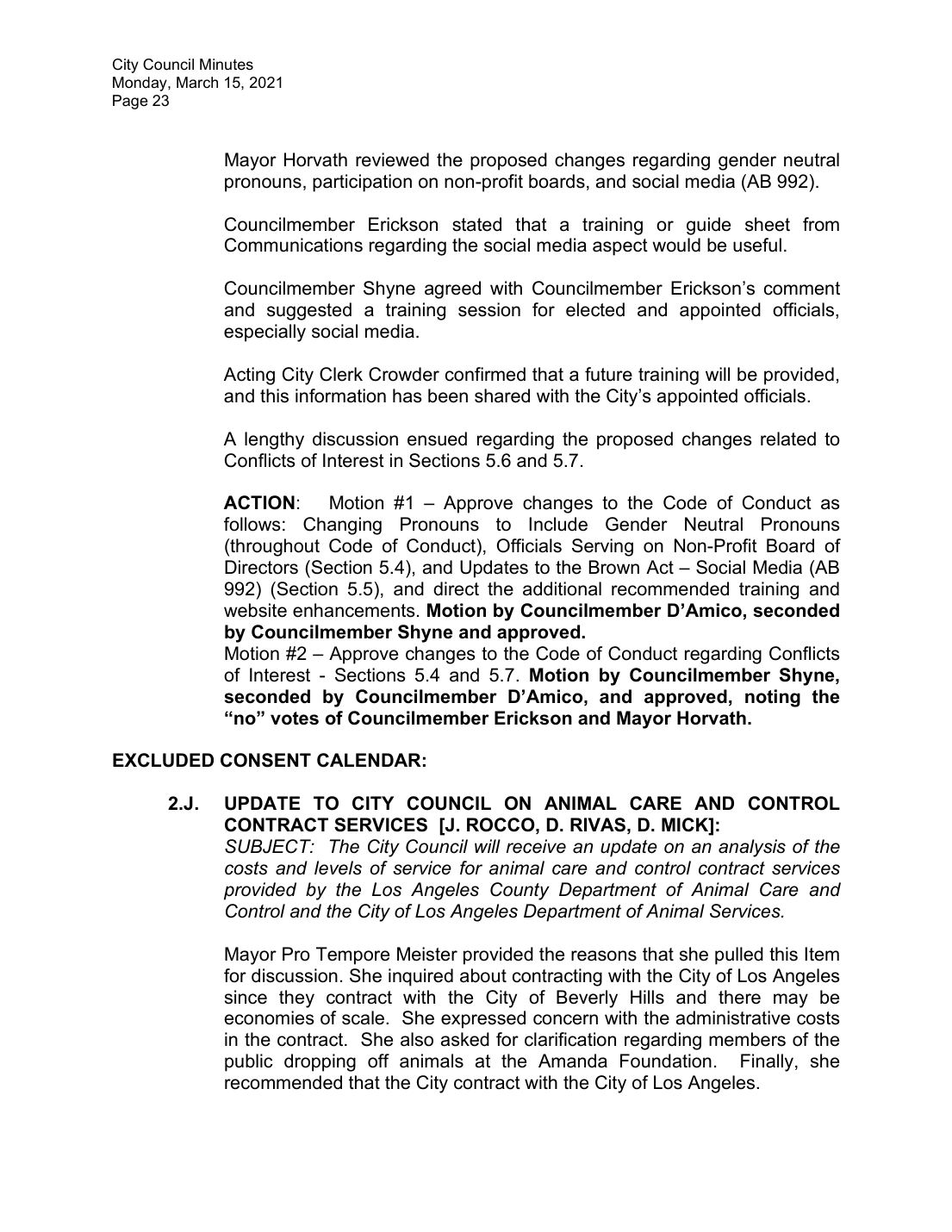 12
12
- 1The conflict-of-interest rules.
- 2She voted against them.
“Motion #2 – Approve changes to the Code of Conduct regarding Conflicts of Interest – Sections 5.4 and 5.7. Motion by Councilmember Shyne, seconded by Councilmember D’Amico, and approved, noting the ‘no’ votes of Councilmember Erickson and Mayor Horvath.”
The minutes number those rules “5.4 and 5.7.” That is a clerical error, and the City’s own staff report corrects it.
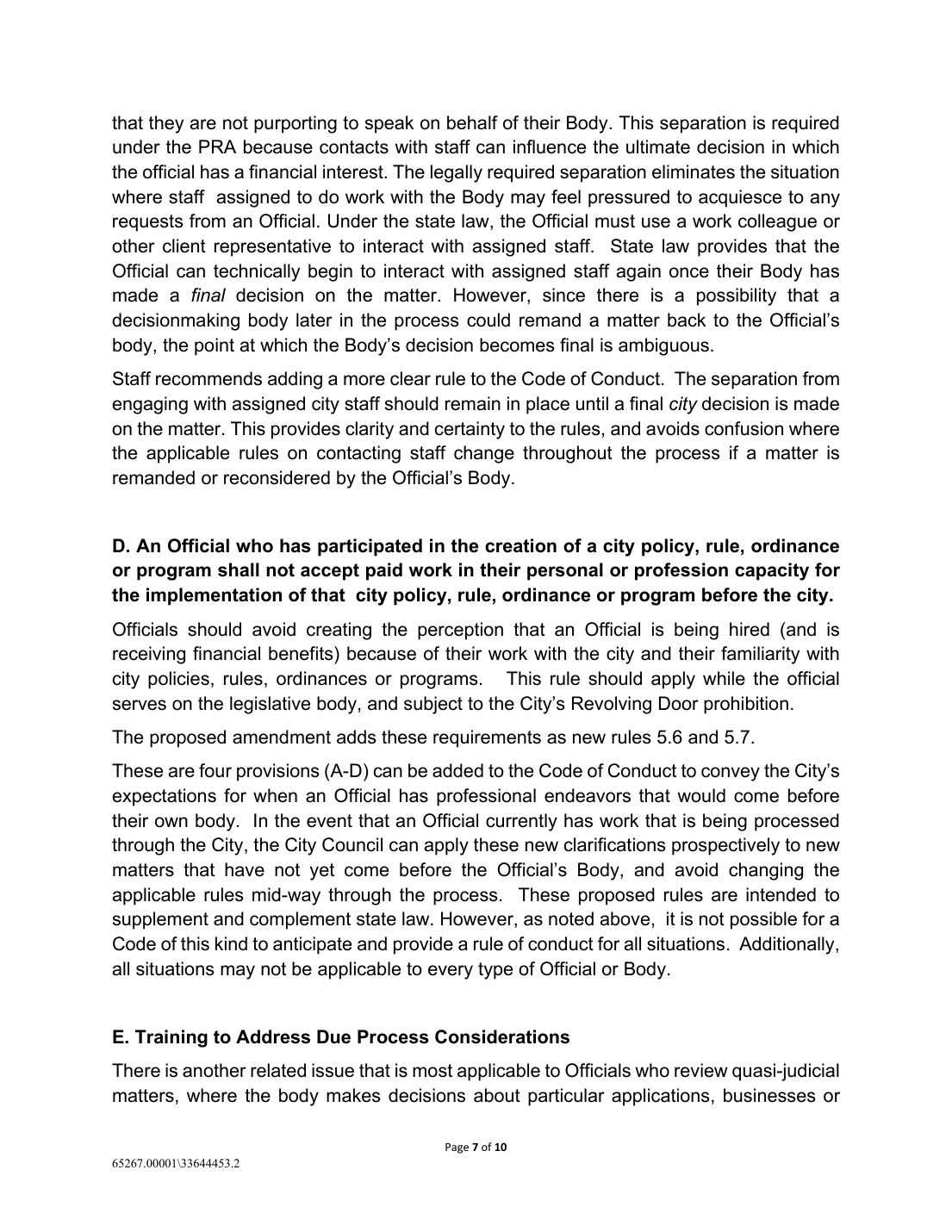 1
1
- 1The City's own numbering of the two conflict rules.
“The proposed amendment adds these requirements as new rules 5.6 and 5.7.“
Here is what she voted against.
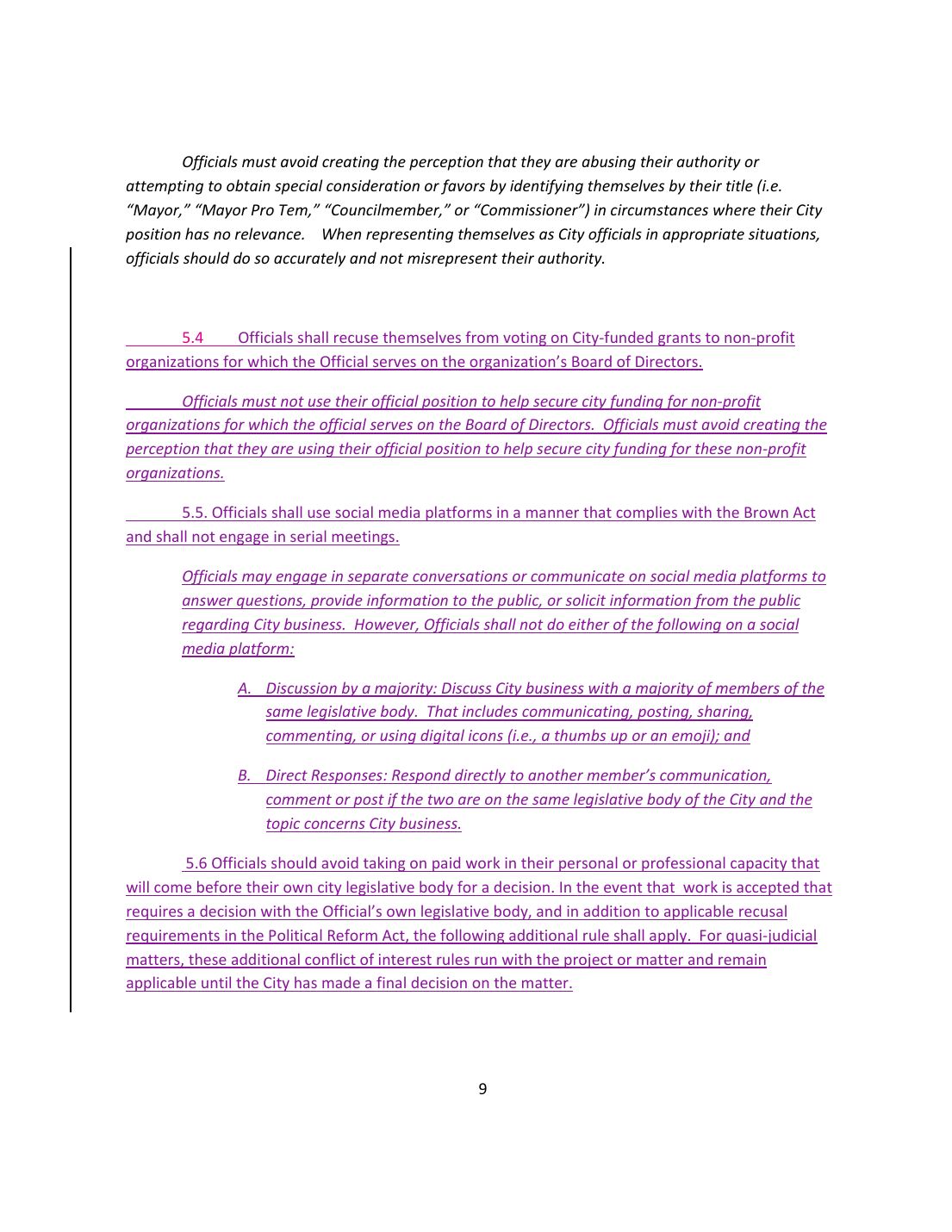 1
1
- 1The rule she voted against.
5.6 “Officials should avoid taking on paid work in their personal or professional capacity that will come before their own city legislative body for a decision.”
The rule went further than state law. An official with such work would have to leave the entire meeting, not merely the agenda item, and could not deal with the staff assigned to their own body until the matter was finally decided.
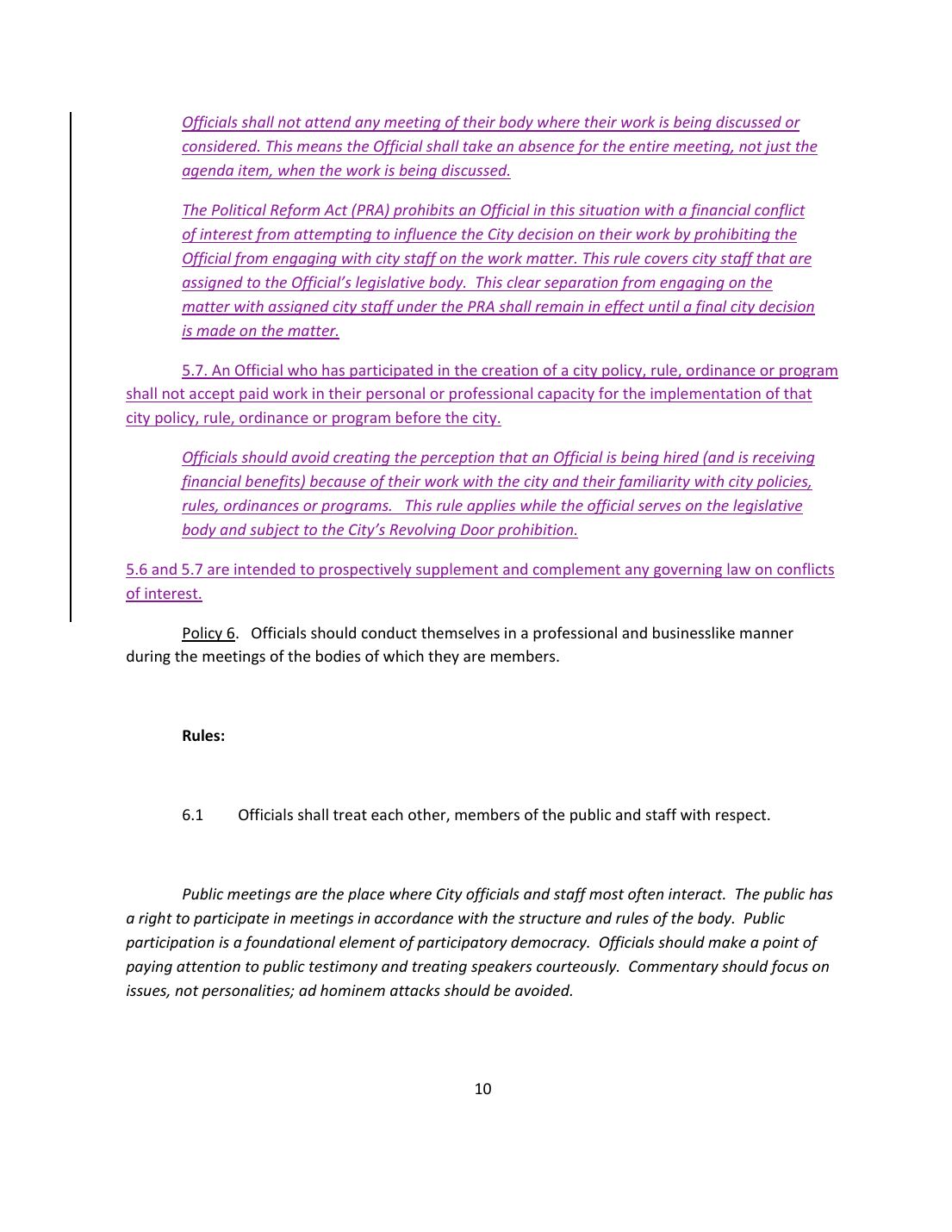 123
123
- 1It went further than state law requires.
- 2Rule 5.7, in full.
- 3The City Attorney's own statement of the concern.
5.7 “An Official who has participated in the creation of a city policy, rule, ordinance or program shall not accept paid work in their personal or professional capacity for the implementation of that city policy, rule, ordinance or program before the city.”
And directly beneath it, West Hollywood’s own explanation of why the rule exists:
“Officials should avoid creating the perception that an Official is being hired (and is receiving financial benefits) because of their work with the city and their familiarity with city policies, rules, ordinances or programs, and blurs the line between professional endeavors and civic engagement.”
That sentence was written by the City Attorney’s office, not by us. It describes a general problem that the City had decided to name and legislate against. Two members voted no. One was John Erickson, who would later vote $91,235 of City money to the organization that employed him. The other was the Mayor, whose sole outside income came from an advertising agency in the industry her Council regulates.
What these rules would and would not have reached
Rule 5.6 probably would not have covered her. It addresses an official’s own paid work coming before their own body for a decision. Leroy & Rose never appeared before the West Hollywood City Council as an applicant. The billboard structures came to the Council; the advertising that goes on them does not.
Rule 5.7 is a closer question and still not a clean fit. She participated in shaping the Sunset Boulevard off-site signage policy, and she was paid by a firm whose clients use the inventory that policy creates. Whether that is “paid work for the implementation of that policy before the city” is arguable, and we are not going to pretend it is settled.
What is not arguable is the vote itself. A sitting Mayor in exactly the situation the City was trying to legislate about voted against the legislation, and the record shows no statement from her explaining why.
Eleven · Evidence against this file’s premise
An honest file includes the evidence against its own thesis, and this one has a real piece of it. We are putting it in the body of the story rather than a footnote.
Horvath held and voiced a pro-billboard position years before Leroy & Rose existed as a going concern in Los Angeles.
She served an earlier, appointed term on the Council from May 2009 to March 2011. We recovered the minutes for that period, 1,169 items across 46 meetings, 45 of them after her appointment, and her position on billboards then was consistent and supportive. Her 2010 remarks in favor of the digital display proposed for the Sunset Time hotel are set out in Section Two.
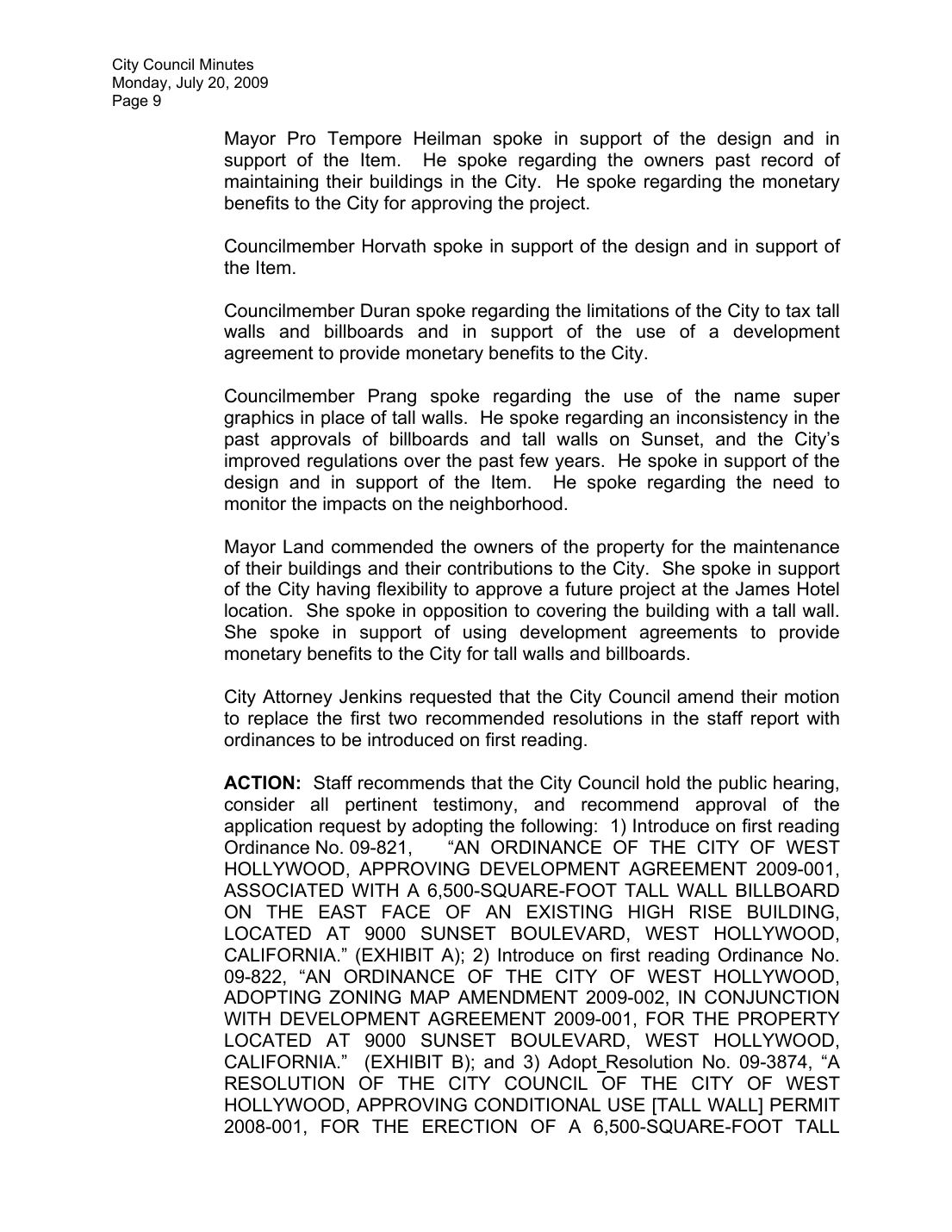 1
1
- 1Ten weeks into her appointed term, six years before the income.
On July 20, 2009, ten weeks after her appointment, on an item titled “Request to Erect a Tall Wall Billboard,” the minutes record that she “spoke in support of the design and in support of the Item.”
She also did more than speak. The item was a 6,500 square foot tall wall on the east face of an existing high rise at 9000 Sunset Boulevard, and the minutes record the motion as made by Mayor Pro Tempore Heilman and seconded by Councilmember Horvath. When an amended motion followed, she seconded that one too. Both carried with Mayor Land voting no.
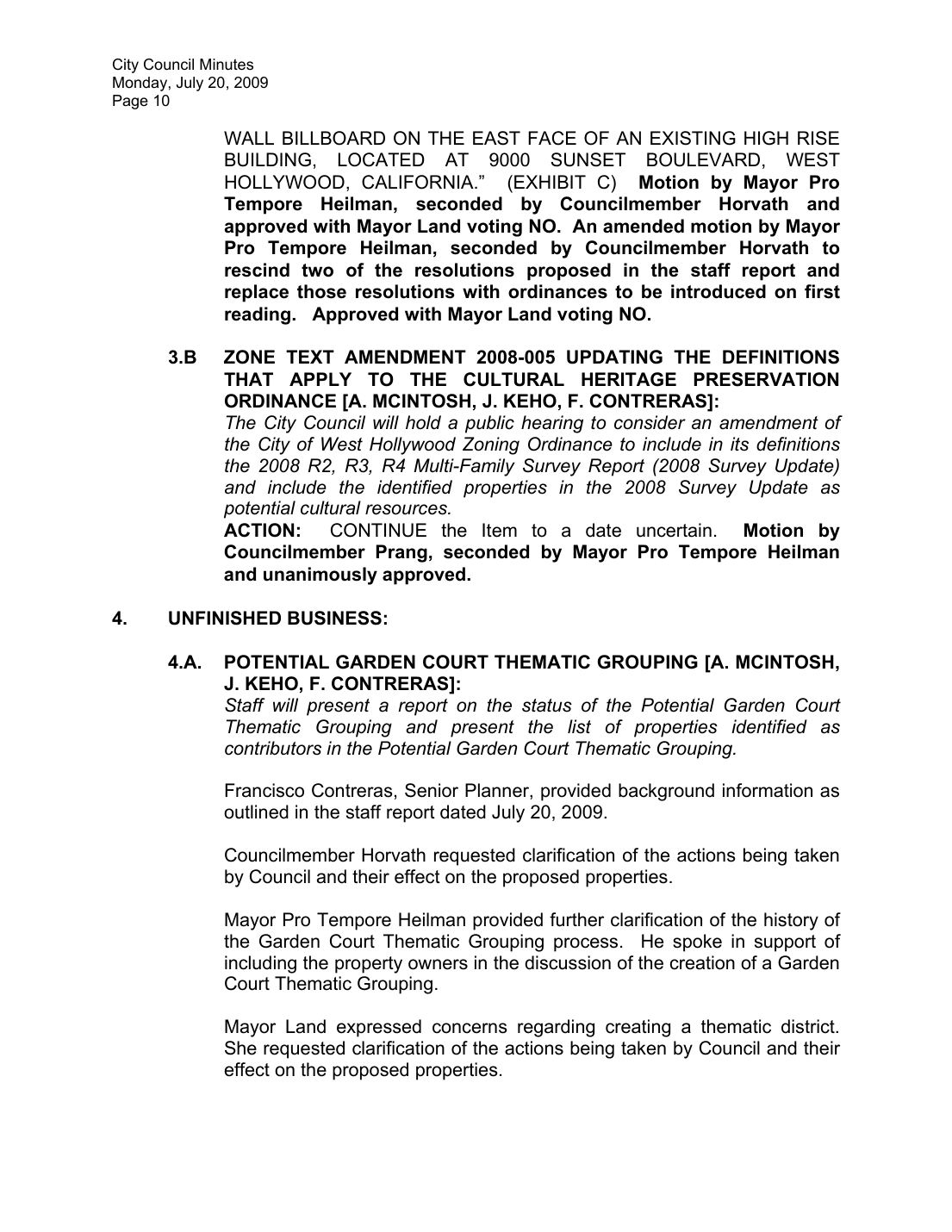 1
1
- 1her second
The tape adds what the minutes compress. Before the staff report, Councilmember Duran read a property disclosure into the record, his office lease within 500 feet of the building, and rebutted it point by point. She followed with no disclosure of any kind. Her own remarks, as the City’s captions render them: on the Sunset Strip “we do have several ways of advertising that I think is definitely in line with what the sunset strip achieves … I think it would make this landmark building that much more a landmark on the sunset strip.” Then, twice, “second.” Nineteen days into her term the building’s existing tall wall had been carrying HBO’s True Blood, photographed there on June 1, 2009; the wall she seconded was a second one, on the east face. Nothing in this paragraph asserts a conflict in 2009. It records that the first billboard she voted on was on a building already carrying the product of her trade, that a colleague disclosed and she did not, and that her Form 700 for that year, the document that would say whether anything needed disclosing, is not in hand.
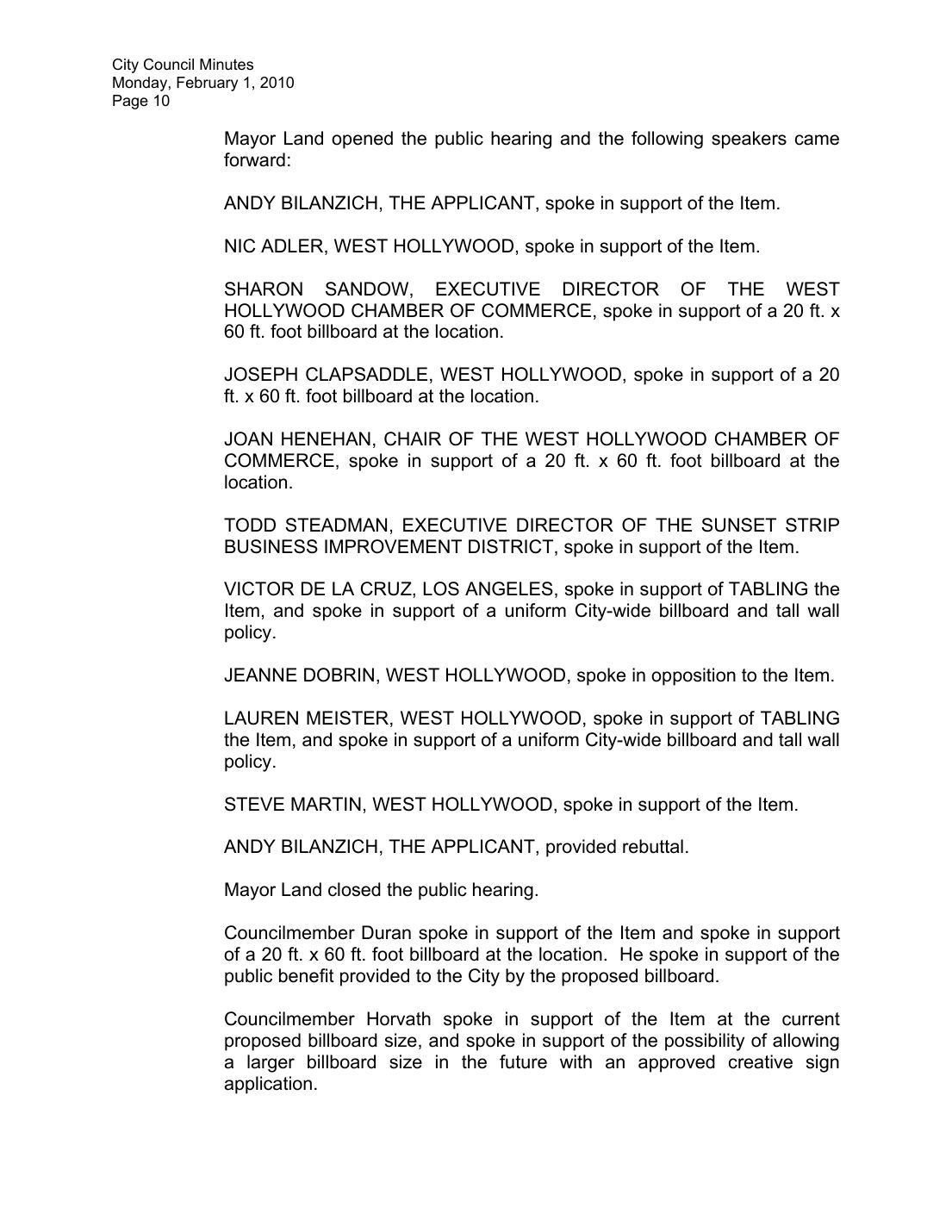 1
1
- 1Her billboard position, five years early.
On February 1, 2010, on converting a roof sign to a billboard, she supported it at the proposed size and went further, speaking in support of the possibility of allowing a larger billboard in the future. In December 2009 she opposed an appeal against a billboard replacement. In November 2010 she was the lone no vote against refusing to place an off-site advertising tax measure on the ballot, meaning she wanted the voters to decide it.
That February 2010 item has a number, an address and a paper trail: Billboard Permit 2009-004 at 9015 Sunset Boulevard, a double-sided fourteen by forty-eight foot billboard atop a pole, up to 110 feet tall, carried with Development Agreement 2009-002 and Zoning Map Amendment 2009-009, both adopted on second reading on February 16, 2010, and both later challenged by referendum petitions the Council took up in May and June of that year. The roll call records her present. It was approved with no dissent recorded. By that date she had been a Senior Account Executive at Cold Open, the Venice key art agency, for five months.
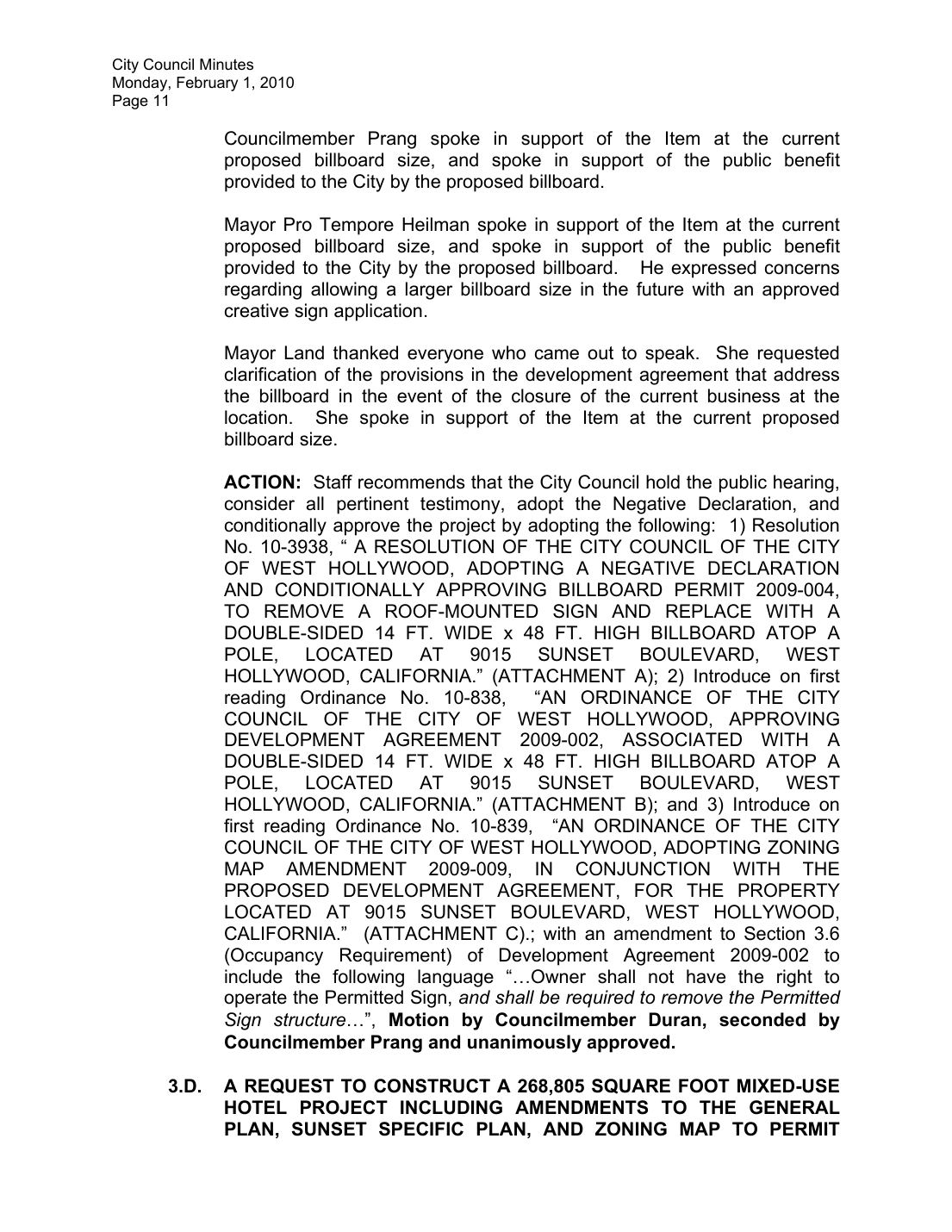 12
12
- 1the permit
- 2the address
Recusals during the appointed term: zero. That is also true, and it was true when there was nothing to recuse from.
It is worth being exact about what “nothing” means. Leroy & Rose did not exist. But she was not outside the business. In July 2009 she was Vice President, Theatrical Print at Canyon Design Group. By February 2010 she was at Cold Open, where the creative director was the man who would later found Leroy & Rose and pay her company for seven years. Neither firm was a party to either approval, neither owned a sign, and neither applied for a permit. We are not asserting a 2009 conflict, and none is established. We also do not clear it by saying the agency did not own the sign, because as Section Six sets out that is not the test. What is missing for the first term is different and simpler: we do not have her Form 700s for 2009 to 2011, so we cannot show what she disclosed, or whether either firm was then a reportable source of income at all. What the first term shows is that she was already working in out-of-home advertising while voting on out-of-home advertising, and that nobody reading the minutes would have known it.
It does not answer the section 87100 question, because section 87100 is not about motive. It asks whether an official participated in a decision while holding a disqualifying financial interest. A sincere, long-held policy preference is not a defense to a conflict of interest. It is not a defense to anything. The rule exists precisely because the public cannot see inside an official’s head, which is why the law requires the interest to be disclosed and the official to step away rather than asking anyone to assess sincerity.
Twelve · Digital billboard approvals, 2009 to 2026
Baseline: the Strip before 2018
When Orange Barrel Media launched the Sunset Spectacular at 8775 Sunset in 2021, its own announcement described it as “the first digital out-of-home media on the storied Sunset Strip in over ten years.” That is not a critic’s characterization. It is the operator’s, and it establishes the starting point: for a decade before 2021 the Strip had gained no new digital billboard at all.
Approvals inside Horvath’s remaining years on the Council. Not every row below is a digital sign: the 9165-69 approval is for a static billboard, and the 8752 row is a pair of ordinances rather than a sign approval. Both are marked as such.
| Approved | Address | What it was | Her role |
|---|---|---|---|
| 2018-11-05 | 8775 | Sunset Spectacular, on City-owned land, Orange Barrel Media | Made the motion |
| 2020-12-07 | 8743 | Static to digital. The first application processed under the new policy | Mayor |
| 2021-07-19 | 9157 | Static to digital. The board she photographed | Mayor; opened the hearing |
| 2021-08-16 | 8752 | Ordinances 21-1161 and 21-1162 | Mayor; consent |
| 2021-12-06 | 9165-69 | New billboard and development agreement. Static, not digital, though its design carries a panel of LED sticks | Seated |
| 2022-06-27 | 8730 | New two-sided billboard, digital east face, applicant Porter24 | Seconded |
| 2022-11-21 | 8901 | Two-sided static to digital, the Whisky a Go Go | Seconded |
8775 Sunset, November 5, 2018: the one divided vote
Of the fifty-nine signage items of Horvath’s elected term, the minutes and the tape record exactly one divided vote. It is the first one in that table.
“Motion by Councilmember Horvath, seconded by Councilmember Heilman, and approved, noting the ‘no’ votes of Councilmember Meister and Mayor Duran.”
West Hollywood City Council minutes, November 5, 2018, Item 4.B
The tape confirms it at 03:37:56: “motion passes with a 3-2.” The item was the final design and site license agreement with Orange Barrel Media for the pilot digital billboard at 8775 Sunset, on land the City owns.
People objected that night, and they are named in the City’s own minutes. Nancy Dushkin spoke against it. Position slips in opposition were filed by Elyse Eisenberg and Mike Carter. Speaking for it were Pete Scantland of Orange Barrel Media and the project’s architect.
Eight weeks later Orange Barrel Media and its executive vice president each gave $500 to her committee. The following month the company gave $5,000 to the independent committee supporting her re-election. Section Nine sets out those flows in full.
Ordinance 19-1063, March 2019: the conversion policy
The wave of conversions did not come from nowhere. On March 18, 2019 the Council held the public hearing on a zone text and Sunset Specific Plan amendment whose stated purpose was “to establish new policy for the size, location, design, and operation of off-site advertising signage on Sunset Boulevard.” It became Ordinance 19-1063, and every conversion after it ran through the award process it created.
This was not a close vote. The motion was made by Duran and seconded by D’Amico, and the minutes record no dissent. Horvath was one of five.
Two features of that hearing. Who spoke: OUTFRONT Media, a consulting group appearing for the industry, and the West Hollywood Chamber of Commerce, all in support. No neighborhood association spoke, and no resident opposition is recorded. What she said: the minutes record that she met with the West Hollywood Chamber of Commerce’s billboard committee, and that she argued applicants already in the queue should receive preference.
Ordinance 19-1063 received its final adoption on the consent calendar on April 1, 2019, in a block of items passed without discussion.
Ordinance 19-1079, September 2019: existing signs may grow
On September 23, 2019 the Council amended the Sunset Specific Plan again, to “clarify certain provisions related to modification of existing off-site advertising signs.” The word clarify undersells it. The minutes record Mayor D’Amico asking about “the size increase of billboards over 10 years,” and staff answering that “the intent was to allow the billboard size to incrementally change along with changing conditions on Sunset.”
“Motion by Councilmember Heilman, seconded by Mayor Pro Tempore Horvath, and approved.”
West Hollywood City Council minutes, September 23, 2019, Item 3.A
Before that vote, the minutes record one more line: “Mayor D’Amico opened the public hearing and no speakers came forward.” It too was adopted on second reading on the consent calendar.
Approvals by year, 2009 to 2026
Counted from the minutes, the Council’s approvals of digital billboards on the Strip run like this. Two digital boards already stood before 2018; the City’s own February 2018 item on placing public art on them records the number without saying which two. Between November 2018 and Horvath’s last meeting in November 2022 the Council approved five more, three of them on her motion or her second. In the three and a half years after she left it approved seven, most of them full-motion animated rather than the static-image digital faces of her years, on motions by other members. Approved is not lit. Only the Sunset Spectacular has an operating date in our record; the City’s permit files would say when, or whether, the others went live.
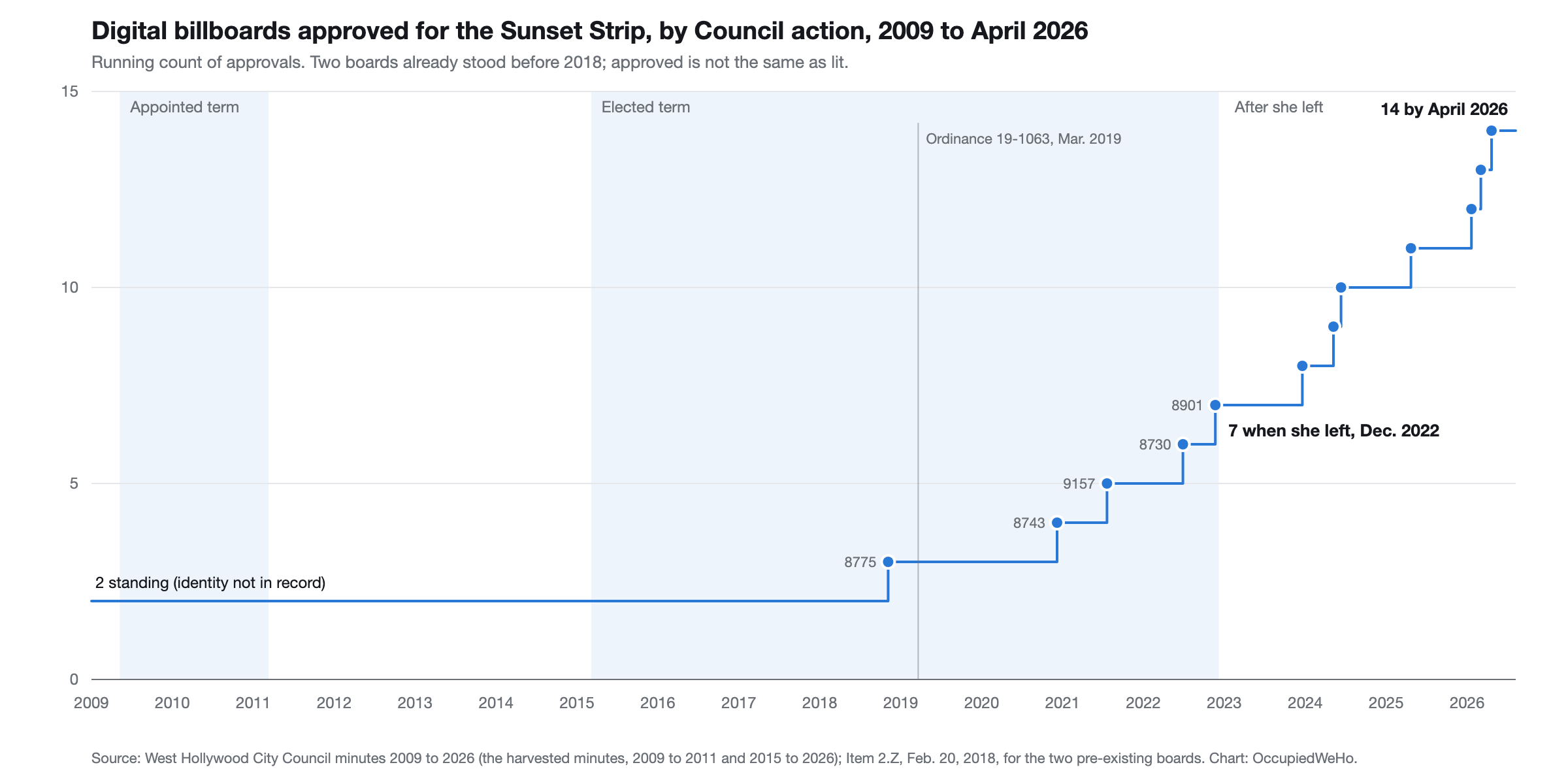
| Year | Digital boards approved | Running count | On the Council | Her role in the record |
|---|---|---|---|---|
| 2009 to 2011 | 0 | 2 | Appointed May 2009; lost the March 2011 election | Seconded two static approvals, the 9015 Sunset billboard-permit appeal in July 2009 and, a week later, the 9000 Sunset tall wall (and its amended motion); spoke for the Sunset Time digital display at 8418 Sunset (2010), a private project, and voted no on that project over housing and the House of Blues |
| 2012 to 2014 | not in record | No | None; no minutes harvested for these years | |
| 2015 to 2017 | 0 | 2 | Yes | Presided as Mayor over the RFP for the pilot digital sign on City land (2015); seated for the team selection (2016) and the first reading of the new billboard regulations (2017) |
| 2018 | 1 (8775) | 3 | Yes | Made the motion; 3 to 2 |
| 2019 | 0 | 3 | Yes | Voted with the unanimous majority on Ordinance 19-1063; seconded Ordinance 19-1079, which lets existing signs grow |
| 2020 | 1 (8743) | 4 | Yes | Presided as Mayor |
| 2021 | 1 (9157) | 5 | Yes | Presided as Mayor; aye on the roll call |
| 2022 | 2 (8730, 8901) | 7 | Until December | Seconded both |
| 2023 | 1 (9015 / 9009) | 8 | No | Not her vote (Heilman and Byers) |
| 2024 | 2 (8501; 8497-99) | 10 | No | Not her vote (Heilman, Meister and Byers) |
| 2025 | 1 (8433) | 11 | No | Not her vote (Heilman and Hang) |
| 2026, to April | 3 (9200; 8222; 9039) | 14 | No | Not her vote (Byers, Erickson and Hang) |
How to read the count. It counts Council approvals of signs, not faces and not screens lit. Two of the approvals after she left replace earlier approvals at the same address (9200 Sunset, and 8497-99), so the number of distinct sites is at most twelve. The two boards standing before 2018 are not identified in our record. The seven approvals after December 2022 are on the chart because the curve does not stop where her service stops, not because they are hers; every one of them carries other names. Section Fourteen picks up where she went next.
Residents’ accounts after the Spectacular lit, 2021 to 2025
The Sunset Spectacular began operating on March 30, 2021. Within weeks the local press was reporting what the residents who had objected said would happen.
A resident of Sierra Towers described “24 hour blinding electronic light pollution which pours into my apartment.” Susan Brant, who manages a nearby residential building, said “the light shines and flashes through their blinds,” and said she feared losing tenants. Jerome Cleary, a block and a half away, said “the colors in my living room, it’s a giant slideshow.” A former resident who had moved out called it “reminiscent of a cheap, gaudy Las Vegas.”
Also quoted was Elyse Eisenberg, chair of the West Hollywood Heights Neighborhood Association. She is the same person who filed a position slip in opposition on November 5, 2018, the night the motion was made. The association objected before the approval and was proved right after it.
Orange Barrel Media
The company that holds the City’s own billboard is not a local one. Orange Barrel Media was founded in Columbus, Ohio in 2004, and is run by its founder, Pete Scantland, who grew up there. It came to Los Angeles in 2013 and began working on the Sunset Strip shortly afterwards. It now operates more than three hundred large format faces across two dozen cities.
It won 8775 Sunset through a juried design competition that drew submissions from Zaha Hadid and Gensler, with Gensler and TAIT Towers among the finalists. The City selected Orange Barrel Media paired with the Los Angeles practice Tom Wiscombe Architecture. The company describes the whole thing as “the result of an over five-year process,” and the City’s share is estimated at around $3 million a year.
Open question, not a finding. Tom Wiscombe Architecture also designed Orange Barrel Media’s own headquarters expansion in Columbus, an 82,700 square foot project completed in 2020. That is after the 2018 Sunset award, so it is not evidence of a prior relationship and must not be presented as one. Unestablished: when the architect and the operator first worked together.
Who filed them
Each City resolution recites who filed the application. Reading that clause in all twelve digital approvals since 2018 produces a table with two names at the top of it, one an operator and one a lobbyist.
| Date | Address | Named filer |
|---|---|---|
| Nov 5, 2018 | 8775 Sunset | Orange Barrel Media (City land, site license, no development agreement) |
| Dec 7, 2020 | 8743 Sunset | Reshma Pendleton for Netflix, Inc., and Jeff Seymour, Seymour Consulting Group |
| Jul 19, 2021 | 9157 Sunset | Jeff Seymour for Ryan Levine of Big Outdoor |
| Jun 27, 2022 | 8730 Sunset | Mark Lehman for Porter24, on behalf of Sunset Towers Partnership |
| Nov 21, 2022 | 8901 Sunset | Clay Collett, Orange Barrel Media, for M&M Media |
| Dec 18, 2023 | 9015 / 9009 Sunset | Aaron Green, Afriat Consulting Group, for Andrew Bilanzich, ACE Outdoor Group |
| May 6, 2024 | 8501 Sunset | Jeff Seymour for Big Outdoor Media Company and Rochelle Sterling |
| Jun 10, 2024 | 8497-99 Sunset | Clay Collett, Orange Barrel Media, for United Property Management Services |
| Apr 21, 2025 | 8433 Sunset | Clayton Collett, Orange Barrel Media |
| Jan 20, 2026 | 9200 Sunset | Jeff Seymour for Mani Brothers 9200 Sunset (DE), LLC |
| Mar 2, 2026 | 8222 Sunset | Dave Neglio for Interstate Outdoor Advertising |
| Apr 20, 2026 | 9039 Sunset | RIOS Architects for SK 26, LLC and Alon Abady |
Jeff Seymour of Seymour Consulting Group and Orange Barrel Media are tied at four apiece, a third of every digital billboard approved on the Strip since 2018. The difference is who they filed for. Orange Barrel brought its own projects: 8775, 8901, 8497-99 and 8433. Seymour brought three different clients — Netflix, Big Outdoor and Mani Brothers — which makes him the only name recurring across unrelated applicants. Big Outdoor filed two. Orange Barrel and Big Outdoor together gave $16,000 to Horvath’s campaign and to the independent committee backing her. Filing an application is lawful and it is what lobbyists are hired to do. Seymour is not accused of anything here and no agency has found otherwise. What the table shows is concentration.
Who moved them after she left
Across the eleven off-site signage items the minutes attribute between Horvath’s departure in December 2022 and June 2026, Chelsea Byers moved or seconded seven and John Erickson three. Between them they carried eight of the eleven.
| Date | Item | Moved | Seconded | Vote |
|---|---|---|---|---|
| 2023-12-18 | 3.C, 9015 / 9009 Sunset | Heilman | Byers | 5/0 |
| 2024-05-06 | 3.A, 8501 Sunset | Heilman | Meister | 5/0 |
| 2024-06-10 | 3.E | Heilman | Byers | 4/1 |
| 2024-10-07 | F.1, off-site signage into commercial zones | Heilman | Byers | 4/1, Meister no |
| 2025-02-03 | C.1 | Heilman | Erickson | 4/1 |
| 2025-04-21 | C.1, 8433 Sunset | Heilman | Hang | 4/1 |
| 2025-11-03 | C.1, policy amendment and CEQA addendum | Heilman | Hang | 5/0 |
| 2026-01-20 | C.1, full motion | Byers | Hang | 3/1, Erickson recused |
| 2026-03-02 | C.1, 8222 Sunset | Erickson | Byers | — |
| 2026-04-20 | C.2, 9039 Sunset | Byers | Hang | 5/0 |
| 2026-06-15 | F.6, more temporary advertising installations | Byers | Erickson | 4/0 |
Two of those are not continuation but expansion past anything Horvath built: October 7, 2024, taking off-site signage off Sunset and into commercial zones, which Byers seconded, and June 15, 2026, Byers’s own item directing staff to allow more temporary advertising installations for longer, which Erickson seconded.
What is still coming: the City’s own count, February and September 2026
On February 17, 2026 Councilmember Meister asked the Council to commission an updated billboard saturation study. The staff report for that item states the inventory in the City’s own words:
“The City has approved 12 projects and there are 31 project applications currently under review in various stages of the review process. As such, over the next few years, there could be 31 new billboard projects approved, under construction, and/or operational.”
Forty-three in all. The report does not break out how many are digital and how many static; the Sunset Arts & Advertising Program covers both new boards and the modernization of existing ones, and the items reaching the Council in 2026 have been a mix of full-motion animated signs and static ones. The same report records that the 2021 saturation study had recommended these analyses be performed on a regular basis, and that they had not been.
The Council declined. Erickson said he did not think they should proceed until the current round was complete; Byers said that with so many already in the pipeline she was not sure they were there yet; most members thought the analysis premature and told staff, informally, to expedite the billboards instead. The item was tabled to a date uncertain. The minutes record the tabling; the individual positions are from the meeting video and are reported here as speech, not quotation.
September 2026: forty-five. The quarterly development update prepared for the Council’s September 22, 2026 meeting (Item E.1, Attachment C) lists the program project by project. Eleven billboards are operational, among them 9157 Sunset and the Whisky a Go Go, which commenced on May 15, 2026; four are approved and not yet built (9200, 8222, 9039 and 8590 Sunset); and thirty are in the pipeline: eleven with valuation complete and development agreements under negotiation, six awaiting the design subcommittee, four older-round projects in redesign, eight Round 2 (2026) applications filed between December 2025 and January 2026, and one mixed-use development carrying program signage. Eleven have Planning Commission or Council dates: 8401 Sunset, the Andaz, Council targeted October 19; 9121 Sunset, Council targeted November 16; 9160–9176 Sunset, Planning Commission in October; 8760, 8873 and 8906 Sunset, Planning Commission November 5 or 19; 8919, 9229, 8371 and 8410 Sunset, December 3 or the first quarter of 2027. Jeff Seymour is the applicant on nine of the forty-two listed projects and Afriat Consulting on eleven. The same packet’s Attachment A lists a proposed two-sided full-motion digital billboard at 8500 Santa Monica Boulevard, resubmitted August 3, 2026: the first program application in this record off Sunset Boulevard.
What this section does not claim
- The enabling policy was not Horvath’s doing alone. It passed unanimously on a motion by another member. She was one vote of five.
- She is not the councilmember most associated with the billboard program. On the record of these hearings that is Heilman, and the current push to convert the Strip’s painted tall walls to digital is his, begun long after she left.
- It did not stop when she left. The approvals after 2022 carry other names. A reader who takes this section as the story of one person will be wrong.
- No resident lawsuit has been found. Residents have called for one in public comment. We have located no filed case and imply none.
- The figure circulating among residents of twenty more billboards over seven years is a resident’s characterization in public comment, not a number we have verified against a City document.
Thirteen · KBS Holdco LLC v. City of West Hollywood
The billboard program Horvath voted on repeatedly has since been found constitutionally defective.
In KBS Holdco, LLC v. City of West Hollywood (No. 2:22-cv-05750, Central District of California), Judge Fernando Aenlle-Rocha ruled on July 8, 2024 that West Hollywood’s “design excellence” criteria vest “unbridled discretion” in the Screening Committee and are unconstitutionally subjective under the First Amendment. The court noted that the plaintiff’s application drew evaluator scores of 230, 211, 191, 188, 168, and 95, observing that a single low score could sink an application.
The named defendants are the City, Orange Barrel Media, LLC, and David Ehrlich, a paid City consultant associated with the screening. On April 21, 2025, the Council adopted a resolution rescinding the Design Excellence Committee, and the minutes state the change was being made “due to litigation.”
The criteria the court struck down are the ones created by the policy in Section Twelve. Ordinance 19-1063 established the award process, and the staff report for 9157 Sunset records that the award round “concluded in June 2020. After qualifying in the award process, applicants were eligible to apply.” That is the gate the 8743, 9157, 9165 and 8901 conversions came through, and it is the gate a federal court later found vested unbridled discretion.
Horvath is not a defendant, and the specific scoring decision the case turns on is not one of hers. We include it because it establishes what kind of program this was: discretionary, subjective, and valuable enough to litigate over for four years. Discretion is what makes a vote worth something. It is also, on the record above, what she asked for: at the March 2019 hearing she argued that applicants already in the queue should receive preference, which is a request that the discretion be exercised in a particular direction.
And the environmental document carried forward, November 3, 2025
The framework did not only survive the litigation. It was extended. On November 3, 2025 the Council amended the Sunset Boulevard Off-Site Signage Policy and, in the same resolution, adopted a CEQA addendum to the 2019 Initial Study / Negative Declaration — an update to a six-year-old document rather than fresh analysis — and applied it to the next generation of signs, the ones the City calls Round 2 and Round 1.5.
Councilmember Meister objected on the tape. Residents had asked for a full analysis rather than an update, she said, and she asked to vote against the environmental half separately. She was told the two were bound into one resolution and could not practically be split, and that her objection could be noted for the record instead. The City Attorney offered exactly that.
Fourteen · Los Angeles County record, 2023 to 2026
Horvath left the West Hollywood City Council in December 2022 and is now the Los Angeles County Supervisor for the Third District. She has served as Chair of the Board.
The pattern did not stop at the city line. It changed industries only in the sense that it stopped being about billboards and started being about the studios whose films those billboards sold.
The Warner Bros motions
 12
12
- 1The County intervenes.
- 2She is the author.
Twice in 2026 Horvath brought the County into the fight over Warner Bros. The first motion was introduced March 17, 2026 as Item 19 and adopted March 24 as Item 10: the County would study the economic impact of the proposed purchase and submit antitrust comments to the state and federal Justice Departments. On July 21, Item 7, she moved that County Counsel participate in or support the Attorney General’s lawsuit to block the merger, by amicus brief or sworn declarations. Both carried five to nothing. She voted aye on her own motions.
Which side her history sits on
Paramount Skydance is the buyer. Warner Bros Discovery is being bought. Blocking the sale keeps Warner Bros independent rather than absorbed. Almost every documented tie Horvath has runs to the company being bought.
| Company | To her committees | From whom | When | Followed her to the County? |
|---|---|---|---|---|
| Warner Bros. | $3,500 | Michael Jones, Senior Vice President, Warner Bros. | 2019 city; 2021 and 2022 County | Yes |
| Paramount Pictures | $750 | David Sameth, President; Michael Oh, VP Creative Advertising | 2019 only, city only | No |
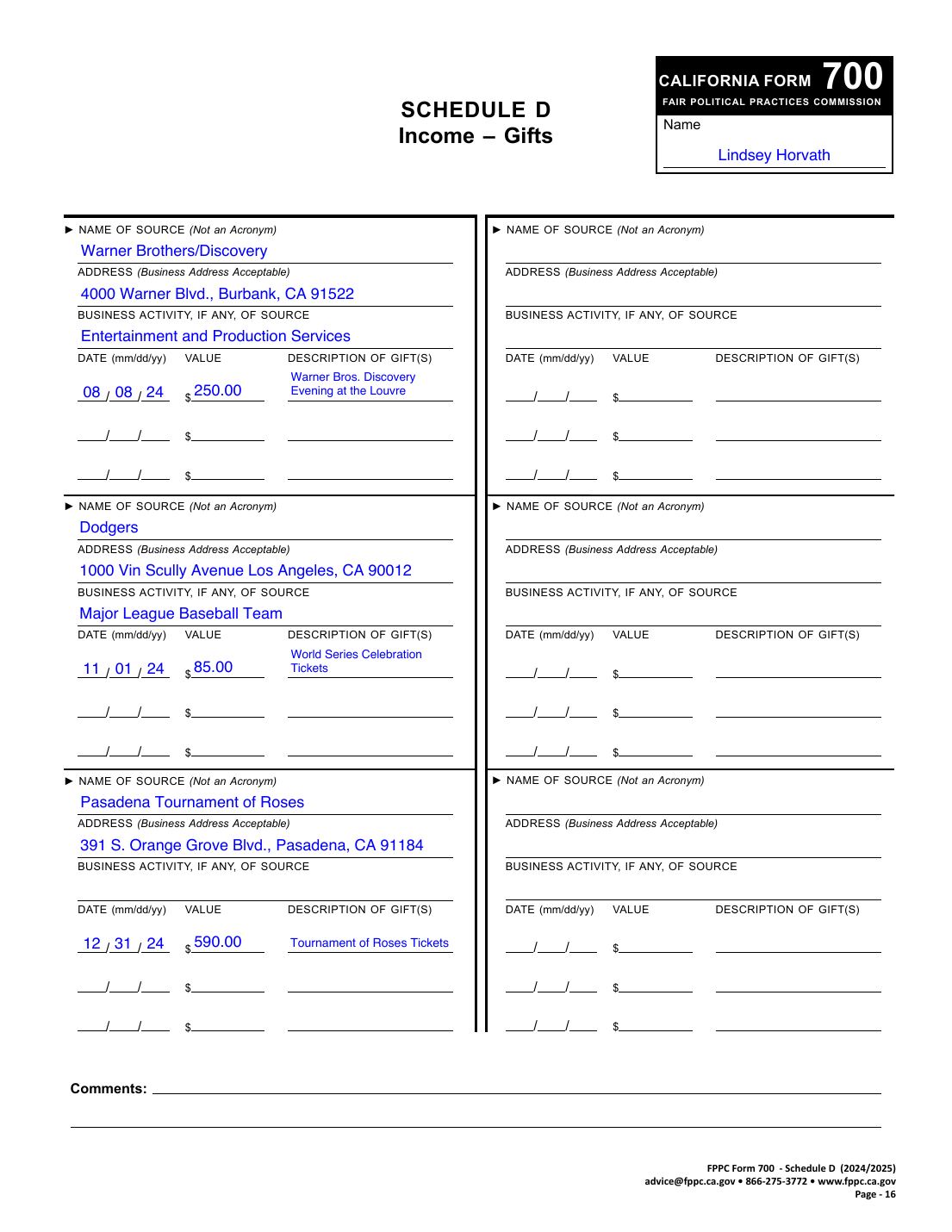 12
12
- 1The company now being acquired.
- 2Her own description of the gift.
And on August 8, 2024, Warner Bros. Discovery gave her a gift valued at $250, which she recorded on her own County disclosure as “Warner Bros. Discovery Evening at the Louvre.” There is no Paramount equivalent anywhere in her County record. Across her employer’s own public posts, Warner Bros and HBO campaigns outnumber Paramount campaigns roughly three to one.
And it is not only the money
Warner Bros business runs through both of the jobs Horvath held while sitting on the West Hollywood Council.
Cold Open’s own client directories, archived from its website while she worked there, show nine Warner Bros campaign directories, for seven releases, between February 2010 and January 2011: The Losers, Due Date, The Town, Hereafter, Yogi Bear, Red Riding Hood and The Rite. Warner Bros was the agency’s largest documented account across the months she sat on the Council. In 2012 The Hollywood Reporter’s Key Art Awards winners list credited Cold Open with the outdoor concept and design of the Dimensional Billboards winner, Warner Bros’ The Campaign, which is to say it was doing billboard work for that studio while she was there.
Leroy & Rose then carried Warner Bros too. Its own website listed the studio as a client by no later than July 26, 2021, and Paramount by December 1, 2021, both while she sat on the Council with the agency as her disclosed income source.
And on January 1, 2021, on her own account, she photographed a Warner Bros billboard on the Sunset Strip, tagged @warnerbros, @warnerbrosentertainment, @leroyandrose and @hbomax, and wrote: “With gratitude to @wbpictures for the opportunity.” Section Five identifies that board as 9157 Sunset, and records that she chaired the hearing on it six and a half months later and voted aye.
None of this shows she personally worked a Warner Bros account. We have not established that at either agency, and we do not assert it. What is established is that her employer of record held substantial Warner Bros business during both of her council terms, and that she has never described any of it while taking a public position on the studio’s sale.
And the same silence
We pulled the Statements of Proceedings and the complete Board Meeting Transcripts for both dates: 681 pages. There is no recusal, no abstention, no conflict statement, and no mention of advertising, of Leroy & Rose, or of the Warner Bros. Discovery gift. In March Horvath spoke about the people the industry carries with it, the “prop houses, dry-cleaners and caterers that support the industry.” In July she spoke at length again. Neither time did she mention advertising.
Across more than 3,400 Instagram posts running back to 2014 she names or tags Warner Bros and HBO eighteen times, fourteen of them before the merger fight began. She names Paramount four times, all of them in 2026 and all of them about the merger: March 24 (the day of her first merger motion), July 13, August 25 and August 27. The company appears nowhere else in the account.
Counts as of September 20, 2026. The first 3,446 posts, through July 10, 2026, come from the July 12, 2026 corpus; the forty posts from July 13 to September 19 were read from the live account on September 20, 2026 and are held at evidence/horvath/leroy-rose-ooh/2026-09-20-horvath-ig-corpus-extension.json. These are live-account figures and will move as she posts.
What is left is the shape. A decade of ties to an industry, disclosed only in filings that communicate nothing, and never mentioned from the dais while she acts on that industry’s biggest transaction. The billboard record is what makes that legible as a habit rather than an oversight.
Fifteen · The network: Erickson and Byers
This file is about Lindsey Horvath. This section is here because the same pattern did not leave the dais when she did, and because the three careers are connected by more than coincidence. Nothing here alleges an agreement between them. It sets out what the record shows about two colleagues she helped put in office.
John Erickson and his employer’s City contracts
Erickson joined the Council in December 2020. From roughly 2018 to 2024 he was Vice President of Public Affairs at Planned Parenthood Los Angeles, which operated a licensed health center inside West Hollywood continuously and held a City services agreement.
| Date | Item | What happened |
|---|---|---|
| 2021-03-15 | Code of Conduct | He and Horvath are the two votes against the conflict-of-interest amendments, three months after he joined. |
| 2022-09-19 | Contract | He participated in approving a $89,446 City contract with his own employer. No recusal. |
| 2022-11-07 | 2.L | The Council formally rescinded that approval and re-approved it with his disclosure and recusal. The agenda item is titled “Correction of Processing Error” and expressly cites “the Councilmember employed by the contractor.” |
| 2023-09-18 | 2.I | He participated again. The 2023-24 social-services renewals, 28 programs totalling $6,951,985, list “PLANNED PARENTHOOD … $91,235”. Approved on the consent calendar, him present, no recusal. This one was never corrected. |
| 2024, 2025 | — | He recused. The minutes expressly note “the recusal of Mayor Erickson.” |
The sequence is recused, recused, participated, recused, recused. The City Attorney’s office caught and corrected the 2022 participation and did not correct the identical participation in 2023.
Across every Form 700 from 2020 through 2025 he reported no income at all, while completing Schedule D (gifts) and Schedule E (travel) in multiple years. His salary was a reportable source in the years his employer did business with the City.
Chelsea Byers and the housing organization that pays her
Byers holds the seat Horvath vacated. She is a paid Policy Campaigns Manager for the Welcoming Neighbors Network, a pro-density housing advocacy organization, and reported it as a source of income on her Form 700, describing her title only as “Manager.” She participated in West Hollywood housing and zoning decisions advancing that agenda.
On June 29, 2026 the Council voted 3 to 2 to refer the question to the Fair Political Practices Commission. Byers and Erickson were the two votes against referring it.
The same disclosure gap this file documents for Horvath appears here in a different form: a Form 700 that names an employer without saying what the employer wants from the body the filer sits on. “Manager” discloses as little as “Creative Advertising and Marketing Strategy.”
What the three of them put on the form
The Political Reform Act asks a filer to name a source of income. It does not ask what the source does. Across all three officials the result is the same: a name that a resident can read without learning anything.
| Official | What the form says | What it is |
|---|---|---|
| Lindsey Horvath | “LPH”, her own sole proprietorship, never registered with the Secretary of State, and “Leroy & Rose”, described on the form as “Creative Advertising and Marketing Strategy.” | A boutique entertainment agency whose business is the billboard and out-of-home campaigns that run on the Sunset Strip, the industry she was voting on. |
| Chelsea Byers | “Welcoming Neighbors Network”, her title given only as “Manager.” | A pro-density housing advocacy organization, on the subject she votes on. The name reads like a block club. |
| John Erickson | Earlier, Planned Parenthood Los Angeles, which held a City contract. Now the “Alliance for a Better Community.” | He has cited the Alliance from the dais as his reason to oppose street-vendor enforcement, his employer having backed the state law that limits it. |
This is the argument of Section Six in a different key. None of these filings is false. Each names the payer, as the statute requires. The failure is that the statute requires a name and stops there, so the disclosure that is supposed to let a resident see a conflict instead hides it behind a phrase that could belong to anything. Part Three of the companion article sets out the two fields that would close it.
How the three are connected
| Direction | What the record shows |
|---|---|
| Horvath → Erickson | Endorsed him in 2020 while she was Mayor, calling him “the person I trust to serve the people of West Hollywood with me”; appeared at his campaign launch; gave his committee $500 across five contributions, and another $600 in 2024. |
| Erickson → Byers | Endorsed her for the seat Horvath vacated. |
| Horvath → both | Now endorses Byers’s re-election and Erickson’s run for State Senate. |
| Byers → Erickson | On his State Senate endorsement list, beside Horvath. |
What this section does not claim. It does not claim the three coordinated, or that any endorsement was given in exchange for anything. Endorsements and disclosed contributions between allied officials are ordinary politics. What the record shows is that the same failure to step aside recurs across all three, and that none of them arrived where they are without the others.
Documents we are still seeking
This file is built on records we hold. These are the records on Lindsey Horvath we do not hold, named so a reader can see the shape of each gap and, if they have a copy, close it. Nothing in this section is a claim about what these documents contain.
The appointed-term employment rests here on Horvath’s federal campaign-finance filings and her own professional profile, which place her at Canyon Design Group and then at Cold Open. The Form 700s for those years would put the same fact on a filing sworn under penalty of perjury, as the seven elected-term statements already do. Nineteen signage items sit in that term, eleven of which meet both prongs of the nexus test on our reading.
This is the document that would date the Leroy & Rose engagement against her April 30, 2015 mayoral swearing-in. We hold her 2022 Los Angeles County assuming-office statement. These are two different documents and must never be collapsed into one.
The form the Council asked applicants to file. We hold the essay WeHo News published on May 11, 2009, but not the form itself, which is where an employer and a job title would have been written down.
If you hold any of these, or know where they are posted, write to us. What arrives gets read, and what changes here gets logged below.
Changelog
This file is a living record, and it will change. Corrections are made in the text itself, where a reader meets the fact; this log is where the change is recorded, so that anyone who read an earlier version can see what moved and when. We do not silently edit.
The section headed “What this file does not claim” has been removed. It set out, in a single list, every limit on what the record so far establishes: what the agency’s work involved, where its advertising ran, why an arrangement ended, whether money moved between two companies. Those limits were accurate when written and several of them are live research questions that further records may well answer. Publishing them together as a standing list stated the gaps more prominently than the findings, and invited them to be read as concessions rather than as the open items they are. No finding has changed and nothing has been withdrawn. The limits that attach to a particular fact remain with that fact, in the section that carries it, where a reader meets them in context. Section Twelve keeps its own scope note for the same reason. The standing caveats that are not about open research — that nothing here has been adjudicated, that the Fair Political Practices Commission has made no determination — are stated in the article and remain true of every line in this file.
Linked to the article, section by section. Every heading in this file now carries a stable anchor, and each footnote in Political Escape Velocity that cites the file lands on the section or subsection that holds the cited record rather than at the top of the page — 22 subsections and 13 sections are targeted directly. To make the money record addressable, Section Nine’s operator contributions were given their own headings (Orange Barrel Media, Big Outdoor, Porter24). No facts changed; this version is about finding them.
Published, alongside the article Political Escape Velocity: How Lindsey Horvath Monetized a Part-Time Council Seat into a Full-Time Supervisor. Fifteen sections, forty-eight exhibits, seventy-eight signage items across both Council terms, every source public.