







State law bars a West Hollywood councilmember from accepting more than $500 from anyone with business before the council, and keeps barring it for a full year after the vote. John Erickson has accepted thousands of dollars in illegal campaign contributions while running for State Senate.
Corruption in a small city like West Hollywood almost never looks like a bag of cash. The people who need something from City Hall pay for the councilmember’s next campaign, and the councilmember votes on what they need.
John Erickson wants a promotion.
He is asking voters to send him to Sacramento as their state senator. And the money paying for that campaign came from at least three parties with business before the West Hollywood City Council: the company that holds the city’s exclusive trash franchise, the paid lobbyist pushing a billboard at 9200 Sunset, and the chief executive of a pharmacy that wanted a social services contract.
Each of them had a matter in front of him. Each of them got a decision out of the Council. And every one of those contributions is larger than the $500 ceiling state law sets for exactly this situation.
Not one dollar has been returned.
California law aims at both ends of the transaction. It forbids the officeholder from accepting, and it separately caps what a party may give and bars a party’s paid agent from giving anything at all.
Erickson accepted at least six illegal contributions. As set out below, two of the three donors were barred from writing the checks at all. These are only the first illegal contributions we have found. Ongoing review of Ericksons’s campaign finance records are being conducted to determine if there any additional illegal receipts.
What happened
Over a fourteen month period, three businesses came before the West Hollywood City Council wanting something: a permit for a sign, an easier hand on a monopoly, a share of public money. Each got its decision.
Each then wrote checks into the campaign account of a councilmember who is asking voters to promote him to the California State Senate.
None of it is hidden. It sits in the city’s own minutes and in the campaign finance reports Erickson files under his own name.
What follows is what each of them wanted, what the council did about it, and why its a problem under the law.
The sign on Sunset
An off-site advertising sign on the Sunset Strip is not decoration. It is a long-term revenue stream carved out of a view that belongs to everybody, and the only thing standing between a developer and that revenue is a vote of the city council.
In June 2022 the owners of 9200 Sunset Boulevard, a company called Mani Brothers, applied for one as part of a project marketed as the Legacy Loop.
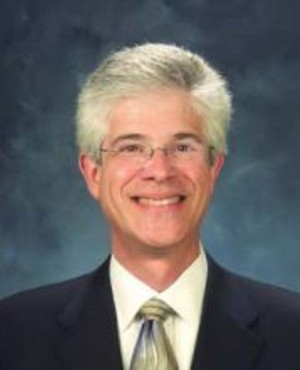
They did not walk it through City Hall themselves. They retained Jeffrey Seymour, whose profession is converting access into approvals. He filed the application. He stood at the podium and argued for it, and returned to give the rebuttal.
He is listed on the city’s own lobbyist registry as retained by Mani Brothers for “ongoing representation” at that address.
What happened next is the part that is not normal. On December 30, 2025, with the application still undecided and sitting in front of the council, Seymour gave Erickson $1,000. Three weeks later the council approved the project, and Erickson stepped out of the vote. The minutes record his reason in his own words: he had taken a campaign contribution from the party in the proceeding.
He had, in other words, identified the conflict precisely, announced it, and given up his vote to cure it. And then, 66 days after the approval, he accepted $2,500 more from the same man.
There is a further point, and it puts Seymour in a worse position than Erickson.
The Levine Act does not restrain only the officeholder. It separately forbids a party’s paid agent from giving an officer of that agency any amount at all, while the matter is pending and for a year after it is decided.
Not more than $500; any amount.
The threshold that governs every other donor in this story does not apply to him, because the Legislature took the view that a person paid to obtain a public decision should not be funding the officials who make it. On the face of that provision both of his contributions were unlawful for him to write, and the ban had been in force for the whole of the period in which he wrote them.
A candidate asking voters to send him to the State Senate in Sacramento should know this part of the law.
The damage here is not that a billboard got approved. It is that the professional retained to obtain a public decision was, at the same time, funding the campaign of one of the people making it, and that when the officeholder saw the problem clearly enough to name it out loud, what he gave up was the vote rather than the money.
In the same campaign filing that reports Seymour’s $2,500, Erickson’s committee returned $4,000 to another donor connected to 9200 Sunset. Somebody was sorting this money. Seymour’s stayed.
The company that collects your trash
Athens Services holds an exclusive franchise to collect West Hollywood’s waste, which means no competitor may bid for your street and every household in the city is its customer by operation of law.
The city never put that franchise out to bid. It began as Athens’s own unsolicited proposal in 2011, was voted down by the council in 2012, and was revived after the company, in the city’s own phrasing, “continued to encourage the City Council to consider their proposal.”
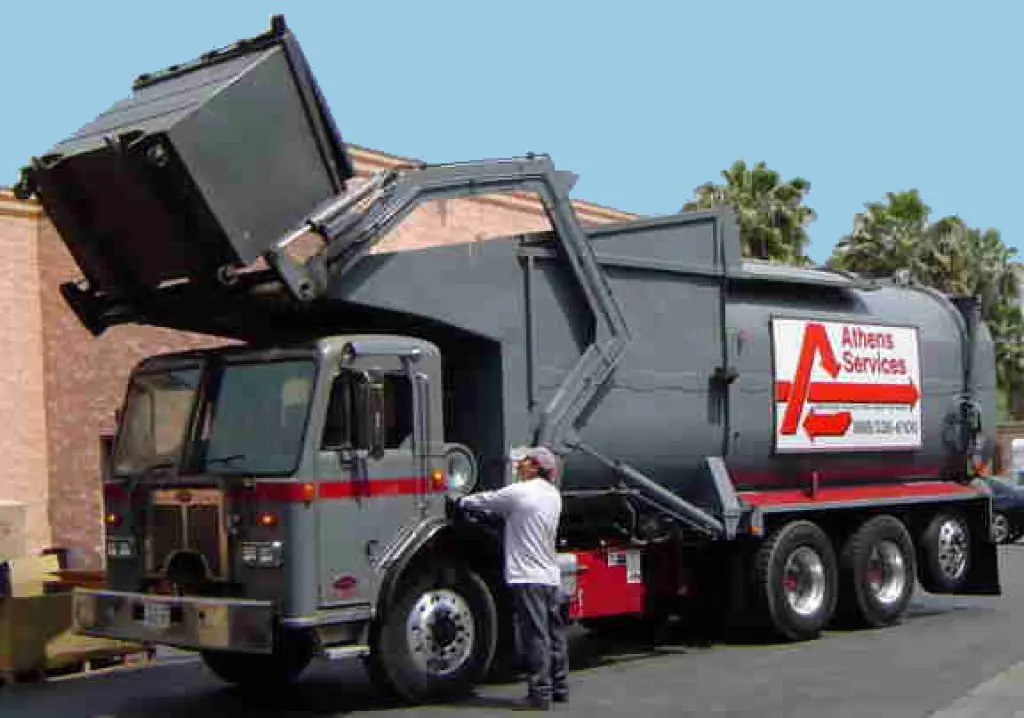
On February 3, 2025, the council approved Amendment No. 4 to that franchise. It was taken on the consent calendar, the block of items passed together without discussion because nobody expects them to be controversial. The staff report records the fiscal impact as none, which is true as far as the city’s own budget goes and beside the point for everyone else, because West Hollywood’s waste system is paid for by residents rather than out of the general fund.
Read the executed amendment and the value is not hard to find. Approval of the company’s annual rate increase “may be done at the administrative level,” and the city “may not unreasonably deny” it. The yearly question of what residents pay to have their bins emptied moved out of a public council vote and into a staff sign-off, with the city’s power to refuse narrowed. The amendment also deleted the Performance Review Methodology, the standard by which the company is judged when it asks to extend its term, and replaced it with a new one, five months before that term was due to expire.
Seven weeks after that vote, Athens Services gave Erickson $5,000. In December it gave $900, and then $5,900. The Levine Act disclosure line in the minutes of the night the council amended the franchise reads, in its entirety, “None.”
Athens was not free to write those checks either. The same statute caps what a party to a proceeding may give an officer of the agency deciding it at $500, for the length of the matter and twelve months beyond it. Each of the three contributions cleared that ceiling by a wide margin, and all three landed inside the window. Whatever else was happening here, it was not a company making an ordinary campaign donation to an official who failed to notice where it came from.
The pharmacy that was turned down
Every three years West Hollywood divides several million dollars among the organizations that deliver its social services. In August 2025 the council worked through 47 applications seeking more than $18 million and allocated $8.3 million of it. Capitol Drugs, a pharmacy on Santa Monica Boulevard, was one of the applicants.
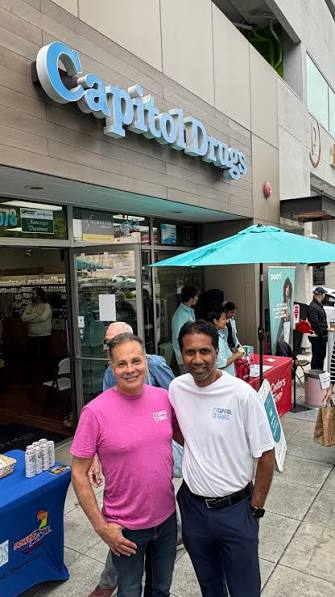
Erickson recused himself from that item, and again he explained why, in language that leaves nothing to interpretation: he was stepping back “due to accepting contributions in excess of $500.” He named the pharmacy. The council then declined to fund it.
Eight months later, on April 30, 2026, the pharmacy’s chief executive gave him $1,000.
That the application failed is worth pausing on, because it disposes of the crudest reading of this story. Nobody bought a vote here; there was no vote to buy.
It also explains why the law is drafted the way it is. A rule that only caught officials who delivered for their donors would be almost impossible to enforce and would miss the actual harm, which is an officeholder maintaining a financial relationship with the people whose applications he judges.
The statute therefore closes the window for a full year after the decision, whoever won.
Why this is not a filing error
The obvious defense in a case like this is inadvertence: a busy official, a large donor list, nobody joining the dots between a check and an agenda item. That defense is unavailable here, and Erickson closed it himself.
Most people, including most officials, understand the Levine Act as a rule about voting. Do not vote on your donors. Erickson followed that rule twice, out loud, and the minutes give him the credit for it. But that is one half of the statute. The other half says an officeholder may not accept the money at all from a party with business before him, and may not accept it for a full year after the matter is decided. Recusal answers the first prohibition and does nothing whatever for the second. The law provides exactly one way to undo an improper contribution, which is to give it back within thirty days.
He gave none of it back. And in two of the three cases, as set out below, the person writing the check was breaking a rule of their own by writing it.
The remainder of this article shows each of these points in the city’s own documents.
He cannot say he did not know
Cases like this are normally defended as bookkeeping: an official who never connected a donor to a vote. Erickson closed that door himself.
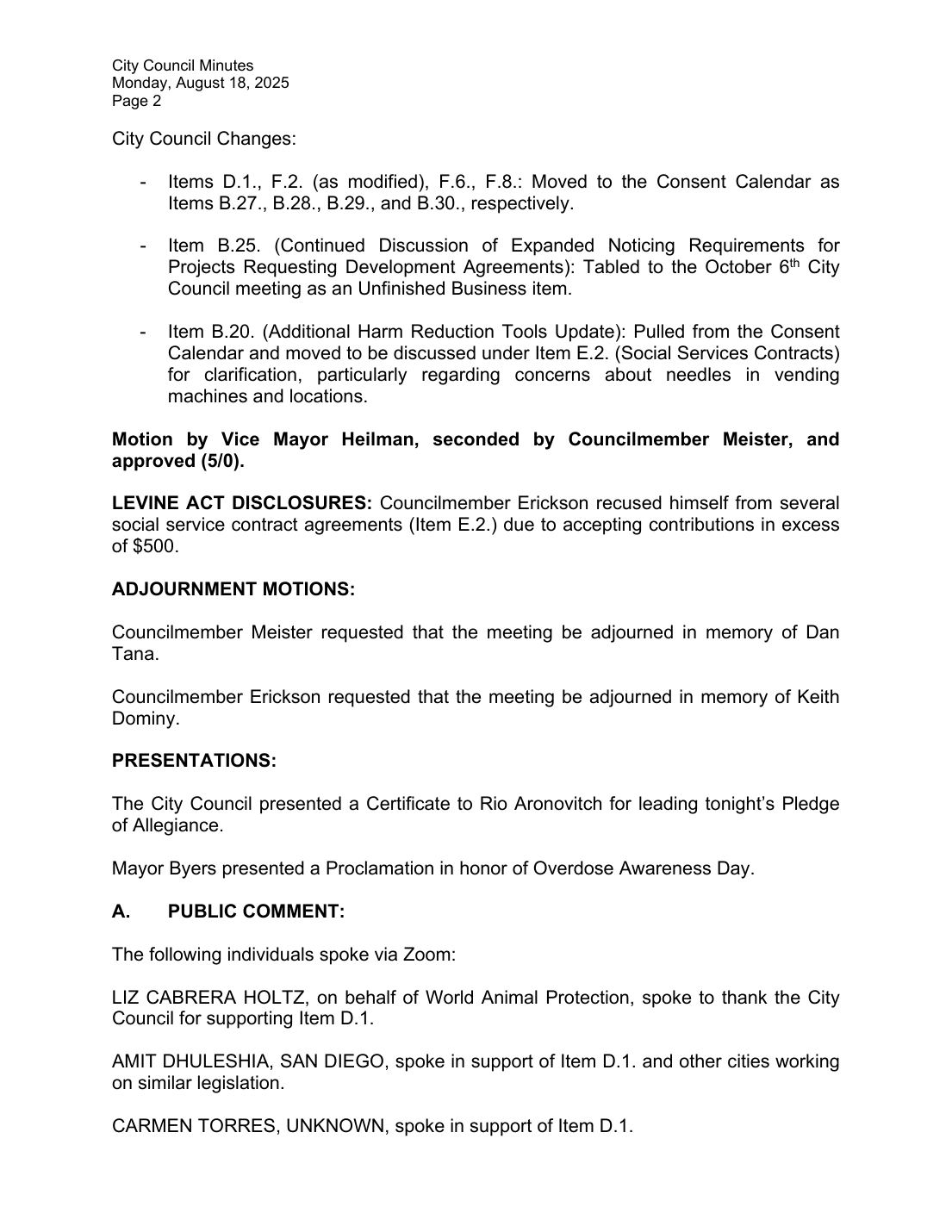
On August 18, 2025, the council was handing out the 2025 to 2028 social services contracts. Forty seven applicants, $18 million in requests, $8.3 million on the table. Before the item was called, the minutes record this:
“LEVINE ACT DISCLOSURES: Councilmember Erickson recused himself from several social service contract agreements (Item E.2.) due to accepting contributions in excess of $500.”
He said it again when the item came up, naming the applicant: his recusal covered “funding recommendations related to Capital Drugs and Defense Diagnostics.”
 12
12
- 1He steps back from the vote
- 2And he names the threshold
He named the law. He named the number. He applied both to a company doing business with his city, and gave up his vote to prove he understood them.
Then he kept taking the money. Four months after that recusal he accepted $900 and then $5,900 from the trash company. Eight months after it he accepted another $1,000 from the pharmacy he had just named.
How the Levine Act actually works
The law is Government Code section 84308. It was written for a specific problem: an official deciding a contract or a permit for the same person who is writing checks to the campaign. Until recently it applied mainly to appointed commissioners. Since January 1, 2023, under SB 1439, it applies to elected city councilmembers too.
Step one: is there a “proceeding”?
The law covers decisions about a license, permit, or other entitlement for use. Section 84308(a)(5)(A) defines that phrase, and it is not narrow:
“‘License, permit, or other entitlement for use’ means all business, professional, trade, and land use licenses and permits and all other entitlements for use, including all entitlements for land use, all contracts, and all franchises.”
All contracts. All franchises. The carve-outs sit in section 84308(a)(5)(B) and there are only three, of which one matters here:
“Competitively bid contracts that are required by law, agency policy, or agency rule to be awarded pursuant to a competitive process.“
What is not covered is general policymaking: a zoning ordinance for the whole city, a budget, a resolution. In City of Agoura Hills v. Local Agency Formation Com. (1988) 198 Cal.App.3d 480 the Court of Appeal adopted the Commission’s own reading, that section 84308 “does not cover proceedings where general policy decisions or rules are made or where the interests affected are many and diverse.”
One named company, one agreement, one recorded vote is the opposite of that.
Step two: who is a “party,” and who counts as their money?
A party is, per section 84308(a)(1), “any person who files an application for, or is the subject of, a proceeding involving a license, permit, or other entitlement for use.”
Winning or losing is irrelevant. An applicant who is turned down is still a party.
An agent, under section 84308(h)(1), is a person who “represents that party or participant for compensation and appears before or otherwise communicates with an agency for the purpose of influencing the proceeding.” And section 84308(h)(3) adds: “‘Agent’ includes a lobbyist registered to lobby the agency and who otherwise meets the requirements of paragraph (1).” A consultant hired to walk a project through city hall is covered by name.
There is also a rule for closely held companies. FPPC Regulation 18438.5(a)(2) aggregates, alongside the party’s own giving, “all contributions made by an individual … required to be aggregated with the party or participant under Section 82015.5.” And Government Code section 82015.5(b) supplies that test: “If an individual directs or controls an entity’s contributions, the entity’s contributions shall be aggregated with contributions made by … that individual.” Note what it turns on. Directing the giving, not owning the company.
Step three: the two prohibitions, and the one Erickson ignores
This is the crux. Section 84308 contains two separate bans, and complying with one does nothing for the other.
Do not vote. An official who has taken more than $500 from a party in the preceding twelve months may not make, participate in, or use their position to influence that decision. The fix is recusal, and it is visible: you announce it and you step back.
Do not take the money. Section 84308(b)(1): while a proceeding “is pending, and for 12 months following the date a final decision is rendered in the proceeding, an officer of an agency shall not accept, solicit, or direct a contribution of more than five hundred dollars ($500) from any party or a party’s agent.” This one is invisible. Nobody announces it from the dais, and it is not cured by recusing.
Recusal does not fix the money. Giving up your vote is not the same as giving back the check. The statute provides exactly one cure, in section 84308(d)(2)(A): returning the contribution, or the portion over $500, “within 30 days of accepting.”
The clock
- The ban switches on when the matter becomes pending.
- It stays on through the hearing and the vote.
- It keeps running for twelve months after the decision, win or lose, whether or not the official recused.
- Only a return within 30 days undoes an acceptance inside that window.
And this is the part that answers the obvious dodge
Which campaign account the money lands in makes no difference.
The natural objection is that this money went to a state senate campaign, not a city council campaign, so a city rule should not reach it. The Legislature closed that door in the definitions. Section 84308(a)(6):
“‘Contribution’ includes contributions to candidates and committees in federal, state, or local elections.”
Federal, state, or local. If the councilmember controls the committee, the money is his for this purpose, whatever office the committee was opened for. A sitting local official who is running for higher office does not get a clean second account. The elsewhere-facing campaign is bound by the same rule as the city one, and the statute says so in terms rather than by implication.
So the rule for a candidate controlled committee is simple to state. If the person who controls that committee sits on a body that has a matter pending from a given party, or decided one in the last twelve months, then that committee must not accept more than $500 from that party or its paid agent. It does not matter whether the committee is for city council, state senate, or Congress. If it does accept, the money has to go back within 30 days.
The $500 figure is the ceiling on what the officeholder may accept. It is not the ceiling on what a paid agent may give.
Section 84308(e)(3) bars an agent of a party from giving an officer of the deciding agency a contribution in any amount over the same period. The two rules sit on opposite sides of the same transaction, and they are not set at the same number, so a contribution from a lobbyist can be lawful for the councilmember to accept and unlawful for the lobbyist to have written.
With that in hand, here is what the records show.
Case one: the billboard. $3,500.
In June 2022 an application landed for a large off site advertising sign at 9200 Sunset, the project pitched as the “Legacy Loop.” The city’s ordinance names who filed it.
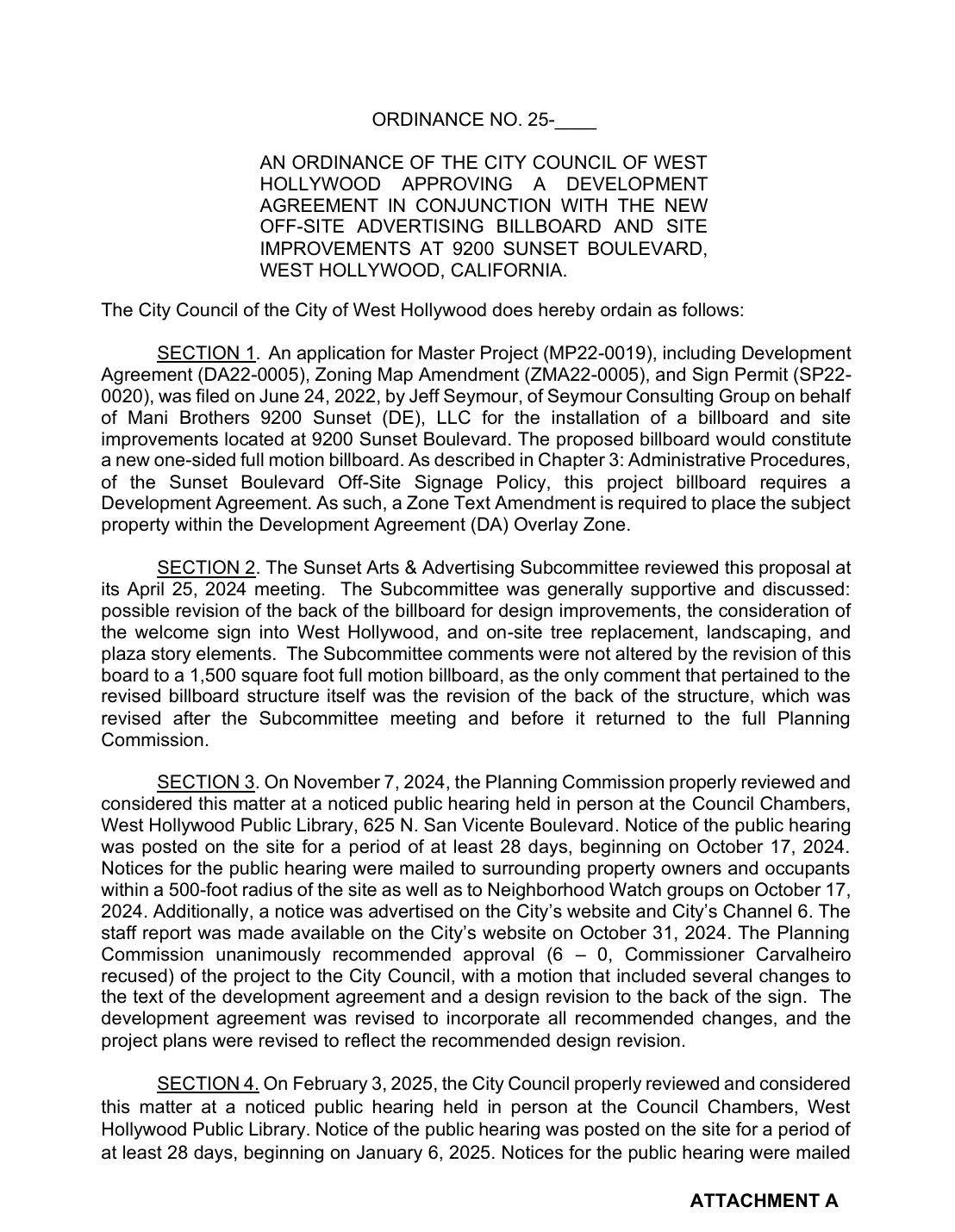 1
1
- 1The paid agent
Seymour did not just file it. He worked it. When the item came before the council, the minutes record that “Jeff Seymour and Benjamin Anderson, on behalf of the applicant team, provided background information,” and that “Jeff Seymour provided rebuttal on behalf of the applicant.”
And the city’s own lobbyist registry closes the loop, because it names the client and the address.
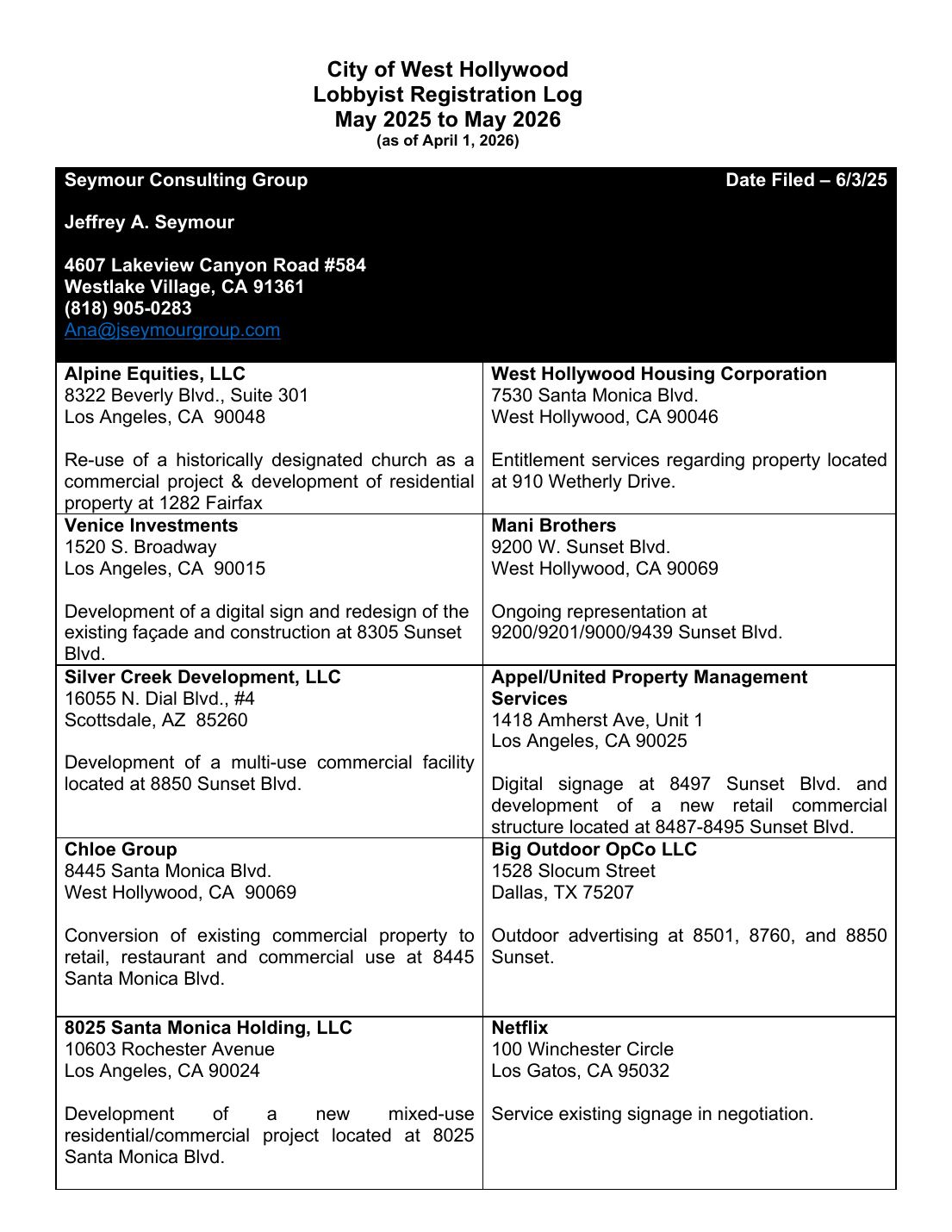 12345
12345
- 1The registrant
- 2The registered lobbyist
- 3The client
- 4Compensated representation
- 5On this property
Paid representation, this client, this property, declared to the city in writing, over a period covering both checks. That is the statutory definition of an agent, met three separate ways on three separate city records.
| Date | Amount | Where the proceeding stood |
|---|---|---|
| December 30, 2025 | $1,000 | still pending |
| March 27, 2026 | $2,500 | 66 days after the final decision |
| Total, none returned | $3,500 |
Here is the part that should end any argument about whether Erickson understands this statute. On January 20, 2026, three weeks after taking Seymour’s first check, he recused from the 9200 Sunset item and the minutes record exactly why.
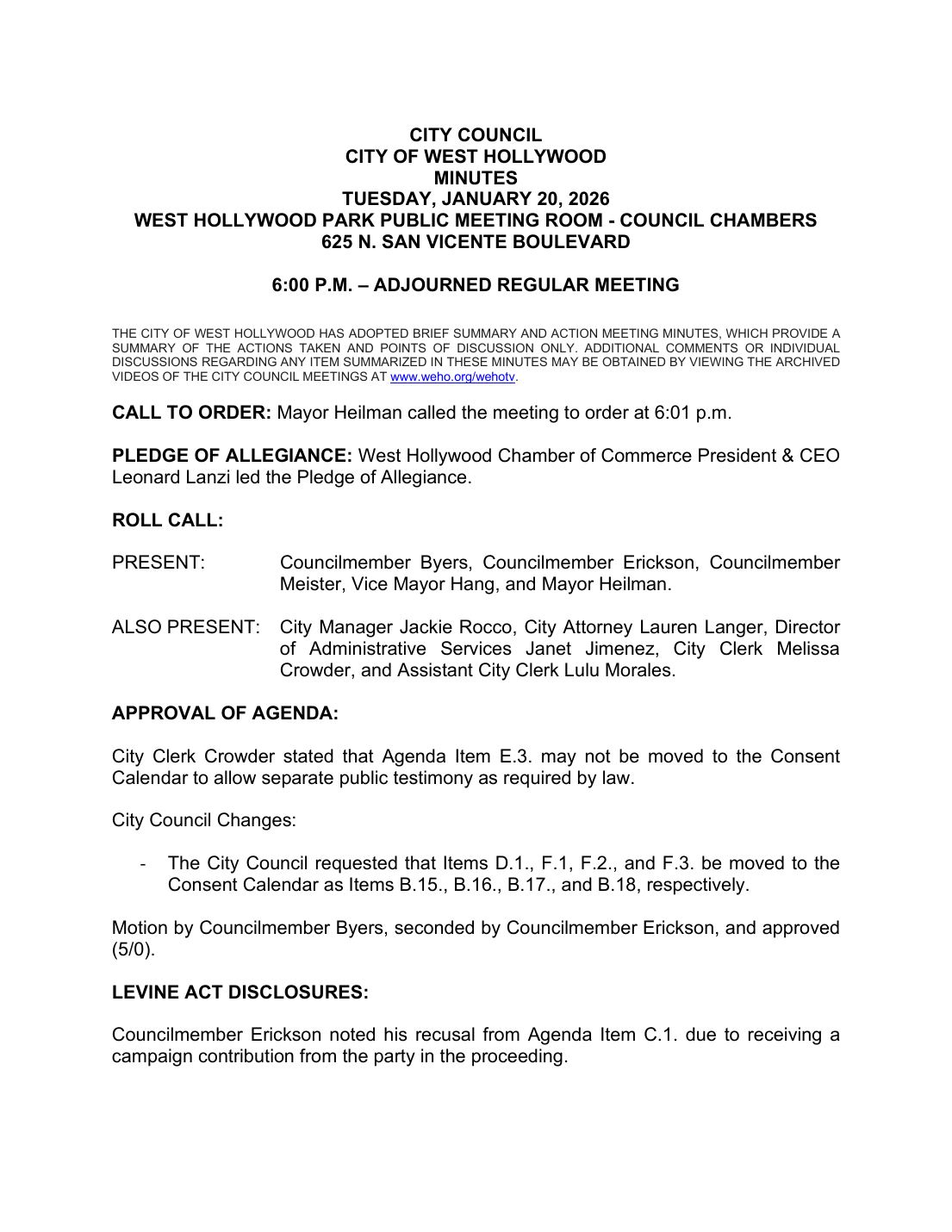 1
1
- 1He sees the conflict
He identified the conflict. He named the reason. He gave up the vote. That is subdivision (c), correctly applied.
Then, 66 days after the project was approved, he accepted $2,500 more from the same man. That is subdivision (b), and recusing did nothing for it.
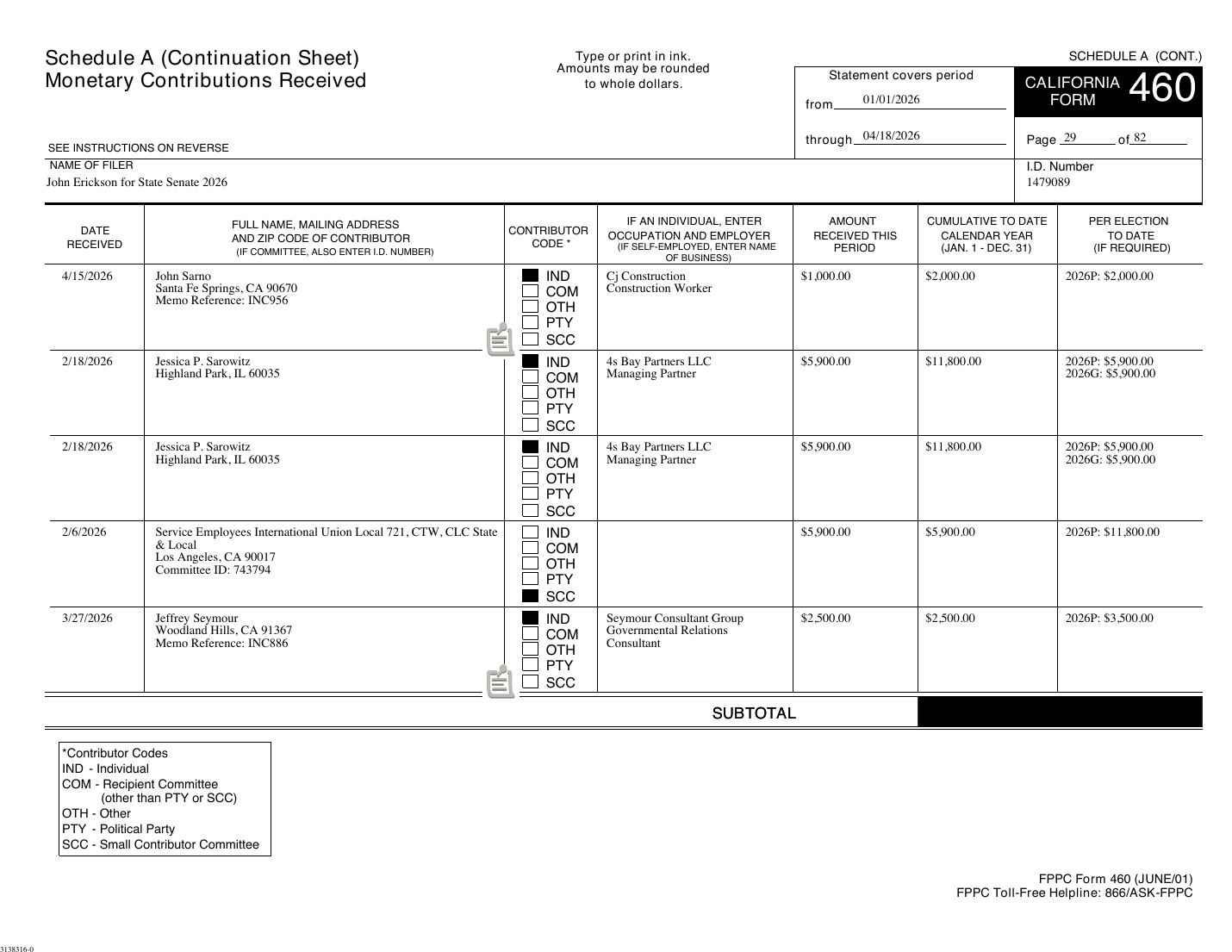 1
1
- 1Cumulative $3,500
The refund mechanism was not a mystery to this committee either. In the very same filing, it sent back $4,000 to another 9200 Sunset donor and booked the running total at zero.
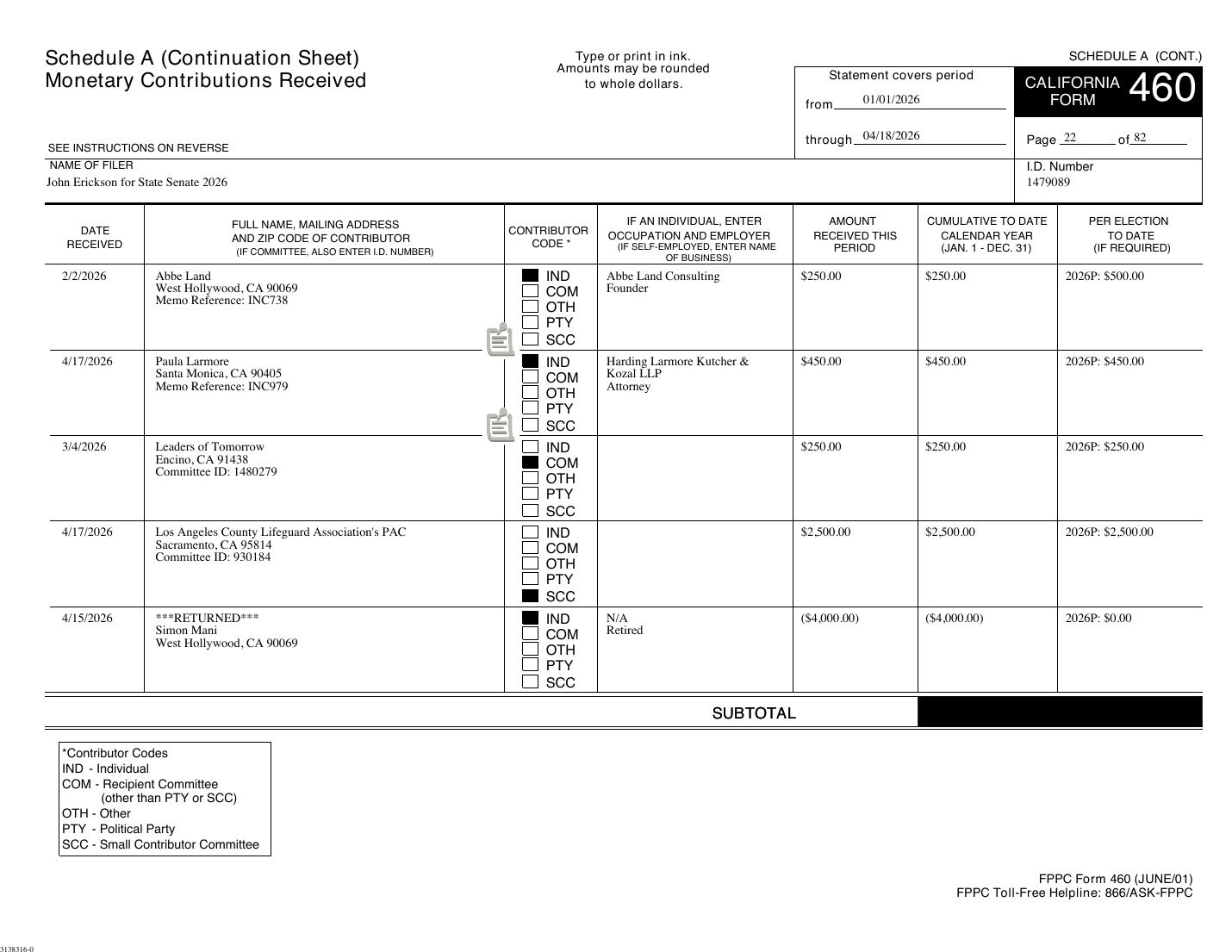 1
1
- 1Returned in full
Case two: the trash contract. $11,800.
On February 3, 2025, the council approved Amendment No. 4 to the city’s exclusive solid waste franchise with Arakelian Enterprises, Inc., doing business as Athens Services. The company that picks up your garbage, on the contract that makes it the only company allowed to.
It went through on the consent calendar. Erickson was present. The Levine Act disclosure line in the minutes for that night reads, in full: “None.”
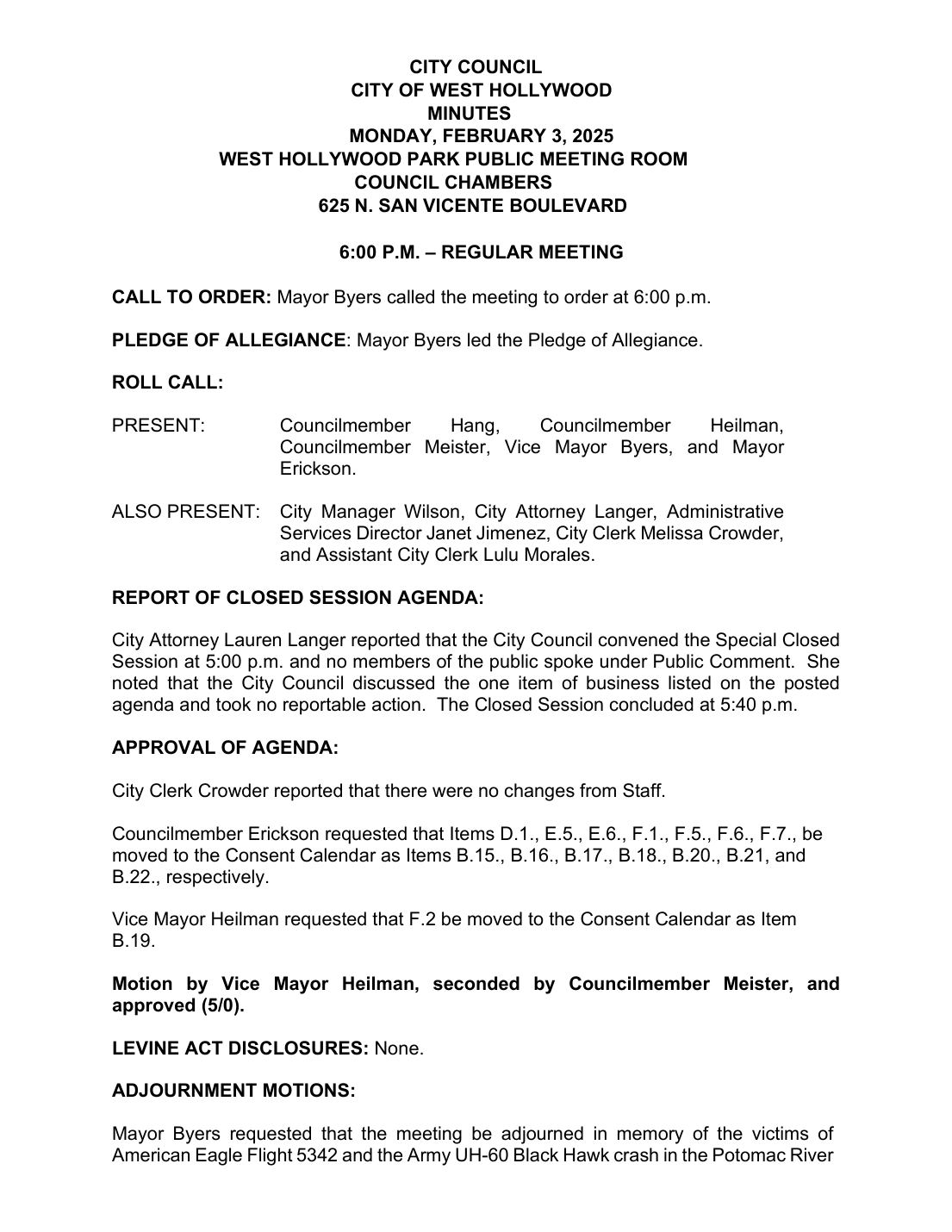 1
1
- 1Nothing declared
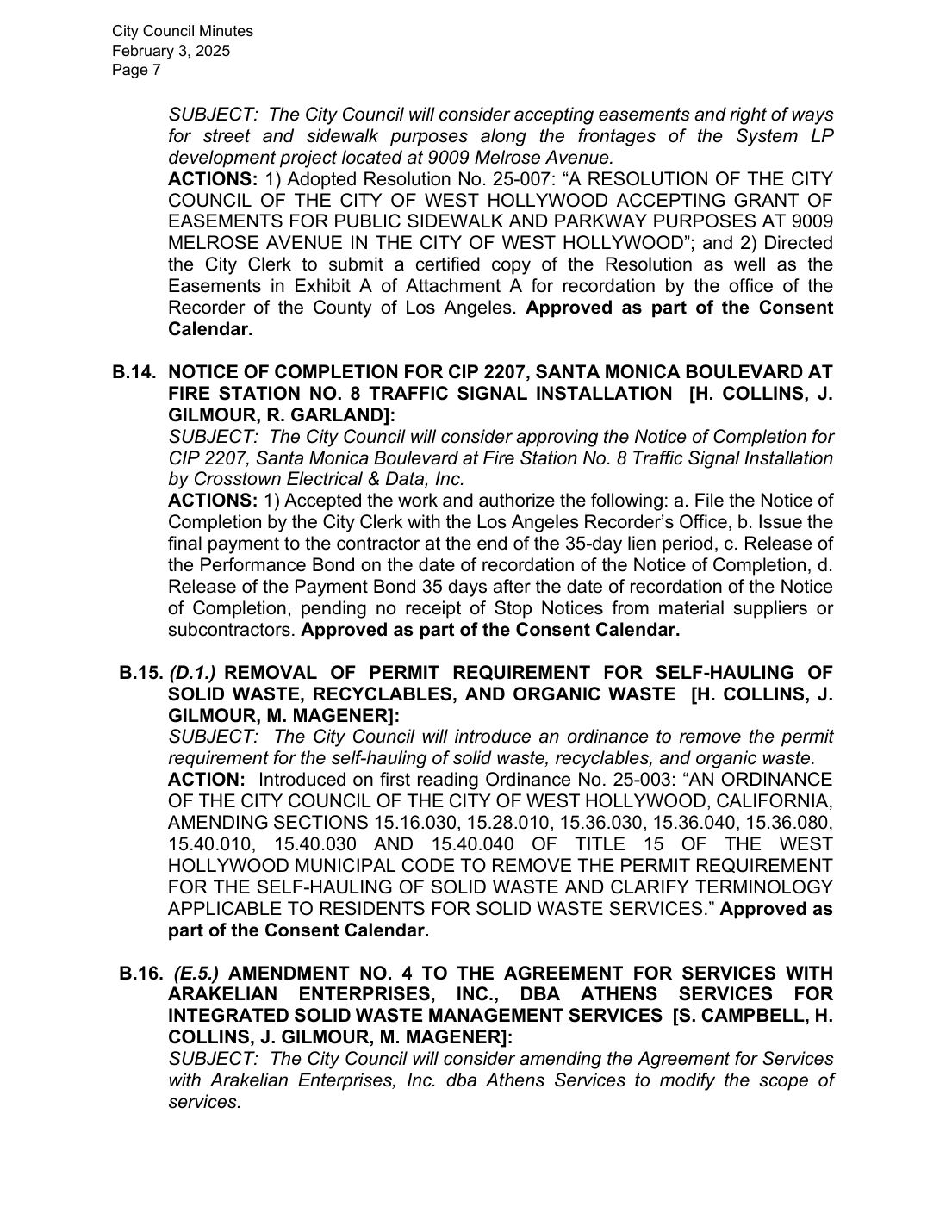 1
1
- 1The party to the proceeding
Then this happened.
| Date | Amount | Days after the decision |
|---|---|---|
| March 27, 2025 | $5,000 | 52 |
| December 12, 2025 | $900 | 312 |
| December 30, 2025 | $5,900 | 330 |
| Total, none returned | $11,800 |
All of it inside the twelve month window. All of it from Athens Services itself, not a lobbyist, not an executive, not a cousin. The company that got the vote wrote the checks.
Look at the dates on the last two. December 12 and December 30, 2025. That is nearly four months after he stood up on August 18 and explained to the room that taking more than $500 from a city contractor meant he had to step back.
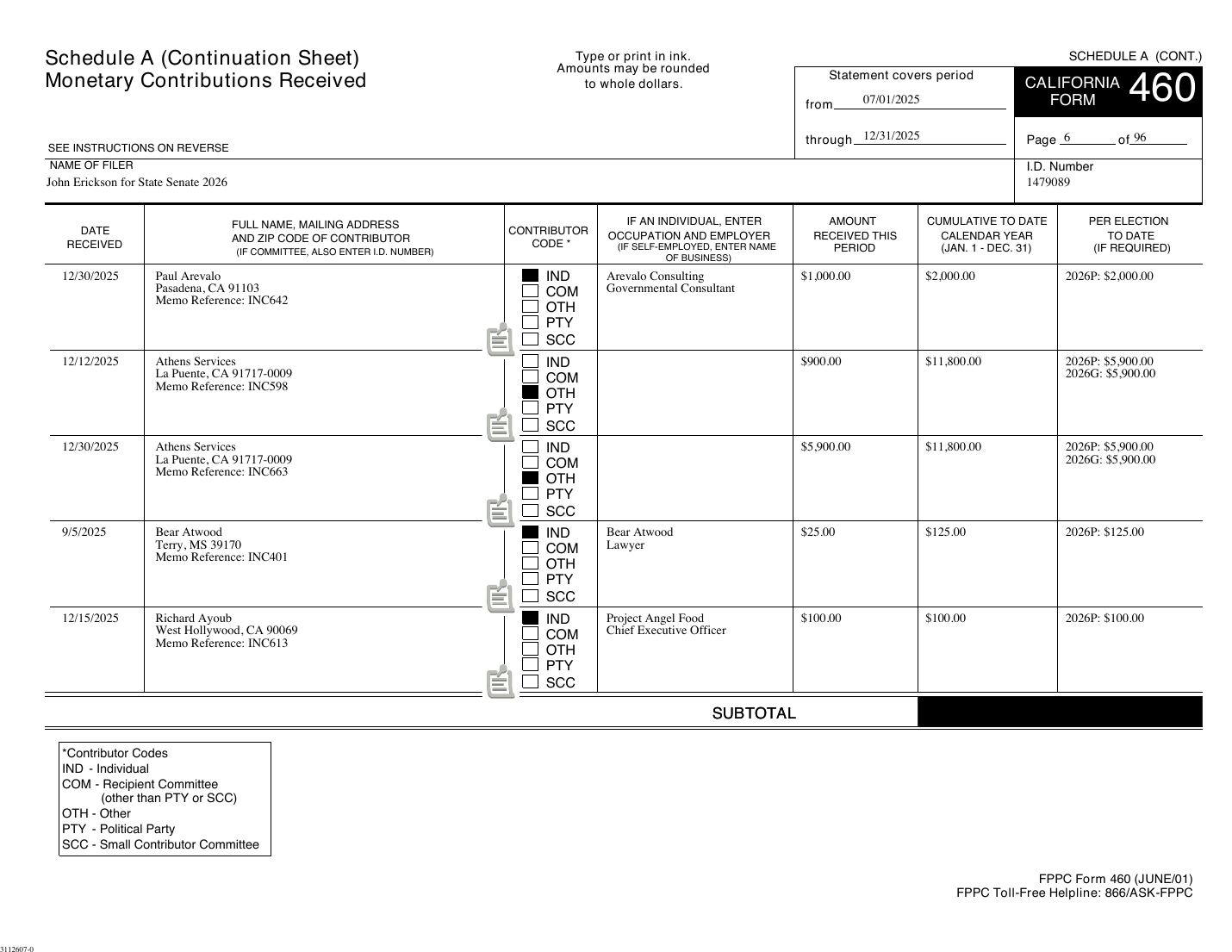 1
1
- 1The company that got the vote
“But it was competitively bid, so the law does not apply.”
It was not. The city’s own staff report of June 23, 2014 lays out where this agreement came from. It started as Athens’s own unsolicited proposal in December 2011. The council voted it down in July 2012. Then, in the report’s own words, “Athens Services continued to encourage the City Council to consider their proposal.” The city hired a consultant to evaluate Athens’s request and draft an agreement with Athens. No request for proposals. No competing bidder.
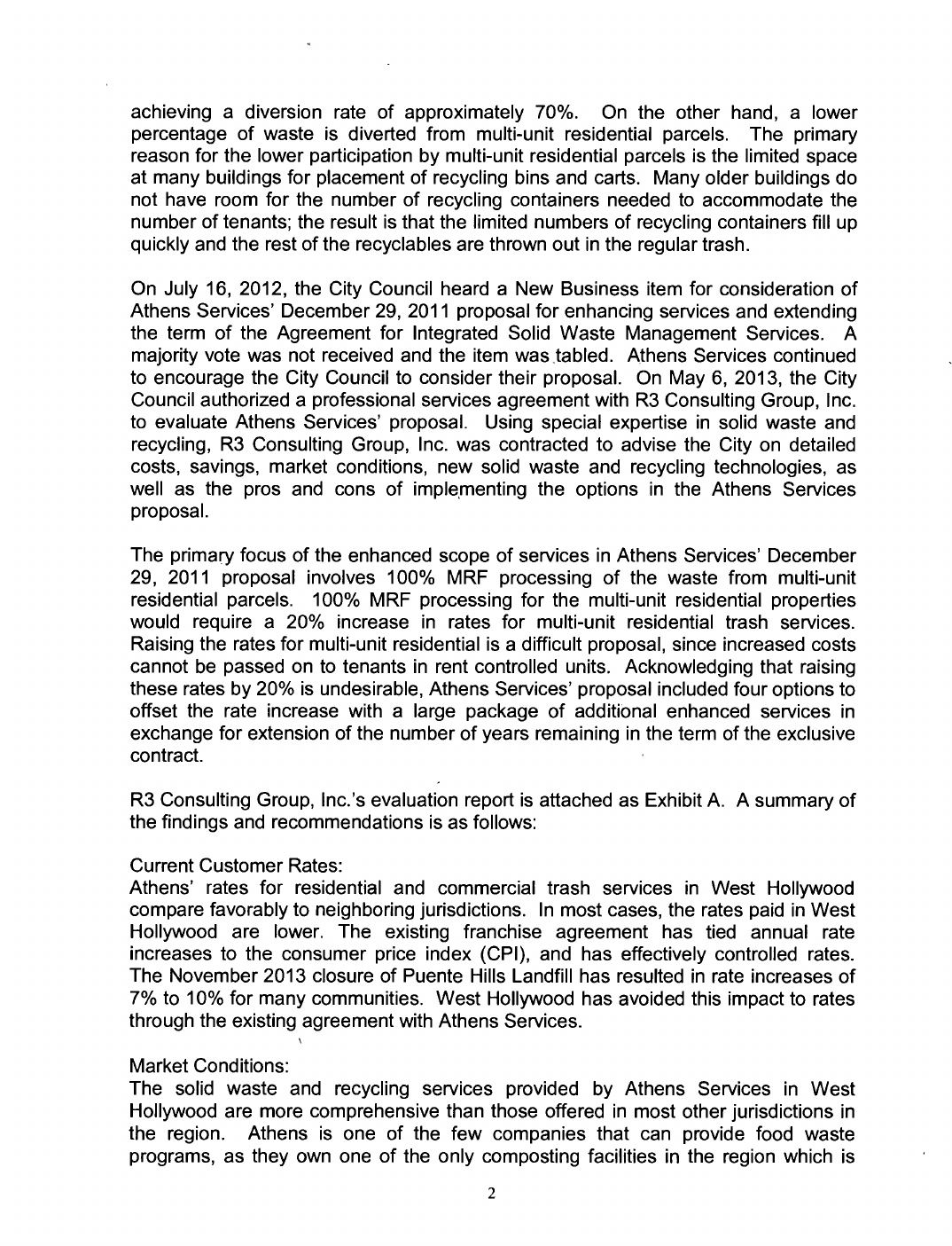 12
12
- 1Voted down in 2012
- 2Then revived by the vendor
Public Resources Code section 40059(a)(2) expressly lets a city provide solid waste handling by “wholly exclusive franchise, contract, license, permit, or otherwise, either with or without competitive bidding,” and West Hollywood took the second option. That matters twice over, because of how the exemption is written. Section 84308 does not exempt contracts that merely happened to be bid. It exempts contracts required by law, policy or rule to be bid. Nothing required this one. The exemption misses on both halves.
Meanwhile the statute covers “all franchises” by name, and the city’s own paperwork calls this one a “franchise agreement.”
Case three: the pharmacy. $1,000.
Back to the recusal at the top of this article.
Capitol Drugs, the pharmacy at 8578 Santa Monica Boulevard, had applied for a social services contract. Erickson recused, naming it. The council declined to fund it, citing duplication.
That did not end anything. Once a decision is rendered, the ban on accepting runs for the next twelve months, win or lose. The window ran to August 18, 2026.
On April 30, 2026, 255 days into it, the committee accepted $1,000 from Rajashekar Sannidhi, who listed his employer as “Capitol Drugs.” California’s Secretary of State says who Sannidhi is.
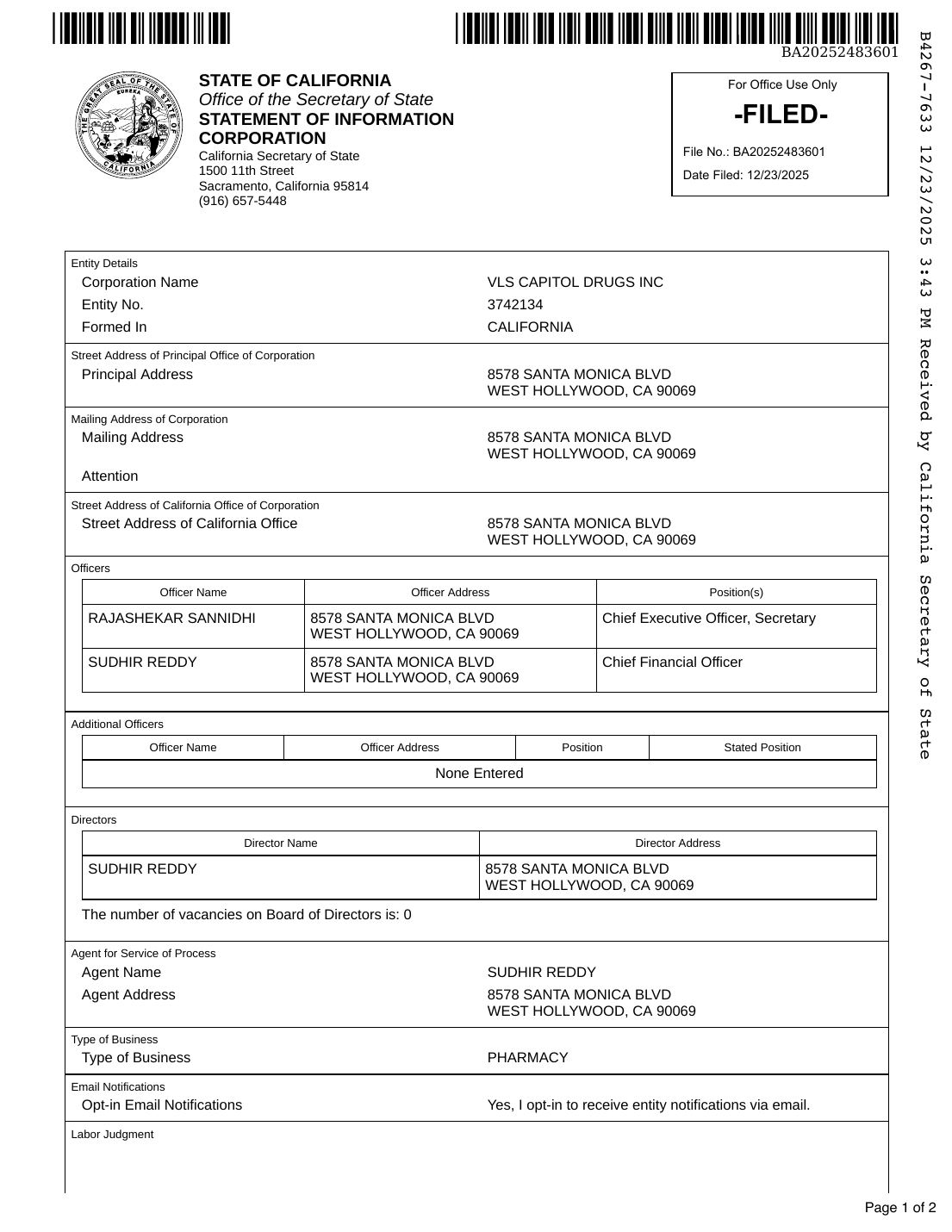 123
123
- 1The applicant company
- 2The contributor
- 3Its chief executive
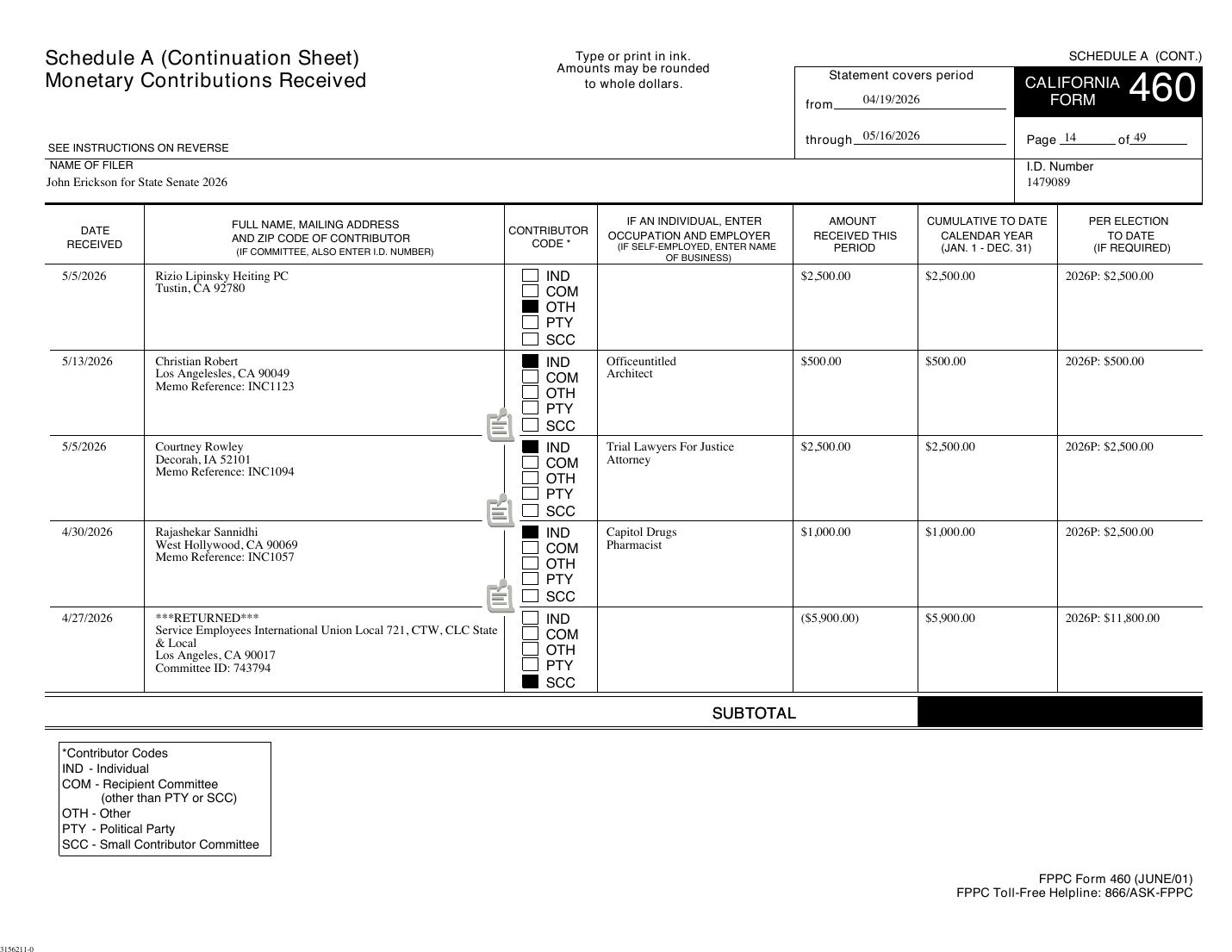 12
12
- 1The count
- 2Unrelated donor, returned
It was illegal to give, too
Everything above is about what Erickson was barred from taking. The Levine Act has a second half, pointed at the other end of the transaction, and it catches two of these three.
Section 84308(e)(2) bars a party to a proceeding from making a contribution of more than $500 to an officer of the agency deciding its matter, during the proceeding and for twelve months after the decision. Athens Services is the party. It gave $5,000, then $900, then $5,900. Every one is over the line, and every one is inside the window.
Section 84308(e)(3) is harder still, and it is aimed squarely at the people paid to work City Hall. An agent of a party “shall not make a contribution in any amount” during that same period. Not more than $500. Any amount. One dollar would do it.
Jeffrey Seymour is the agent, on three separate city records: he filed the application, he appeared before the council for the applicant, and the City Clerk’s own lobbyist registry lists him as retained by Mani Brothers for “ongoing representation” at that address. He gave $1,000 while the billboard was still pending and $2,500 after it was approved. On the face of the statute both were prohibited for him to make, and the $500 threshold that governs everyone else does not apply to him at all.
That provision is new. It took effect on January 1, 2025. Before then, an agent’s giving was simply added to the party’s running total; now it is banned outright. Both of Seymour’s contributions came after the change.
The pharmacy is different, and we say so plainly. The party there is the company, VLS Capitol Drugs Inc, and the check came from its chief executive personally rather than from the company. Section 84308(e)(4) provides that when “a closed corporation is a party to, or a participant in,” such a proceeding, “the majority shareholder is subject to the disclosure and prohibition requirements” of the section, and we have not established who holds the shares. We make no claim that Rajashekar Sannidhi violated the giving side of the statute.
None of which changes who this article is about. Erickson is the officeholder, the one the public elected, and the only one of the four who took an oath. But the record does not support the idea that he was the passive recipient of money he had no business accepting. On these documents, the trash monopoly and the billboard lobbyist were not supposed to be writing him checks either.
“It went to my senate campaign, not my council account.”
As set out above, the statute answers this directly: contributions to committees in federal, state or local elections all count. But there are two further reasons this defense is unavailable here.
The first is that the committee is his in every sense. He is the candidate and he is the treasurer.
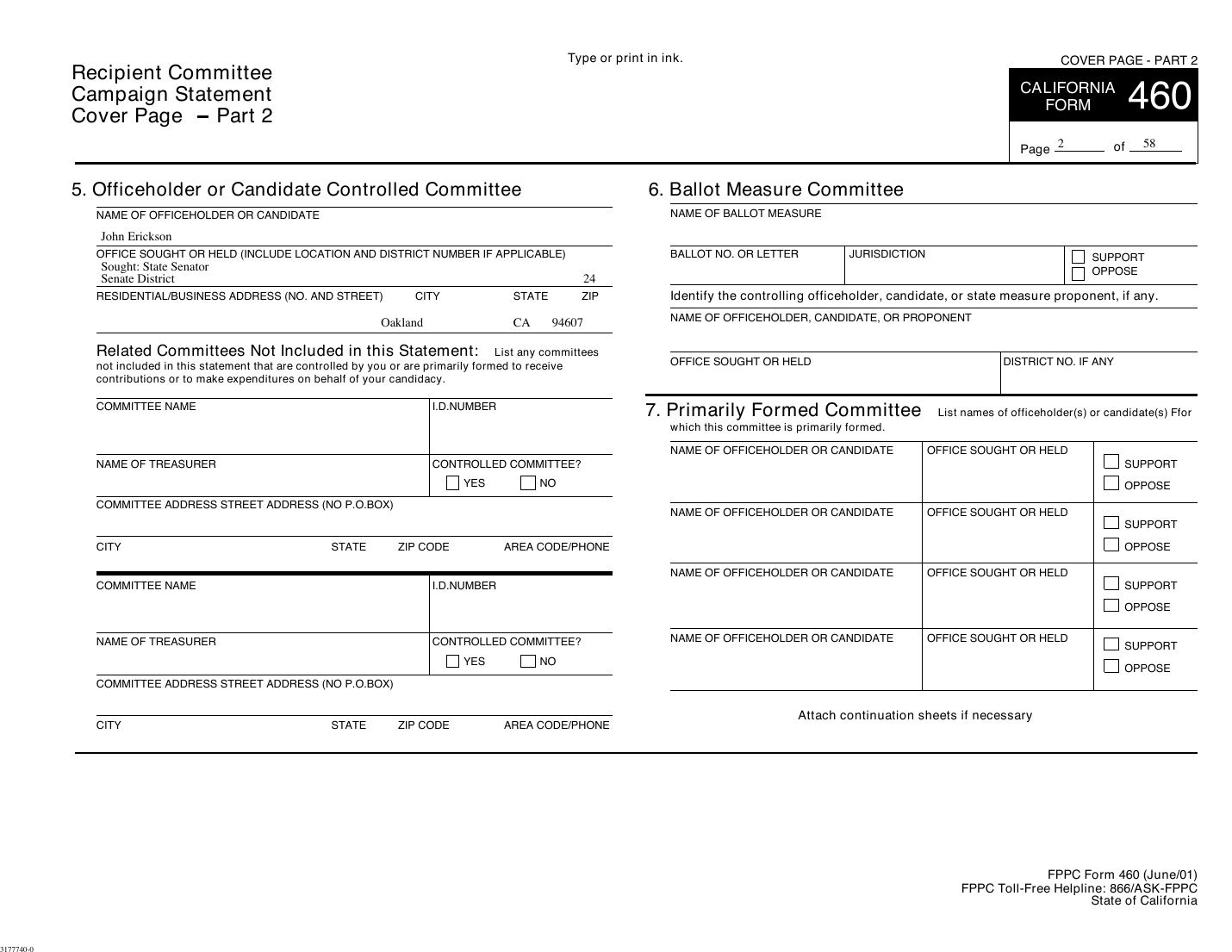 1
1
- 1He controls it
The second is that this very council has already applied the rule the other way, with Erickson in the room. On March 18, 2024, a colleague treated contributions to her congressional campaign, a federal committee even further from city hall than a state senate seat, as triggering the Levine Act, and stepped back.
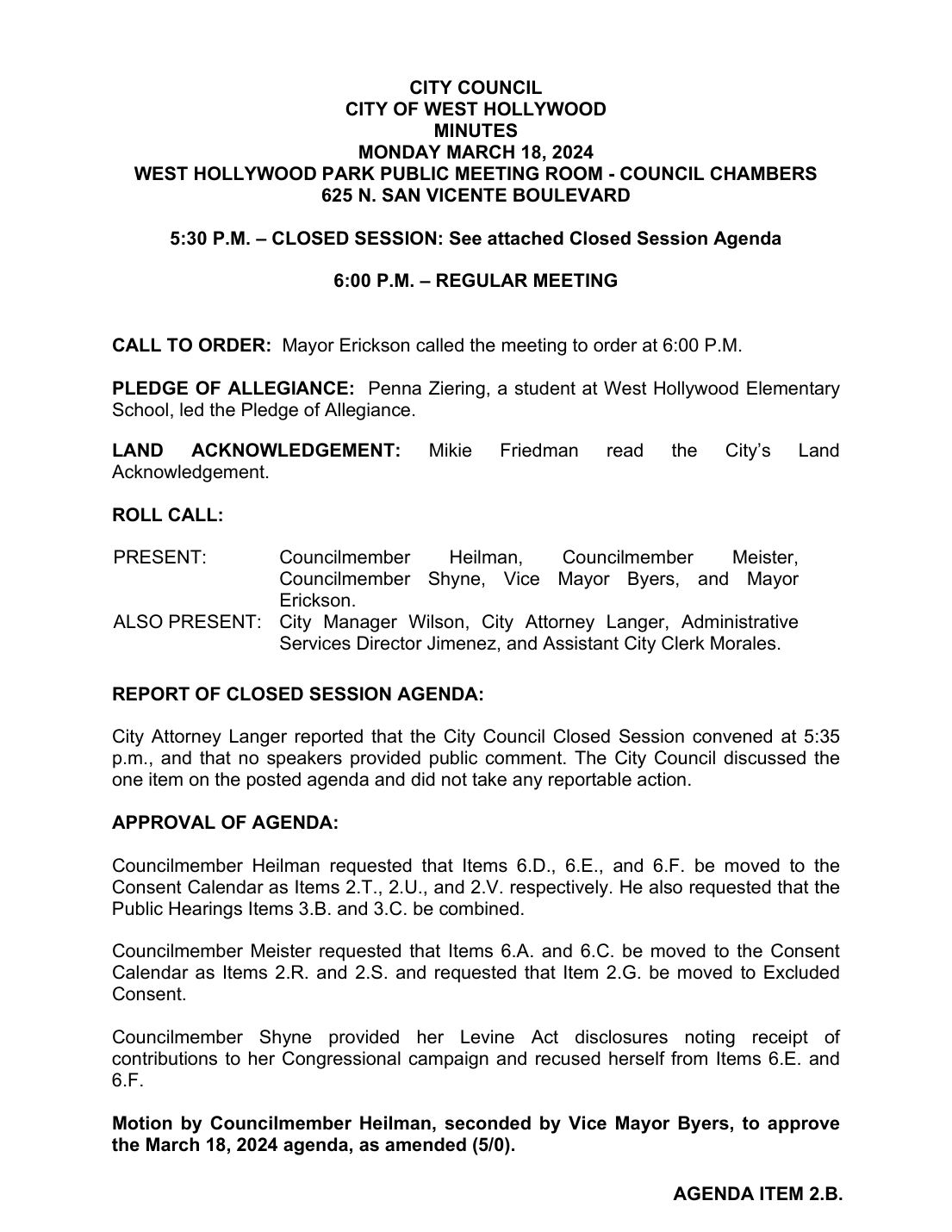 12
12
- 1A federal committee
- 2He was in the chair
The roll call for that meeting begins: “Mayor Erickson called the meeting to order at 6:00 P.M.”
He was in the chair.
What this adds up to
Three parties. Three unrelated proceedings: a billboard entitlement, a garbage franchise, a pharmacy’s contract bid. Six contributions. $16,300. Every one larger than the $500 line. Every one inside a window the statute closes. Not a dollar returned, by a committee that was returning other people’s money the entire time.
| Party | Proceeding | Amount | Position |
|---|---|---|---|
| Mani Brothers, via its agent | 9200 Sunset billboard | $1,000 | pending |
| Mani Brothers, via its agent | 9200 Sunset billboard | $2,500 | +66 days |
| Athens Services | Solid waste franchise | $5,000 | +52 days |
| Athens Services | Solid waste franchise | $900 | +312 days |
| Athens Services | Solid waste franchise | $5,900 | +330 days |
| Capitol Drugs, via its chief executive | Social services contract | $1,000 | +255 days |
| Total accepted, none returned | $16,300 |
In two of the three cases he stood up beforehand and recused, proving he can see the conflict when it is in front of him, and then accepted the money afterward, when the statute still forbade it. The pattern is not that he does not understand the Levine Act. The pattern is that he understands the half about voting and behaves as though the half about money does not exist.
State law contemplates a penalty of up to $5,000 per violation. The Fair Political Practices Commission has fined an official $2,000 for a single $550 acceptance, and cut that figure because the money went back.
John Erickson gave nothing back. The $16,300 is still there, still funding a campaign for the State Senate, still money the Levine Act says a councilmember in his position was not entitled to accept.
Every day it stays in that account is another day he is choosing to keep it.
Evidence file
The documents. Every record shown above is public and we have posted all of them in full, unmarked, with the page numbers we cite: the council minutes, the staff reports, the executed franchise amendment, the ordinance naming the applicant’s agent, the city’s lobbyist registry, the Secretary of State corporate filings, and the campaign finance reports. Read them yourself. That is the point.
Annotation. The red underlining on the images above was added by OccupiedWeHo to mark the language we quote. Nothing has been drawn on the originals, and nothing has been retyped. Where a document is reproduced here, the complete unaltered file is in the evidence folder.
On the giving side. The prohibitions in section 84308(e)(2) and (e)(3) run against parties and their agents, and this article reports what the public record shows about Athens Services and Jeffrey Seymour under those provisions. Neither has been charged with anything, and no agency has made any finding. We make no claim about Rajashekar Sannidhi under those provisions.
Corrections. If any date, dollar figure or quotation here is wrong, write to us and we will correct it at the top of this page within 24 hours.


