





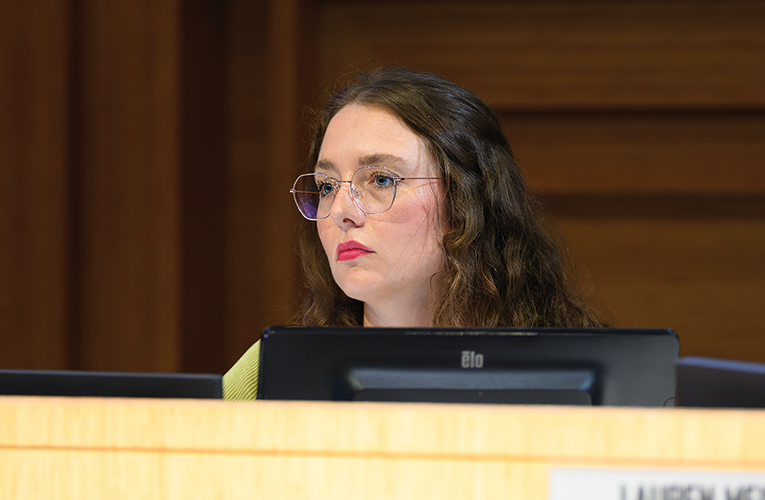
Nearly four months ago, the West Hollywood City Council stopped a housing vote and asked the state whether Councilmember Chelsea Byers should be casting it, because she is paid by a national advocacy network that campaigns for the same housing and parking policies she votes on. The State still has not answered thanks to the City Attorney misunderstanding the law and fumbling the referral. On Monday, Byers takes her seat for Item F.5, a vote on whether to reconsider removing 210 parking spaces from Fountain Avenue.
Byers’ employer has a script for exactly this fight. Last December it co-published a 22-page guide, built with professional pollsters and tested on thousands of people, that teaches lawmakers and advocates how to win parking fights: say “flexibility,” never “eliminate”; steer residents away from “Where will I park?”; treat their worries about overflow as “what if” scenarios; and concede that communities need parking, because the concession “works.” Below, we walk through that playbook, set Byers’s own words beside it, explain why the state’s rules and its Santa Monica ruling point to recusal, and give you a comment to read on Monday demanding that she step aside.
Last June, we reported that Chelsea Byers is paid to lobby against single-family homes and parking. Her day job is with the Welcoming Neighbors Network, a national 501(c)(4) whose California members, California YIMBY and Abundant Housing LA, helped sponsor SB 79, the state law that brings taller apartment buildings to neighborhoods near transit. She reports the salary on her own financial disclosure. We published the network’s focus-grouped messaging playbook and set her words from the dais beside it.
The next night, residents filled public comment, and the Council voted 3 to 2 to pause a housing item and refer the question to the Fair Political Practices Commission. Vice Mayor Danny Hang joined Mayor John Heilman and Councilmember Lauren Meister, saying it would “put an end to any fog of speculation.” Byers and her closest ally, John Erickson, voted no. Given the chance to answer, Byers defended her beliefs instead: “my day job is working for a cause that I am and have been passionate about.”
The record started disappearing almost immediately. Her LinkedIn job description came down. Her employer deleted dozens of its own posts, including its celebrations of SB 79, and we published the 42 we had already archived. At a regional planning board, Byers said her employer takes no position on housing or parking; its own posts said otherwise.
On July 13, City Attorney Lauren Langer sent the state a formal request for advice. It lists ten upcoming decisions and asks whether Byers may take part in them. The second is a citywide ordinance removing minimum parking requirements. Santa Monica had asked the same kind of question about its own councilmember, Jesse Zwick, a paid director of a pro-housing advocacy group, and was answered in seventeen working days: Zwick was barred from his city’s housing decisions. The state’s 21-working-day window for West Hollywood’s request closed on August 11. On August 31, according to the draft minutes, Langer told the Council the advice is delayed while the state’s enforcement division reviews a separate complaint raising similar questions. The clock has kept running, and as of October 8 no answer had been published. (The full paper trail is here.)
Now it is Parking on Fountain
In September 2025, with Byers presiding as Mayor, the Council voted 3 to 2 to redesign Fountain Avenue with protected bike lanes and the removal of “approximately 210 parking spaces, or approximately 60 percent of existing on-street parking.” Byers voted yes; Heilman and Meister voted no. (We covered that fight too.)
Monday’s Item F.5, brought by Meister, asks staff to evaluate a version that “would retain existing parking and omit protected bikeways,” while keeping the lane reduction and adding a center turn lane, high-visibility crosswalks, painted curb extensions and traffic calming. Staff warns the change could put part of a $4.6 million state grant at risk unless the agency that awarded it signs off, and would report back before anything is built. (F.5 staff report) It is, in the staff report’s own words, about “residential access, parking retention, and pedestrian accessibility.”
Which brings us back to Byers’s employer. The network that pays her has a script for exactly this kind of fight. Here is what it says, so you will recognize it on Monday.
A 22-page script, written for lawmakers
In December 2025 the Welcoming Neighbors Network, the Parking Reform Network and Sightline Institute published “Crafting Powerful Parking Reform Messages,” a 22-page deck and a two-page summary, posted on the network’s own messaging page. (deck, archived copy; two-pager, archived copy) The first page says who it is for:
“With research-backed and road-tested messages, lawmakers and advocates can build support for parking flexibility across race, class, and party affiliation.”
And it says what the job is: “We can make an obscure issue like parking policy feel urgent.”
This was not a blog post. According to its methods page, the groups worked with the polling firms FM3 and Global Strategy Group and the testing platform Grow Progress. They ran a national survey of 1,211 people, a second national parking survey of 832, focus groups with suburban renters and homeowners, and a survey of 500 “influencers,” which the deck describes as “a proxy sample for politically-engaged community members and lawmakers.” Then they ran randomized controlled trials on 2,800 more people to measure which messages persuade.
The research ran from the fall of 2024 through the fall of 2025. Byers went to work for the network in November 2024.
Say “flexibility.” Never say “eliminate.”
Like the housing deck we published in June, the parking deck comes with a list of words to use and words to avoid. Here it is, as printed:
| DO say | DON’T say |
|---|---|
| Allow parking flexibility | Eliminate parking mandates |
| Wasteful parking mandates | Parking minimums; parking requirements |
| Wasted space, empty parking lots, acres of asphalt; prioritize home choices over waste and pavement | Car storage; homes for people, not cars |
| Local homebuilders, property owners, business owners; more home choices, local business investment | Developers; development |
| Neighborhoods where you can live near jobs and shopping, classic Main Street neighborhoods | Walkability, walkable |
| Focus on flexibility and safe, connected neighborhoods | Avoid using jargon or keeping the conversation on cars |
Read the right-hand column. Those are the honest words, and they are the ones the network uses when it is celebrating instead of persuading:
- “Missoula, Montana notched a HUGE zoning reform win… Eliminated (❗) parking mandates citywide (‼️)” (February 3, 2026)
- “KCMO nixed parking mandates across its urban core. Goodbye to empty asphalt” (May 4, 2026)
- “Homes > parking. Always.” (May 16, 2024)
- Quoting Abundant Housing LA, one of its California members: “Are we going to prioritize housing for cars? Or are we going to prioritize housing for people?” (July 1, 2025)
“Eliminate” and “homes for people, not cars” are on the don’t-say list because they lose. They are still the goal. West Hollywood’s own version of it is the 2025 Council direction “to prepare a Zone Text Amendment to eliminate parking minimums throughout the City.” The minutes: “Motion by Councilmember Erickson, seconded by Mayor Byers, and approved (4/1).”
“Where will I park?” is the question they are trained to change
The deck is frank about the obstacle. It is you, behind the wheel:
“Avoid leading with calls or implicit suggestions to drive less, reduce car dependence, or switch to public transit. While important, these messages can put people on the defensive…”
“…when they’re thinking in ‘driver mode,’ more parking sounds good and the prospect of less parking causes anxiety.”
Note “while important.” Getting people out of their cars is not dropped as a goal. It is just not said out loud. The fix the deck recommends is to change the subject: “Switch the frame from ‘Where will I park?’ to ‘What’s it like to live here?'”
Then it tells advocates what to do when neighbors worry about where the cars will go:
“Opponents of parking reform consistently raise ‘what if’ scenarios about parking shortages and overflow. Redirect the conversation from abstract fears about what might happen in the future…”
That is how the network treats spillover when it happens to real neighbors. In May it shared a news story about Omaha cutting required parking. The story’s own summary said “neighbors fear will worsen street congestion.” The network’s comment: “Less pavement, more homes, lower costs. Good call, Omaha. 👏”
On Fountain, overflow is not a “what if.” It is the City’s own finding. The F.5 staff report:
“Many buildings along and near Fountain Avenue were constructed before current parking requirements and have limited or no off-street parking. Removing approximately 210 spaces could affect nearby residents, employees, and visitors.”
For the people in those buildings, “Where will I park?” is exactly what it is like to live here.
“Of course communities need parking”
Expect to hear that line on Monday, as proof that nobody is coming for the parking. It is in the deck too, and the deck explains why you say it:
“Emphasizing flexibility works because it acknowledges that communities do need parking, but that wasteful mandates for excessive parking come at the cost of other things people value.”
It “works.” The concession is a tactic. The very next instruction is to avoid the question of how much parking a place actually needs: “It’s unproductive to debate what amount of parking is right.” And while the deck coaches advocates to move away from “a zero-sum argument about parking being removed,” its headline poll result is a straight trade: “87% of voters prefer more homes that working people can afford over more parking spaces.” The approved Fountain design removes about 60 percent of the street’s parking.
Trees and heat
The deck’s research found that climate talk works best when it is local and visible. Its list of what to emphasize includes “Trees being cut down” and “Dangerous temperatures in hot weather due to asphalt trapping heat,” because “These are more persuasive than abstract appeals about the global climate impacts of car dependency.”
Here is Byers on Fountain, speaking as Mayor before the September 15, 2025 vote that approved removing the parking, from the City’s live captions: parked cars are “taking up space from where trees can go,” “We cannot create a heat island in an increasingly heat, hot planet,” and “every parked car is a missed opportunity for something else to be there.” (video)
That was three months before the deck was published, while the research behind it was still in the field. Byers had been on the network’s payroll for ten months.
Why this is Byers’s conflict
The network does not keep a “parking person.” It runs one agenda in cities across the country, and less land for cars is part of it, as the deck above shows. Byers’s job is to win that agenda in cities: the City Attorney’s July letter to the state gives her title as “Municipal Policy Campaigns Director.” (City Attorney letter) A cause she is, in her words, “passionate about.”
F.5 is a parking decision about housing. The staff report says its purpose is to “emphasize residential access, parking retention, and pedestrian accessibility.” Eliminating parking minimums, which Byers seconded, means more buildings with little or no parking of their own. Their residents’ cars go to the street. Fountain is that street. The network’s agenda has two ends, and Byers is being asked to decide both.
The Santa Monica ruling shows how the state reads this kind of employment. It barred Zwick from housing decisions because of what those decisions could mean for his employer’s “membership and donations resulting from the Coalition’s perceived success in achieving its stated goals” (FPPC Advice Letter A-25-153; we covered the ruling in June). The parking deck’s own pitch is a scoreboard: “At least one hundred cities of all sizes and politics have embraced parking flexibility, with hundreds more eyeing these reforms.” Under the state’s rule, a decision that would “aid, or hinder a purpose or goal” of the employer counts either way.
For Monday: what you will hear, and what to say
- If you hear “flexibility,” say: the network’s own guide puts “Eliminate parking mandates” on its don’t-say list. Flexibility is the word they tested to replace it.
- If you hear “what’s it like to live here,” say: for people in Fountain’s older buildings, it means circling the block. “Where will I park?” is the question the guide was written to make you stop asking.
- If you hear “that’s just a ‘what if,'” say: the City’s own staff report says these buildings have “limited or no off-street parking.” That is a finding, not a fear.
- If you hear “nobody wants to take away all the parking,” say: the guide calls that concession the line that “works.” The approved design takes about 60 percent.
- If you hear trees, heat and asphalt, say: those are the deck’s top-tested climate lines. F.5 keeps the lane reduction, adds a center turn lane, and keeps the crosswalks, the curb extensions and the traffic calming. What it saves is the parking.
- If you hear “it’s only a study,” say: under the state’s Regulation 18704(a), an official makes a decision when the official “votes” or “directs any action.” F.5 is a vote directing staff.
- If you hear “her vote won’t change anything,” say: maybe not. In 2025 Fountain passed 3 to 2. The law does not ask whether she is the deciding vote. It bars a conflicted official from taking part at all.
And ask for one thing. Under Government Code section 87105, a councilmember with a conflict must publicly identify the interest, recuse, and “leave the room until after the discussion, vote, and any other disposition of the matter is concluded.” F.5 is New Business, so the consent-calendar exception does not apply. Byers should step out before F.5 is called. If she will not, the City Attorney should say on the record why.
Demand recusal twice: at Public Comment and on F.5
Demand the recusal twice. First at Public Comment at the start of the meeting, before F.5 comes up: under section 87105, a councilmember with a conflict must step out “immediately prior to the consideration of the matter,” before the staff presentation begins. Then again under Item F.5 itself, if she is still in her seat. Sign up for both. To speak by phone, email publiccomment@weho.org by 12:00 p.m. Monday with your name, the number you will call from, and that you want to speak at Public Comment and on Item F.5. Each speaker gets two minutes. Here is a comment you can use both times, as written or in your own words. It runs under two minutes at a steady pace.
Good evening. My name is [NAME], and I live in [NEIGHBORHOOD].
I am asking Councilmember Byers to recuse herself from Item F.5 and leave the room until it is concluded.
Councilmember Byers is paid by the Welcoming Neighbors Network to run municipal policy campaigns. That network posts “Homes > parking. Always.” Last December it co-published a guide teaching lawmakers and advocates how to win parking fights. It tells them to say “flexibility” instead of “eliminate,” and to change the question from “Where will I park?” to “What’s it like to live here?”
F.5 is a parking decision. Your own staff report says many buildings along Fountain have “limited or no off-street parking,” and that removing about 210 spaces “could affect nearby residents.” For those neighbors, “Where will I park?” is what it is like to live here.
In June this Council asked the state whether Councilmember Byers has a conflict on housing decisions. Second on the City Attorney’s list is the citywide parking ordinance. Nearly four months later, there is no answer.
The law does not ask whether her vote decides the outcome. It bars a conflicted official from taking part at all. Government Code section 87105 says: identify the interest, recuse, and leave the room. F.5 is not on the consent calendar, so there is no exception.
Councilmember Byers, please step out for F.5. If you will not, I ask the City Attorney to explain on the record, before any further discussion, why you may take part.
Thank you.
West Hollywood City Council, Monday, October 19, 2026, 6:00 p.m., Council Chambers, 8300 Santa Monica Blvd. To speak or submit a comment: publiccomment@weho.org. The full Council: council@weho.org. Mayor John Heilman (jheilman@weho.org), Vice Mayor Danny Hang (dhang@weho.org), Councilmember Chelsea Byers (cbyers@weho.org), Councilmember John Erickson (jerickson@weho.org), Councilmember Lauren Meister (lmeister@weho.org), and City Attorney Lauren Langer (lauren.langer@bbklaw.com).
The Byers file on Occupied: the original investigation (June 28); the Council’s referral to the state (June 30); the “no position” claim and the vanishing SB 79 posts (July 2); the 42 deleted posts (July 8); the full paper trail (July 20); the missed state deadline (August 31).


