






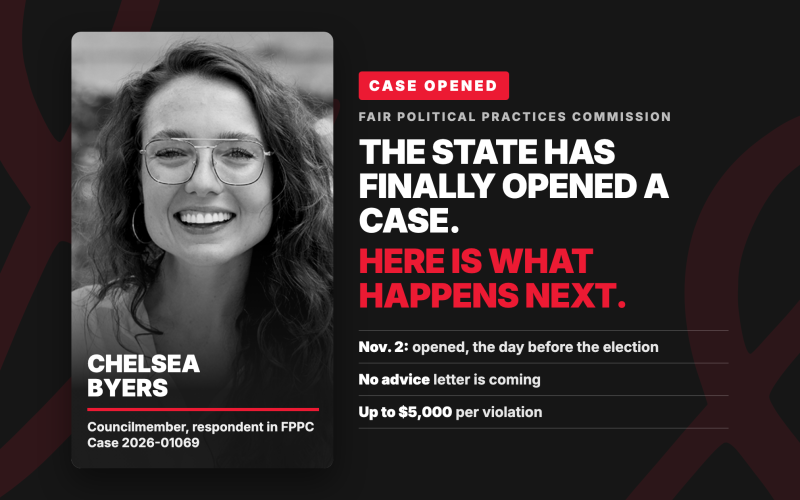
For four and a half months, West Hollywood was told to wait for the state’s advice on Councilmember Chelsea Byers’s job. On November 2, the state stopped advising and started investigating. Here is what happens next, under the law.
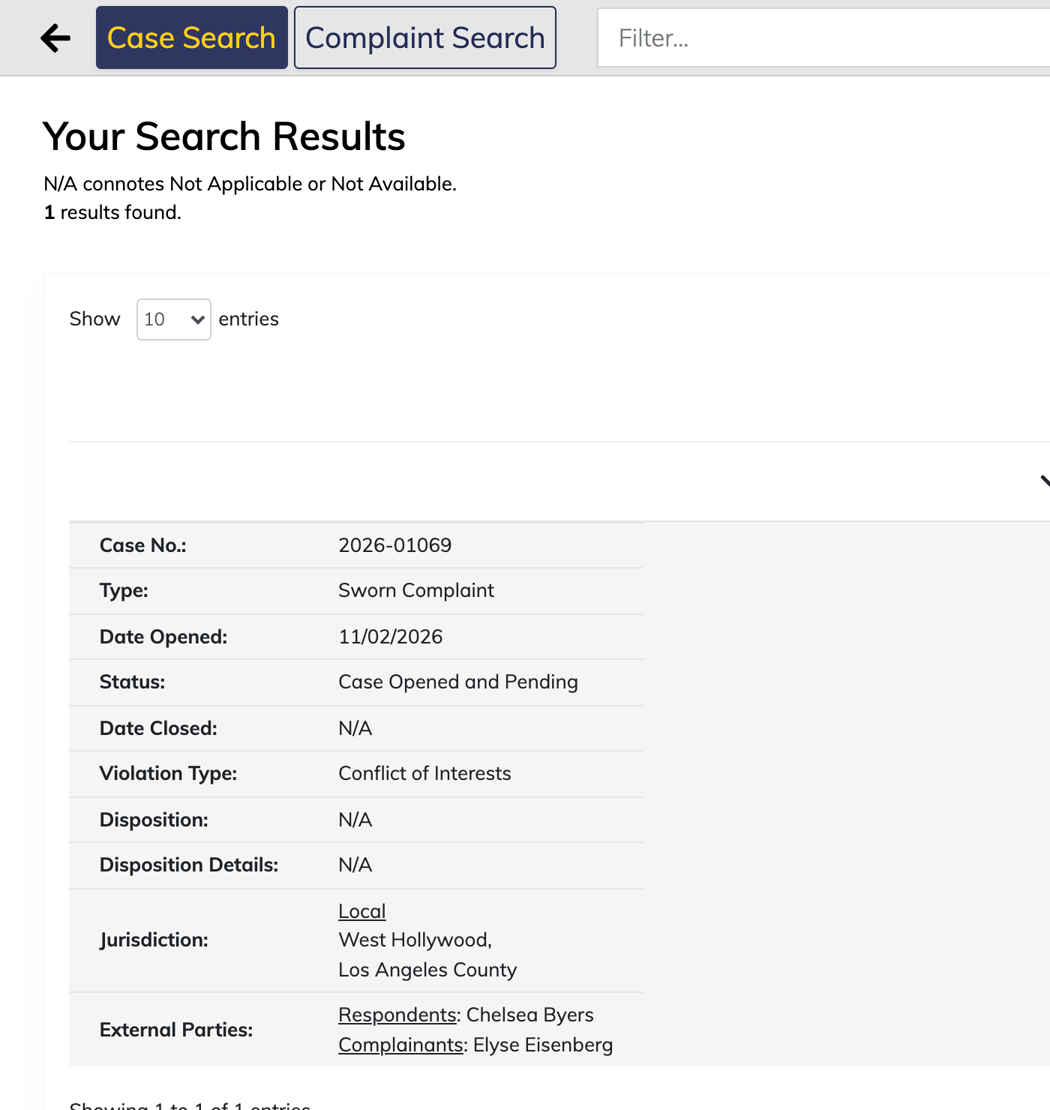
The Fair Political Practices Commission has opened Enforcement Case No. 2026-01069. The respondent is Councilmember Chelsea Byers. Its public case portal lists the violation type as “Conflict of Interests” and the status as “Case Opened and Pending.” The case was opened on November 2, 2026, the day before West Hollywood’s election.
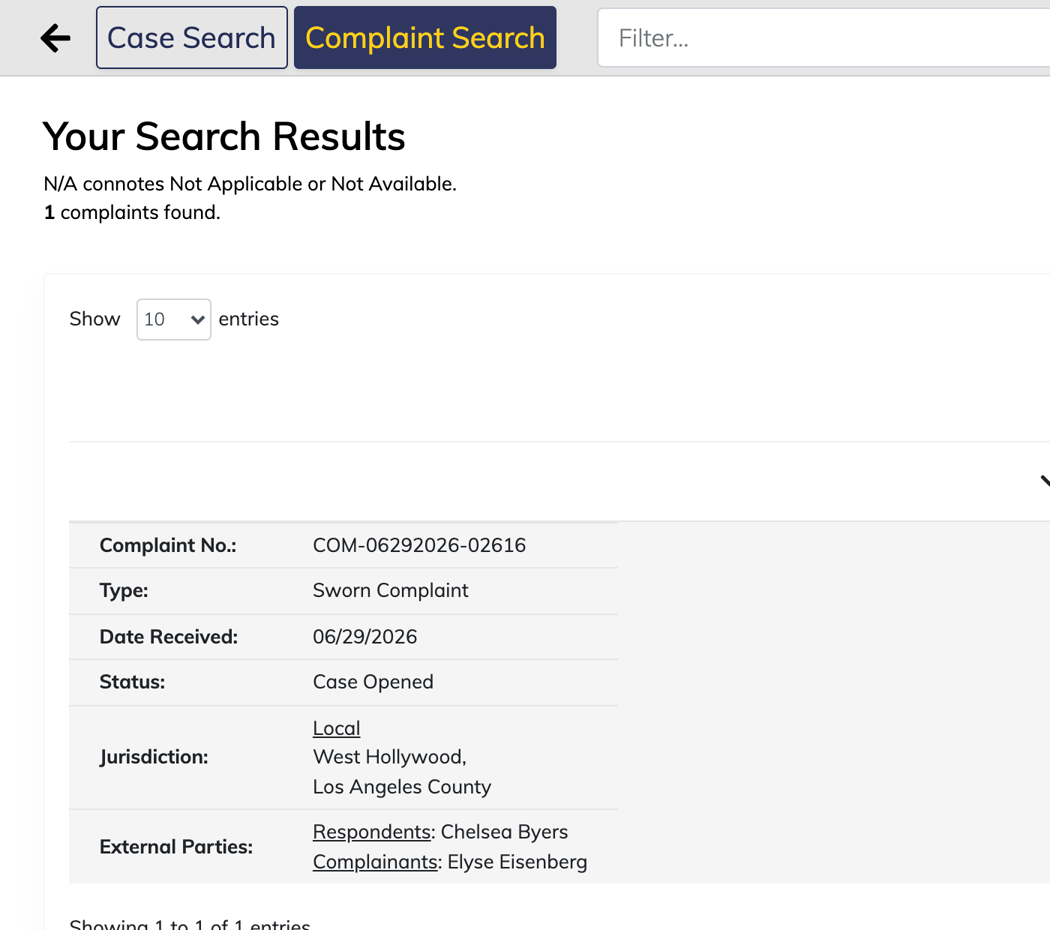
It began as a sworn complaint, filed under penalty of perjury, that the Commission received on June 29. That was the same day the City Council voted to ask the FPPC whether Byers’s paid job as Municipal Policy Campaigns Director for the Welcoming Neighbors Network, a national pro-housing advocacy group, bars her from voting on housing.
What “opening a case” means
When a sworn complaint arrives, the Commission’s Enforcement Division must tell the complainant, within 14 days, what it intends to do. Its choices, under the Commission’s own regulation, are to “open a case, refer the matter to another agency, take no action, take additional time to make a determination,” or take other appropriate action.
This complaint took 126 days. The Division could have closed it. Instead it opened a case.
Under the FPPC’s published standard, a matter is “fully investigated if there is sufficient information to believe that a violation of the Act has occurred.” Opening a case is a decision that the complaint deserves a full investigation.
The investigation: subpoenas, sworn testimony and records
An open case gives the Enforcement Division the Commission’s full investigative power. Under Government Code section 83118, the Commission “may subpoena witnesses, compel their attendance and testimony, administer oaths and affirmations, take evidence and require by subpoena the production of any books, papers, records or other items material to the performance of the Commission’s duties.”
In practice, that means:
- Subpoenaed records. The law reaches “any books, papers, records or other items.” In a case about an official’s paid job, that can include employment and pay records, job descriptions, emails, text messages, calendars, the City’s own file on its July advice request, and campaign records. Staff ask for documents voluntarily first. They can serve a subpoena 21 days after asking, or skip the request entirely in an investigation already under way. Anyone who withholds a record must list it, with its date, author, recipients, current location and the reason it is being withheld.
- Testimony under oath. The Commission can compel witnesses to appear and testify under oath. A witness cannot refuse on the ground that the answers might be self-incriminating: the Commission “may refuse to excuse any person from testifying” on that objection (section 83119). Immunity requires 30 days’ notice to the Attorney General, and a witness who lies under oath can still be prosecuted for perjury.
- No running out the clock. If a court orders a person to produce subpoenaed documents and the person does not, the five-year deadline for bringing the case stops running until the documents are produced. If a person “knowingly conceals” material facts “for the purpose of defrauding the public of information to which it is entitled,” the deadline stops running for the period of the concealment (section 91000.5).
Those powers matter here because Byers’s own account can now be tested against records she does not control. In the City’s request for FPPC advice, Byers “reported that her work duties are to work with members outside of California only.” Her employer’s roster listed her as Municipal Policy Campaigns Director for the “Southern US.” At the Southern California Association of Governments, she told its Regional Council that “the organization I’m employed by does not take positions on specific legislation or policy”. Her employer had posted, about the housing bill SB 79, “SB 79 is now law. This is a HUGE victory.” Those posts were later removed from its account.
Where a case turns on an unsettled question of law, a regulation allows staff to refer that question to the Commission itself.
Who has been told, and when
- Byers. The rules require the Enforcement Division to send the official named in a sworn complaint a copy of it within three business days of receipt, with notice that she may respond. The notice that a case is being opened goes to the official at the same time it goes to the complainant, unless the Enforcement Chief decides that telling her would jeopardize the investigation.
- The public. The Commission may post a new complaint or case only two days after emailing notice to the official, or five days after mailing it. A case opened on November 2 could not appear publicly before November 4, the day after the election.
- The complainant. When the case ends, the complainant receives a notice of resolution.
Until then, the FPPC “may not comment on specific facts or provide analysis” about a pending case.
No advice is coming
In August, City Attorney Lauren Langer told the Council that the City’s July 13 request was “a request for advice, not an investigation.” She said a separate complaint “related to the same or similar legal questions related to her source of income and employer” had to be reviewed first.
That same day, Occupied West Hollywood asked whether the FPPC question was being pushed past the election. The answer arrived the day before it. The complaint has been reviewed, and now there is an investigation. FPPC regulations say a formal advice request “will be declined in writing” when it concerns the subject of a pending enforcement action and the advice could decide a question in that case. No advice letter is coming. Every housing vote from here on is Byers’s own decision, made at her own risk.
The effect showed up within two weeks. On November 2, the Council’s zoning cleanup ordinance was pulled from the agenda that afternoon, with no reason given. On November 16, it came back split into two ordinances, one “housing-related” and one not, so the Council could “accommodate any recusals out of an abundance of caution.” Byers stepped away from the housing half.
A side note from Monday night: the Shoreham contribution
The housing ordinance was not the only item Byers stepped away from on November 16. She also recused from the appeal of a 22-unit building at 8760 Shoreham Drive, under a different law: the Levine Act, which governs campaign money from people with business before a city. When disclosures were called at the start of the meeting, Byers said she would be recusing. She did not name a contributor.
More than two hours later, just before the vote, City Clerk Melissa Crowder put it on the record:
> “Councilmember Byers recused under the Levine Act for this item because she did accept a campaign contribution above the limit from Ben Soroudi, who is the owner of 8760 Shoreham.”
Byers’s own campaign statement for the first half of 2026 reports $1,000 from Ben Soroudi, received May 26. That was five days after the Planning Commission approved the project and six days before the appeal to the City Council was filed. Byers’s statement, which runs through June 30, reports no return.
That question is separate from Case 2026-01069. With Byers out, the Council split 2-2 on the appeal, and the Planning Commission’s approval stands.
If staff find a violation
Most cases that end in a penalty end in a stipulation: an agreement between the Enforcement Chief and the respondent on the facts and the penalty. It does not take effect until the five-member Commission approves it at a public meeting. Once approved, it is released publicly and carries the force of a Commission order.
If the respondent does not settle, the case is prosecuted:
- Probable cause report. Enforcement staff write up the law and the evidence for each alleged violation. The report must also describe any evidence pointing the other way.
- Service and response. The report is served on the respondent, who has 21 days to answer in writing, request the investigative file, and ask for a probable cause conference. The conference is closed to the public unless the respondent asks to open it.
- The standard. Probable cause exists, the regulation says, when the evidence supports “a reasonable belief or strong suspicion that the Act has been violated.”
- Public announcement. A finding of probable cause is announced publicly, with a summary of the allegations and a statement that the respondent is presumed innocent.
- Accusation and hearing. Enforcement then serves a formal Accusation. The case is heard by an administrative law judge or by the Commission. A violation must be proved by a preponderance of the evidence, and at least three commissioners must agree.
What the Commission can impose
The Political Reform Act allows a penalty of up to $5,000 for each violation, along with orders to stop the conduct. In conflict cases, each decision an official took part in can be charged as its own count.
In setting a penalty, the Commission must weigh, among other things:
- “the extent and gravity of the public harm”;
- “the presence or absence of any intention to conceal, deceive or mislead”;
- whether the violation was “deliberate, negligent or inadvertent”;
- whether it was “isolated or part of a pattern.”
A knowing or willful violation of the Act is also a crime, a misdemeanor, and the FPPC can refer a case to prosecutors.
How long it takes
Years, not months. Conflict cases that end in a stipulation routinely take two to three years from opening. The Commission has five years from a violation to bring an administrative action, so the clock does not force an early result.
What to watch for
- The portal. Case 2026-01069’s status will change if the case is closed, settled or advanced.
- Commission agendas. Every stipulation must be approved at a public Commission meeting.
- A probable cause announcement. If one comes, it will be public.
- Byers’s next campaign statement. It will show whether the Soroudi contribution was returned, and when.
- Byers’s votes. With no advice coming, her recusals, and her reasons for them, are now the record the Enforcement Division will read.
Also Monday night: “a motion to censure”
Late in the meeting, during the Vision Zero traffic-safety item, Mayor John Heilman cut off Councilmember John Erickson and moved to end debate. Erickson called it “extremely unprofessional.” Heilman said he was “about ready to make a motion to censure” him. Erickson told the Mayor that his “hypocritical comments continue to show that you don’t care about street safety,” and said he expected “an apology by the end of the meeting.” Heilman: “No thank you.” The Council then approved staff’s recommendation 5-0.
Sources: FPPC Complaint and Case Information Portal, captured November 16, 2026; WeHoTV video of the November 16, 2026 meeting (YouTube); Cal. Code Regs., tit. 2, §§ 18329, 18360, 18361.1, 18361.4, 18361.5, 18362; Gov. Code §§ 83116, 83118, 83119, 84308, 91000, 91000.5; Re-Elect Byers West Hollywood City Council 2026, Form 460 (Jan. 1 to June 30, 2026); FPPC Advice Letter A-25-153 (Dec. 8, 2025); WEHOonline, August 31, 2026; City of West Hollywood agenda packets and video, November 2 and November 16, 2026.


Thank you for this detailed and informative update. We know Byers scrubbed her social media accounts. Now it appears that Welcoming Neighbors may have done the same, deleting references to SB 79. This is a lot like Nixon erasing 14 minutes of the Watergate tapes. Being a self proclaimed “progressive” does not equate with being honest. Byers actions in scrubbing her account where self serving and meant to thwart a full investigation by the FPPC.
So after months of rhetorical gymnastics, Chelsea Byers is now under an official investigation with the FPPC. That’s the narrative, no way around it. I would love to be a fly on the wall when the commission weighs “the presence or absence of any intention to conceal, deceive or mislead” which record is not pretty or in her favor. While the new council lock-step majority renders any calls for recusal irrelevant, the residents of West Hollywood must call on her to recuse anyway. Given the Nixonian behavior leading up to this point, resignation would be the honorable thing to do.
I hope that you, Publius, or another entity was somehow able to save all the material deleted by her and by her employer. And, I hope that you were or will be able to get this information to the commission because it clearly shows their intent to deceive!