






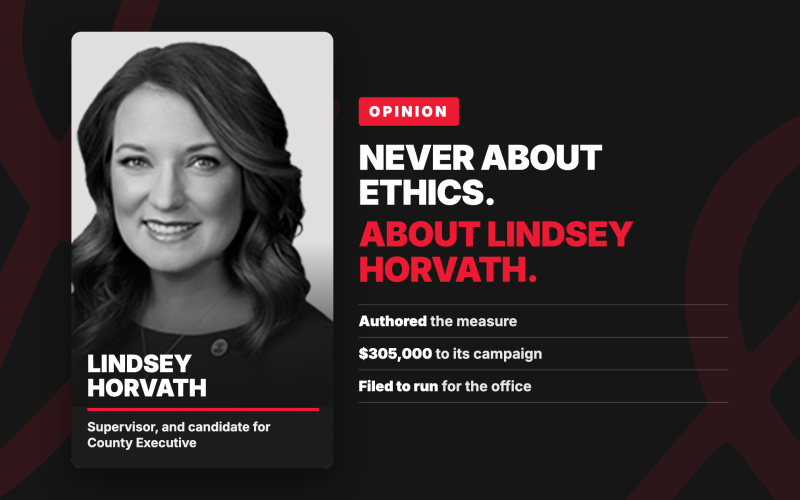
She authored the measure, financed its campaign, seated her co-author on the panel designing the office, and filed to run four weeks before starting the term voters gave her in June.
On November 9, Horvath filed to run for Los Angeles County Executive, an office that does not exist yet. Her new four-year term as Third District supervisor, the one that includes West Hollywood, begins December 7. She won it on June 2 with 66.35 percent of the vote. The first County Executive takes office on December 4, 2028, two years into that term.
Two days after filing, Horvath told the Beverly Press what her voters had asked of her: “They brought me back into this seat and asked me to keep going and do more, and that’s what I’m committed to doing for my district, and if given the opportunity, for the entire county.”
California has no resign-to-run law. Nothing makes Horvath give up the seat. Nothing makes her stop voting on the new office’s powers, staff and pay, either. On October 20 a colleague asked every supervisor to pledge not to run for it. Horvath did not take it, and twenty days later she filed.
This Is About Horvath, Not Ethics and Not Responsiveness
The elected County Executive is not about ethics, and it is not about responsiveness.
A supervisor who cared about responsiveness would not ask two million people for four more years in June and file for a different office in November. She would resign the seat, give the Third District a supervisor who wants the job, and run. A supervisor who cared about ethics would not vote on the powers, the staff and the pay of an office she is campaigning to hold.
It is about Lindsey Horvath. More exactly, it is about a “young white liberal woman” showing that she could do what two “old white men” could not.
Zev Yaroslavsky designed this office in 2000 and could not get it onto a ballot. Bob Hertzberg voted to write it into the state Constitution in 2017 and watched it die. Horvath beat one of them, reused the other’s text, and had it before voters in less than twenty months. She was 40 when she won the seat. Hertzberg was 67 when she beat him. Yaroslavsky was 75 when her launch release quoted him.
She has told that story herself. Her words are below, with everything else.
Yaroslavsky Failed in 2000. The Amendment Hertzberg Backed Died in 2018. Horvath Got It Passed in 2024.
Los Angeles County has been offered an elected executive before. Voters rejected one in 1992.
In 2000 the Third District’s supervisor, Zev Yaroslavsky, wrote another. The Board’s minutes for July 11, 2000 show it “continued to Tuesday, November 14, 2000, pending the results of the November 7, 2000 statewide election.” It never reached a ballot. The Los Angeles Business Journal later put it in one sentence: “In 2000, Yaroslavsky tried to get the board to place a similar measure on the ballot, but failed to do so.”
In 2017 the Legislature tried. Senate Constitutional Amendment 12 would have written an elected executive for Los Angeles County into the state Constitution. Senator Bob Hertzberg was a coauthor and voted for it in two committees and on the floor. The Board of Supervisors opposed it, telling the Senate the office would create “a bigger, but not a better, local government.” The amendment died at the Assembly desk on November 30, 2018.
In 2022 Hertzberg ran for the Third District seat himself. A Palisades News column on his campaign said he supported “the direct election of a countywide executive.” He finished first in the June primary, 31.1 percent to Horvath’s 27.7. In November Horvath beat him, 52.97 percent to 47.03.
Horvath has described what that result meant. She told Capitol Weekly about a voter who knew Hertzberg and voted for her anyway, “because they expressed that his time had sort of come and it was done and that they were looking for something different.”
She was sworn in on December 5, 2022. Nineteen months later she and Supervisor Janice Hahn announced a charter amendment creating an elected County Executive. The release said: “Los Angeles County’s government structure has remained the same since 1912, before women even had the right to vote!” It described “a Board of women leaders looking to the future.” It also carried a quotation from Yaroslavsky endorsing the plan.
Six days later their motion told County Counsel what to draft from: “language from the 2000 Charter amendment ordinance proposing the establishment of a County Executive and expansion of the Board.”
The Board put it on the ballot on July 30, 2024, by a vote of 3 to 2. It passed that November with 51.6 percent.
Horvath told Capitol Weekly how she saw the moment: “it’s not lost on me that the makeup of other boards past or future wouldn’t have been able to do what we were able to do.” To KCRW, a month before the election, she called it “a 21st Century opportunity to be the founding fathers of how government can work for you now.”
Read those together. The structure had not changed “since 1912, before women even had the right to vote.” It took “a Board of women leaders.” Other boards, “past or future,” could not have done it. The man she beat had seen his time “come” and be “done.”
That is not how anyone talks about fixing a procurement system. In our view it is how someone talks about beating a generation.
Yaroslavsky could not get the office onto a ballot. The Legislature Hertzberg sat in could not pass it. Horvath had it before voters less than twenty months into her first term, and two years after that she filed to hold it.
Voters Were Never Told About the Veto or the Real Powers of the Office
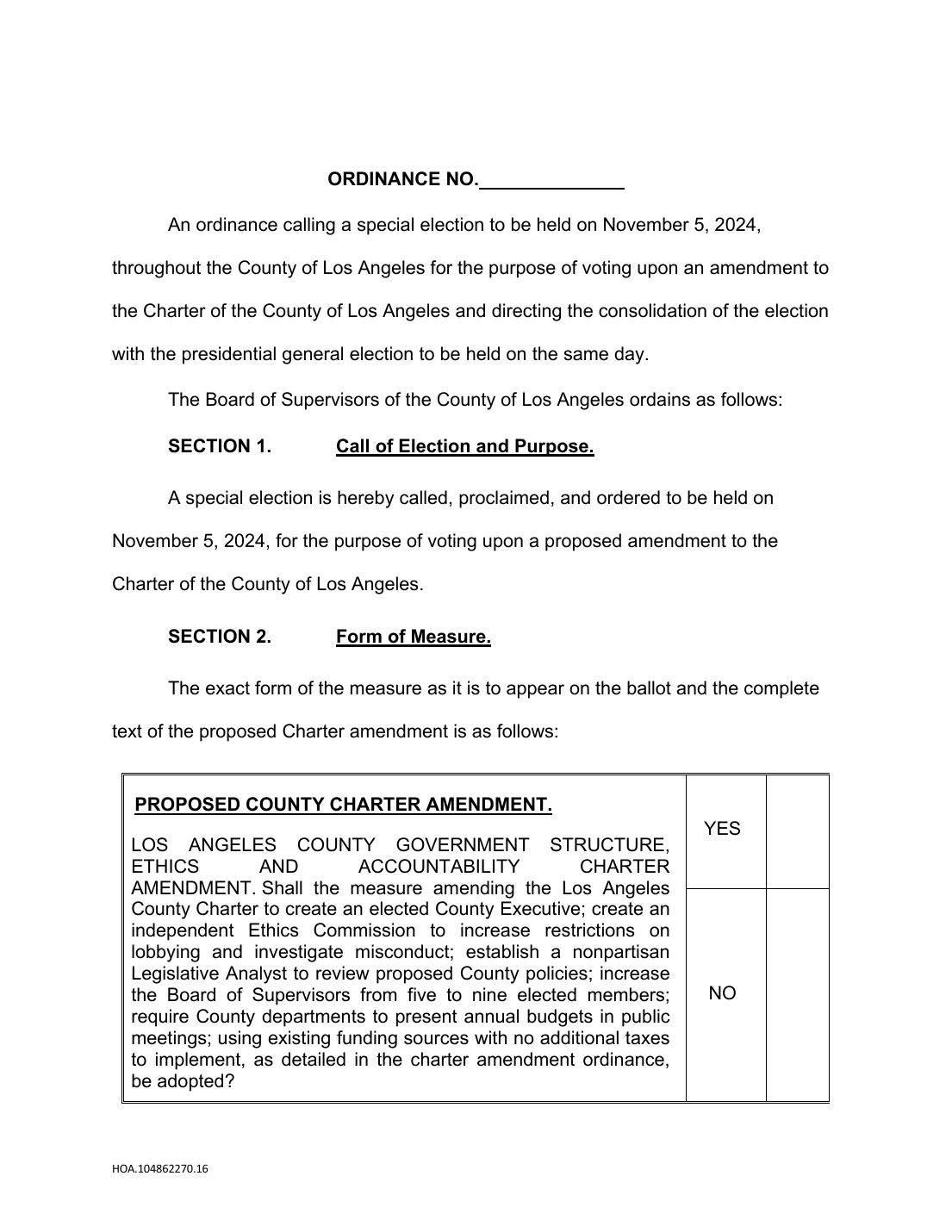
The 2024 ballot asked whether to amend the charter “to create an elected County Executive.” Those six words are everything the question said about the office. The word veto does not appear in it.
 1
- 1Everything the question says about the office.
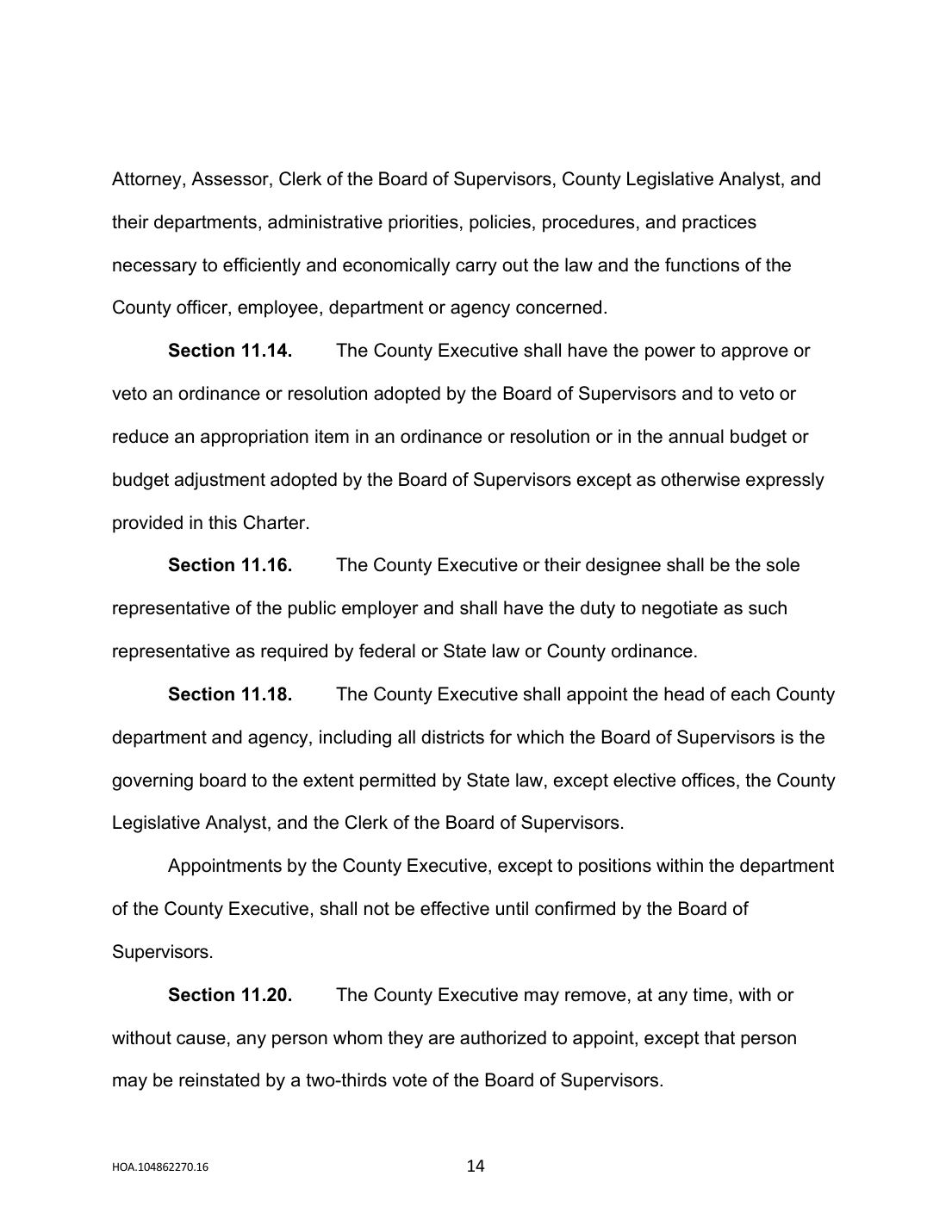
The ordinance says more: “The County Executive shall have the power to approve or veto an ordinance or resolution adopted by the Board of Supervisors and to veto or reduce an appropriation item in an ordinance or resolution or in the annual budget or budget adjustment adopted by the Board of Supervisors except as otherwise expressly provided in this Charter.”
 12
- 1A veto over what the Board enacts.
- 2A line-item veto over what the Board spends.
A voter who wanted to find that sentence had to read the full text of the ordinance, fifteen pages in the Registrar’s printing.
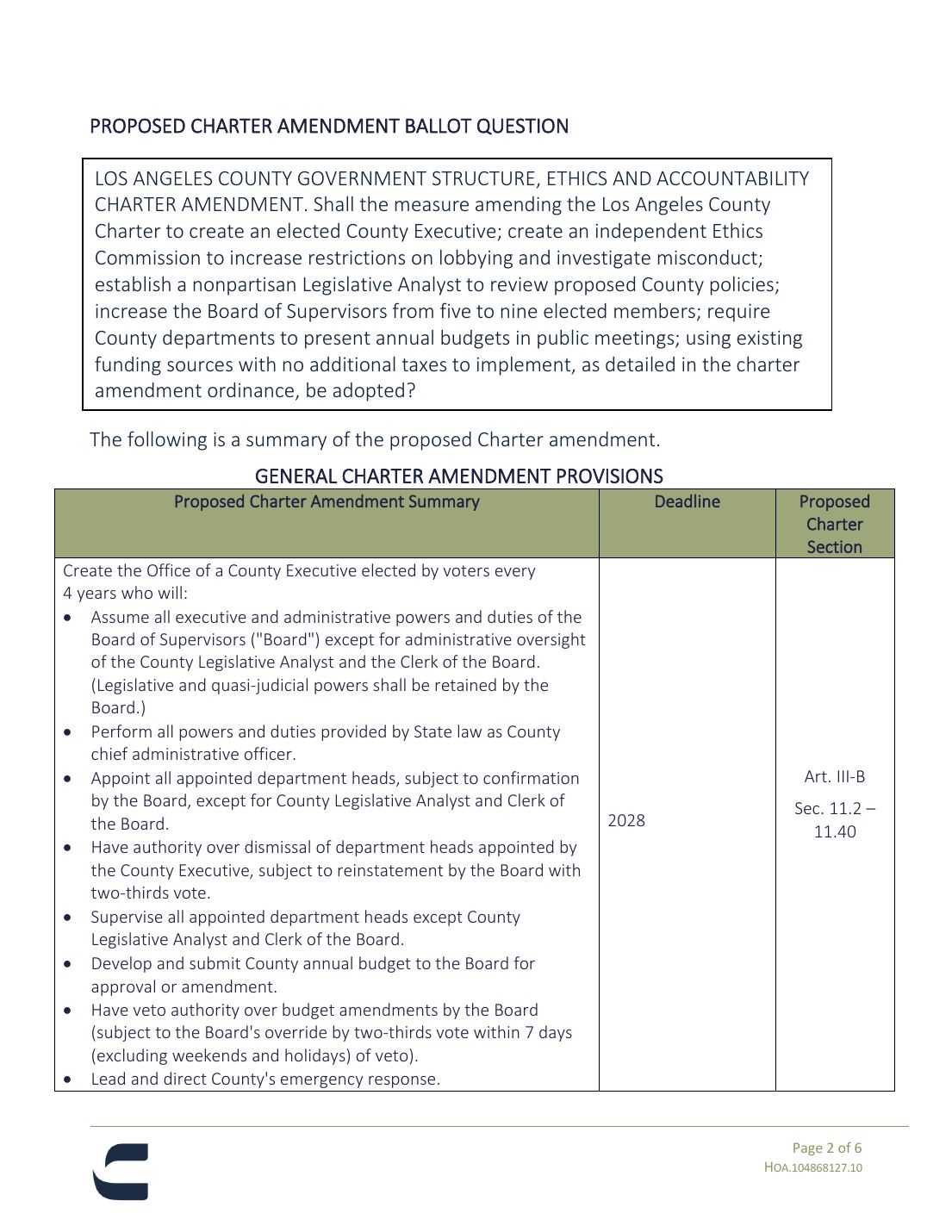
County Counsel’s fact sheet on the measure listed the executive’s powers. The veto appears once: “Have veto authority over budget amendments by the Board.” The veto over ordinances and resolutions is not on the list. Neither is the line-item veto.
 1
- 1The only veto on the list.
The County knew how to say it. The ballot question its lawyers wrote for Yaroslavsky’s version in 2000, the text Horvath’s motion told them to reuse, read: “The Executive will replace the appointed Administrative Officer, reorganize and appoint other managerial positions, prepare the budget and veto ordinances. The Board will continue as legislative body to confirm appointments, adopt ordinances and override vetoes.”
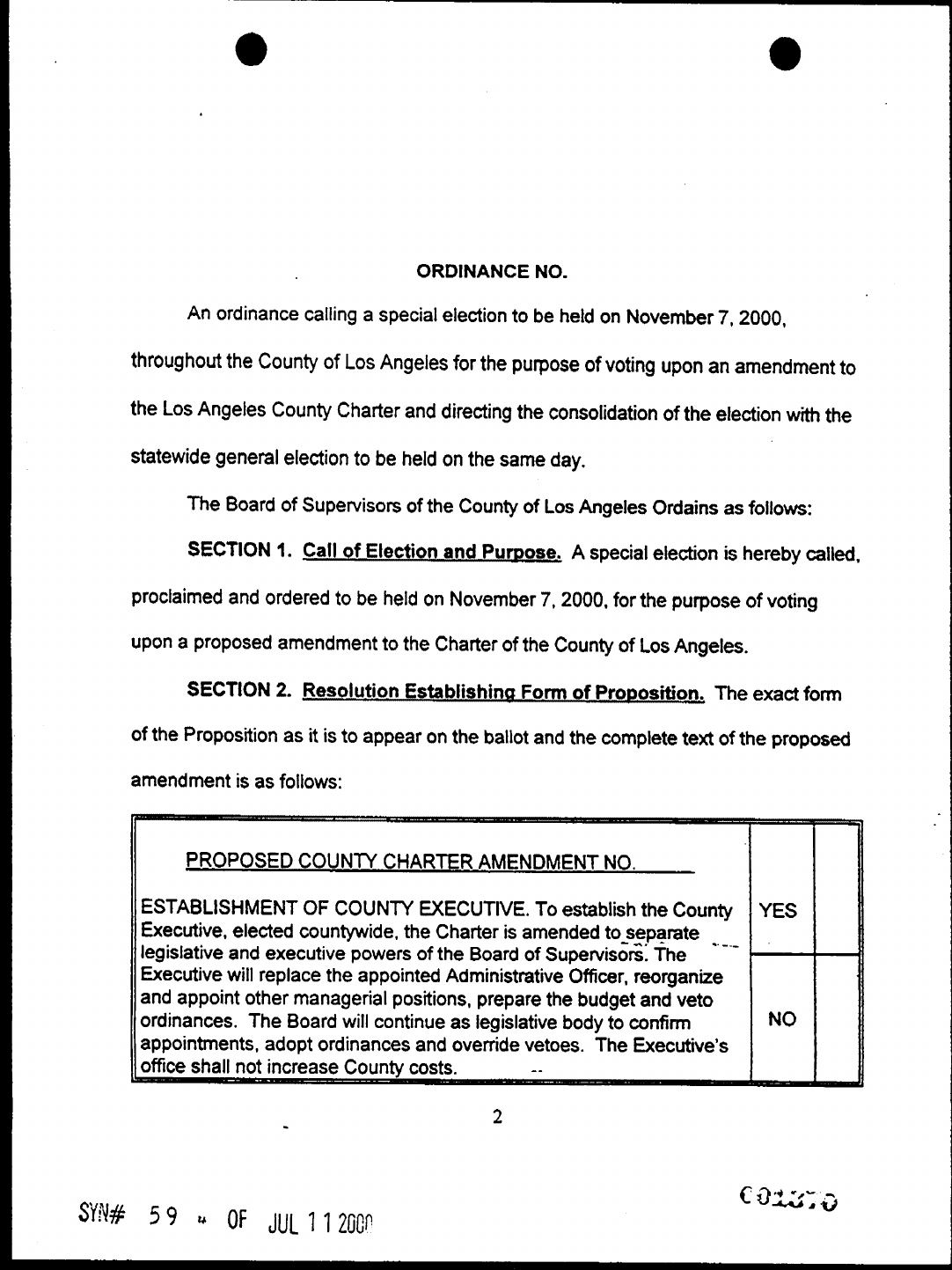 12
- 1The veto, disclosed.
- 2The override, disclosed.
| 2000 ballot question | 2024 ballot question | |
|---|---|---|
| Says the executive can veto | Yes: “veto ordinances” | No |
| Says the Board can override | Yes: “override vetoes” | No |
Nobody signed an argument for the measure in the voter guide. The Registrar’s list for that election reads: “Supporters: None submitted.”
County Counsel Wrongly Told the Board the Executive Has No Legislative Power, and Admitted No Voting Rights Analysis Was Done
On July 23, 2024, a week before the vote, Supervisor Holly Mitchell asked County Counsel Dawyn Harrison a direct question: “Have we done a legal analysis as to whether an at-large elected county executive who has ultimate legislative authority to approve or veto board policy decisions complies with the California Voting Rights Act?”
Harrison answered: “We have not done that analysis but the county executive as written doesn’t have the legislative authority.”
The first half of that answer is an admission. The second half is wrong.
The text in front of the Board that day gave the executive a veto over every ordinance and resolution, and the power to “veto or reduce” individual appropriations. California courts have said for more than a century what a veto is. The Supreme Court in 1893: “the mayor, by virtue of his right of veto in certain cases, has some of the law-making power of the municipality.” A Court of Appeal in 1986, about San Francisco: “the city’s charter makes lawmaking a power to be shared by the board of supervisors and the mayor.”
The Board had heard the same thing two weeks earlier from its own invited expert. Fernando Guerra of Loyola Marymount University told the supervisors on July 9 that “as the executive, they are equal to the legislature as a whole,” and compared the office to the Governor: “the governor would have this veto power.”
Seven days after Harrison’s answer, the Board voted to send the measure to the ballot.
Horvath Assembled a Crew: Her Co-Author, Her Friends and Her Allies Made the Case for the Measure
With no argument in the voter guide, the case for the measure was made elsewhere. Here is who made it, and what connects each of them to Horvath.
| Supporter | What they did in 2024 | Tie to Horvath |
|---|---|---|
| Sara Sadhwani, Pomona College | Co-wrote an op-ed for the measure with Horvath, October 24. One of two academics on the campaign’s supporter list. | Capitol Weekly reports Horvath “enlisted the help of” Sadhwani and Guerra early on. In 2025 Horvath appointed Sadhwani to the task force implementing the measure. |
| Fernando Guerra, Loyola Marymount | Testified to the Board on July 9. The other academic on the supporter list. | Enlisted by Horvath, per Capitol Weekly. |
| Zev Yaroslavsky, UCLA | Quoted in Horvath’s launch release; campaigned for the measure at UCLA. | Horvath’s motion reused his 2000 text. Her administrative director worked in his supervisorial office from 2002, according to Horvath’s County page. |
| Max Kanin, election lawyer | Published an essay, October 25, arguing the County “has the constitutional authority” to create the office. | His own footnote: “a friend and longtime political supporter of both Supervisor Lindsey Horvath and Supervisor Hilda Solis.” In 2018 Horvath moved the motion appointing him to West Hollywood’s Ethics Reform Task Force. |
| John Erickson and Chelsea Byers | Listed as endorsers, as Mayor and Vice Mayor of West Hollywood. | Horvath’s former council and her allies on it. |
| Christy Smith, former Assemblymember | Listed as an endorser. | “A friend and political ally of Horvath’s,” per Capitol Weekly. |
The campaign itself had a sponsor. The Yes on G website carried the disclosure the law requires. First among its “Committee Top funders”: the Lindsey Horvath Ballot Measure Committee for Accountability and Progress.
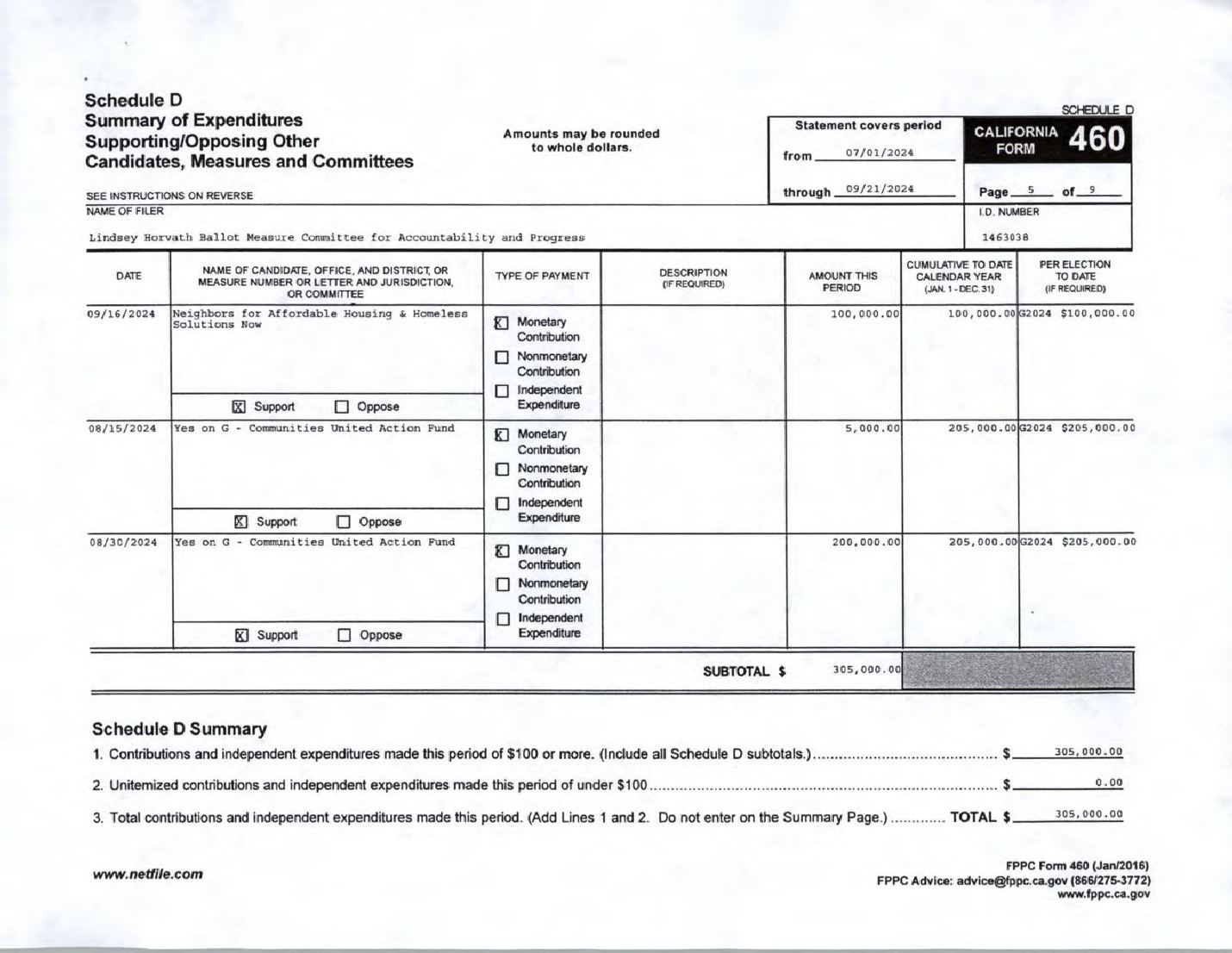 12
- 1August 15, 2024: $5,000.
- 2August 30, 2024: $200,000. Running total $205,000.
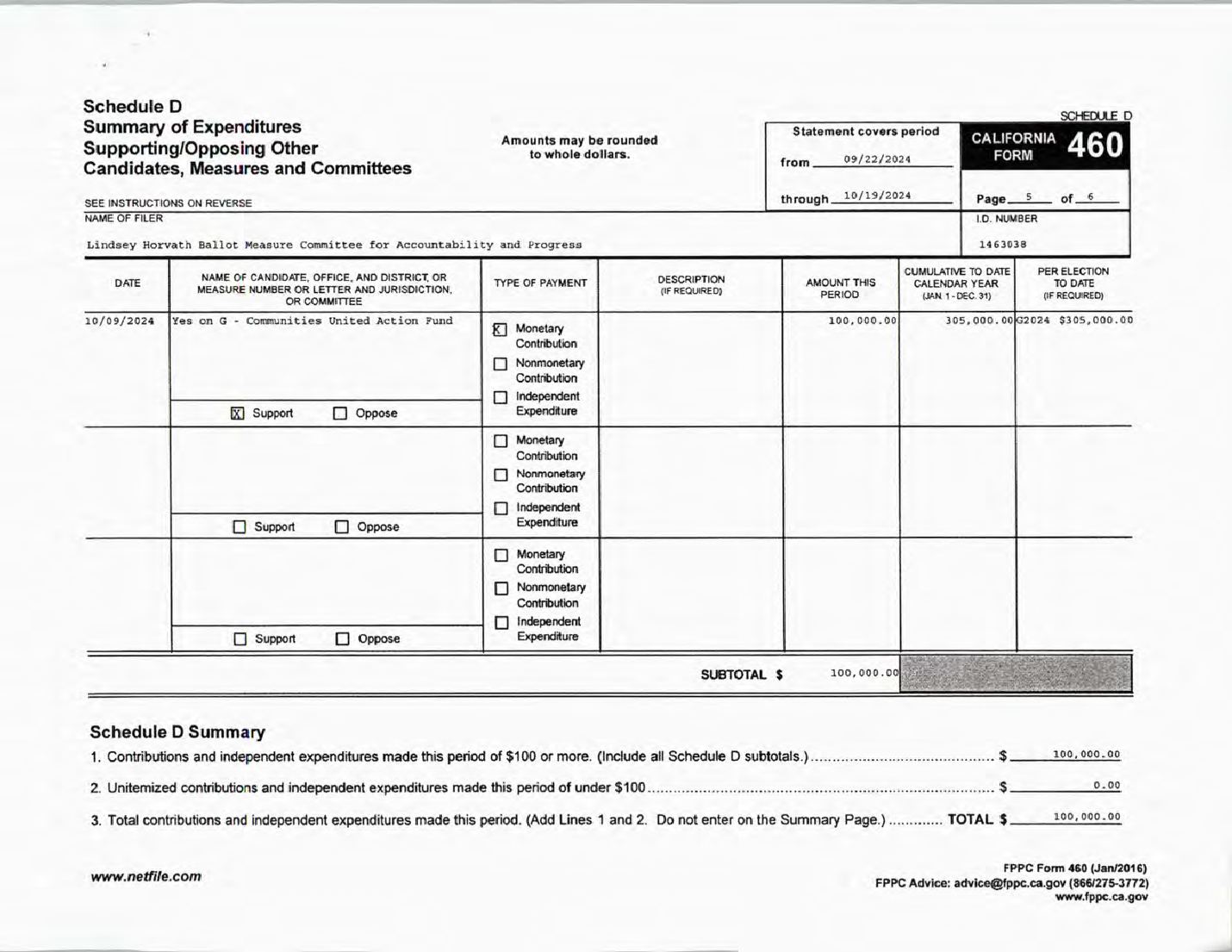 1
- 1October 9, 2024: $100,000. Running total $305,000.
Horvath’s Appointee Is Designing the Office in Private, and Horvath Declined to Pledge Not to Run
Measure G left the details to a Governance Reform Task Force. Each supervisor appointed one member. Horvath appointed Sadhwani, her op-ed co-author. Sadhwani is the task force’s Chair Pro Tem, and chairs its subcommittee on the County Executive. “An ad hoc of which I chair,” Sadhwani told the task force on July 22, 2026. The subcommittee meets in private.
Its first recommendations reached the Board on October 20. Mitchell described what she had heard about the schedule: “there was quite a bit of discussion at a task force meeting about moving these County Executive recommendations along quickly to provide clarity for potential candidates for the new office.”
Supervisor Kathryn Barger then said this: “I’d like to take a pledge to commit that I will not run for this office. I would like to ask my colleagues to make that similar pledge now.”
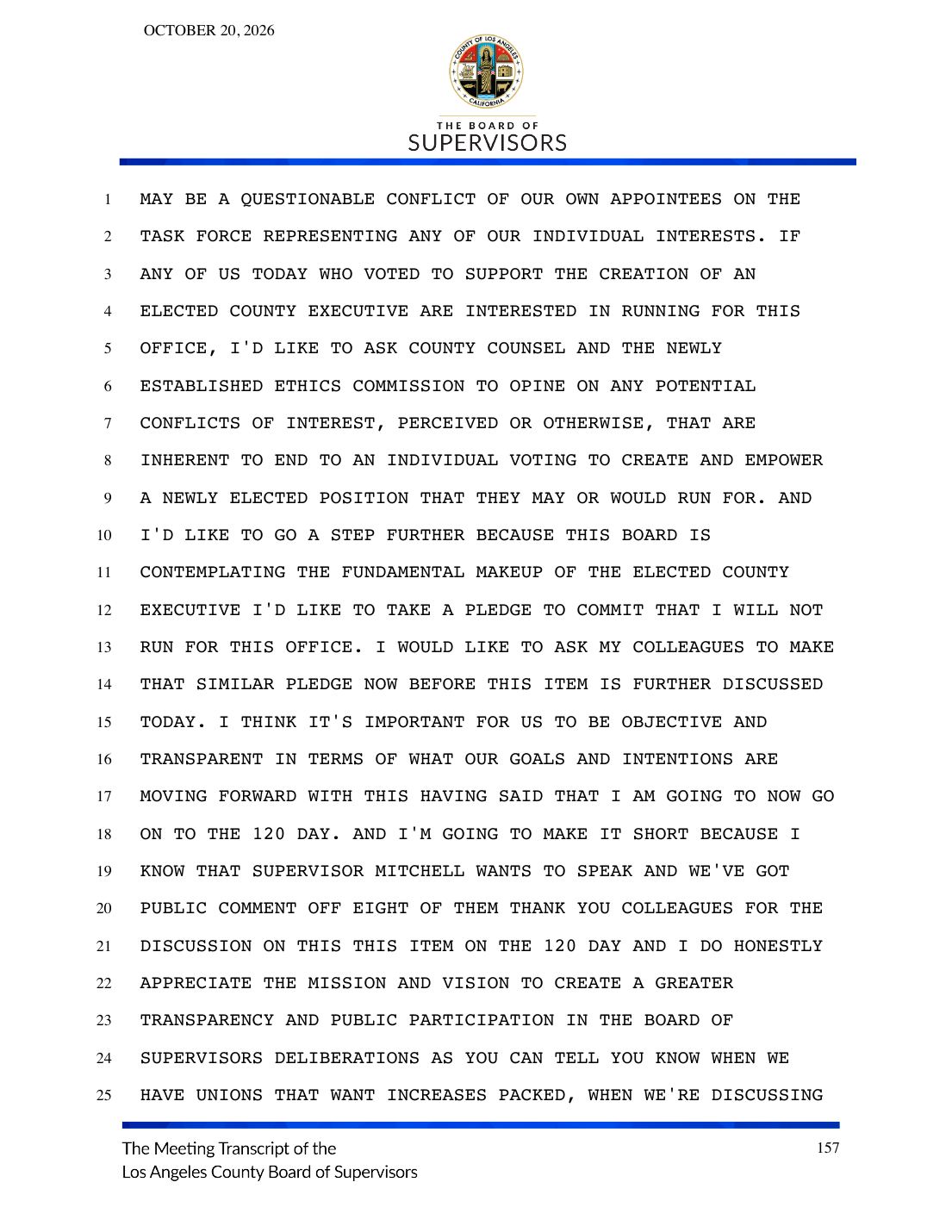 12
- 1Barger's pledge not to run.
- 2Her request to the other four supervisors.
The Los Angeles Times reported that Barger, Mitchell and Solis all said they would honor it. Horvath sent the Times a statement instead: “Pressuring others out of an election is political interference, no matter how many times she calls it ethics.”
The Board voted that day to pause the recommendations until January. Four supervisors voted yes. Horvath abstained.
When Barger raised the conflict again after the filing, Horvath told CBS Los Angeles: “We’ve seen ‘Trumpian’ tactics before where people are trying to thwart change, thwart reform.”
Horvath’s Only Reported Outside Income Was a Billboard Agency. The New Office Must Out-Pay Every Elected County Official.
Occupied has already published Horvath’s income record from her West Hollywood years. On seven sworn disclosure forms covering 2016 through 2022, she reported one business, her own, and one source of income to it: Leroy & Rose, an agency that makes billboard and movie-poster campaigns. The reported amount each year was between $10,001 and $100,000. She took that work in the month the agency registered in California, 109 days after she was installed as Mayor, and voted on Sunset Strip billboards for the next seven years without recusing.
Capitol Weekly, in a profile that credits her with Measure G, described the supervisor who arrived at the County in 2022 as “the youngest and newest member” of the Board, with a “relatively thin political resume.”
Under the County Charter a supervisor is paid what a Superior Court judge is paid. The Legislative Analyst’s Office put that figure at $244,727 last month.
The new office pays more. The charter amendment her motion produced says the County Executive’s compensation “shall at all times be at least $1.00 more than the compensation of any other County elective officer.” Barger’s office puts the figure at “roughly $558,000 in total annual compensation.” There is no term limit.
The Board sets that salary. Horvath sits on the Board.
Here is what that record says to us. Before she beat Hertzberg, the whole of Horvath’s reported outside income was one client, a billboard agency that had her on its books within months of her becoming Mayor of the city that regulates the Sunset Strip’s billboards. The council seat was the asset. The supervisor’s seat was the promotion. The County Executive is the next one, and this time the job was written on a motion she co-authored.
Horvath Should Resign Her Seat on the Board to Run
Horvath’s campaign says she is running for a government that is “accountable to the people it serves.” Two million of those people live in the Third District. They re-elected her five months ago to a term that ends in 2030. She will spend the first half of it running for something else, while voting on what that something else will be.
If responsiveness were the point, the answer would be simple. Resign the seat and run.
Horvath has done the opposite. She kept the seat, kept the vote, declined the pledge, and answered the colleague who asked for it by talking about “‘Trumpian’ tactics.”
She can hold the seat or she can run for the office she built. Supervisor Horvath should resign.
References
The filing and the elections
- Lindsey Horvath for LA County Executive 2028, Form 410, received November 9, 2026
- Los Angeles County Registrar-Recorder, results of the June 2, 2026 primary
- Los Angeles County Registrar-Recorder, results of the November 8, 2022 general election
- Ballotpedia, Lindsey Horvath (June 2022 primary) and Resign-to-run law
The history
- Board of Supervisors, proposed County Executive charter amendment and minutes, July 11, 2000
- “Yaroslavsky Seeks Elected Chief Executive for L.A.,” Los Angeles Business Journal
- SCA 12 (2017), bill history; Senate Floor analysis, September 12, 2017; Senate Elections and Constitutional Amendments Committee analysis, July 12, 2017
- Nick Antonicello, Palisades News, August 12, 2022
- Brian Joseph, “Change Agent: Lindsey Horvath and the massive reform of LA County governance,” Capitol Weekly, October 13, 2025
- Horvath and Hahn announce governance plan, July 3, 2024
- Motion by Supervisors Horvath and Hahn, July 9, 2024
- KCRW, October 2, 2024
The measure and what was disclosed
- Board resolution and Measure G text, July 2024; Certified Ordinance No. 2024-0043
- County Counsel, “An Overview of Proposed County Charter Amendment,” attached to the Board’s implementation motion
- Measures Appearing on the Ballot, November 5, 2024, Los Angeles County Registrar-Recorder
The Board record
- Board of Supervisors meeting video, July 23, 2024 (Agenda Item 80); Board transcripts, July 9 and July 23, 2024
- Board of Supervisors transcript and Statement of Proceedings, October 20, 2026 (Agenda Item 18)
- Governance Reform Task Force transcript, July 22, 2026; task force roster
- McDonald v. Dodge (1893) 97 Cal. 112, 114; Affordable Housing Alliance v. Feinstein (1986) 179 Cal.App.3d 484, 491
The supporters and the money
- Horvath and Sadhwani, “Reforming Los Angeles County Government for the 21st Century,” Santa Monica Daily Press, October 24, 2024
- Pasadena Now, May 31, 2025
- Max Kanin, “Why you should vote yes on Los Angeles County Measure G,” October 25, 2024
- West Hollywood City Council minutes, April 2, 2018, Item 4.E
- Yes on G campaign website, archived October 31, 2024
- Lindsey Horvath Ballot Measure Committee for Accountability and Progress (FPPC ID 1463038), Form 460, July 1 to September 21, 2024 and September 22 to October 19, 2024
October and November 2026
- Los Angeles Times, November 9, 2026
- Beverly Press, November 11, 2026
- CBS Los Angeles
- Supervisor Barger, statement of October 20, 2026
- Horvath campaign website
- Legislative Analyst’s Office, “New Judgeships, Trial Court Judges’ Salaries, and Court Facility Projects,” October 21, 2026; Los Angeles County Charter, Article II, Sections 4 and 6
Occupied’s earlier reporting
- The Horvath File
- Political Escape Velocity: How Lindsey Horvath Monetized a Part-Time Council Seat into a Full-Time Supervisor
Publius writes about West Hollywood politics. Every factual claim above is drawn from the primary sources listed. Readers are encouraged to check all of them.


Political ambition is not inherently unethical. But when an elected official champions the creation of a powerful new public office and then announces her intention to occupy it, legitimate questions about self-interest and public accountability are inevitable.
Lindsey Horvath has every right to seek higher office. The public has an equally important right to scrutinize her role in creating that office, the powers it will exercise, and her willingness to abandon a supervisorial term before it even begins.
What I find particularly troubling is the selective application of the lofty principles of ethics, transparency, and accountability that are so enthusiastically invoked in our local political culture. These principles are not campaign accessories to be worn when convenient and discarded when politically uncomfortable.
Good governance demands more than professed virtue. It demands consistency, especially when the questions become inconvenient.